



 Chat with AI
Exam 17: Carboxylic Acids and Their Derivatives

Exam 1: The Basics158 Questions
Exam 2: Families of Carbon151 Questions
Exam 3: Acids and Bases149 Questions
Exam 4: Nomenclature and Conformations of Alkanes and Cycloalkanes163 Questions
Exam 5: Stereochemistry179 Questions
Exam 6: Nucleophilic Reactions91 Questions
Exam 7: Alkenes and Alkynes I220 Questions
Exam 8: Alkenes and Alkynes II163 Questions
Exam 9: Nuclear Magnetic Resonance and Mass Spectrometry158 Questions
Exam 10: Radical Reactions148 Questions
Exam 11: Alcohols and Ethers256 Questions
Exam 12: Alcohols From Carbonyl Compounds210 Questions
Exam 13: Conjugated Unsaturated Systems201 Questions
Exam 14: Aromatic Compounds186 Questions
Exam 15: Reactions of Aromatic Compounds207 Questions
Exam 16: Aldehydes and Ketones189 Questions
Exam 17: Carboxylic Acids and Their Derivatives213 Questions
Exam 18: Reactions at the Α Carbon of Carbonyl Compounds190 Questions
Exam 19: Condensation and Conjugate Addition Reactions of Carbonyl Compounds182 Questions
Exam 20: Amines207 Questions
Exam 21: Transition Metal Complexes86 Questions
Exam 22: Carbohydrates124 Questions
Exam 23: Lipids127 Questions
Exam 24: Amino Acids and Proteins135 Questions
Exam 25: Nucleic Acids and Protein Synthesis126 Questions
Select questions type



A compound has the molecular formula C8H14O4.Its IR spectrum shows a strong absorption band near 1740 cm-1.Its 1H NMR spectrum consists of: triplet, 1.3
Singlet, 2.6
Quartet, 4.2
The most likely structure for the compound is: 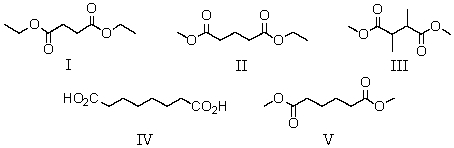
(Multiple Choice)
4.8/5  (76)
(76) What would be the final product,F,of the following sequence of reactions? 
(Multiple Choice)
4.7/5 (66)
(66) Given a mixture of benzyl alcohol,phenol,and benzoic acid dissolved in ether,outline in a flow diagram an extraction method to separate each.
(Essay)
4.9/5 (95)
(95) An acid-catalyzed esterification (a reaction between a carboxylic acid and an alcohol)is called a ___.
(Short Answer)
5.0/5 (80)
(80) Which of the following is the best name for the following compound? 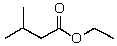
(Multiple Choice)
4.7/5 (75)
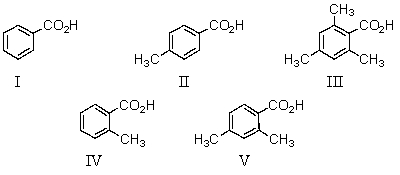
(75) Which of the following acids would be expected to have the smallest value for pKa?
(Multiple Choice)
4.8/5 (77)
(77) The IR spectrum of a compound exhibits a broad absorption band at 2500-3000 cm-1 and a sharp band at 1710 cm-1.Which of these compounds could it be?
(Multiple Choice)
4.9/5 (73)
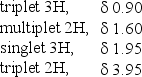
(73) Suggest a structure consistent with the following spectroscopic data:
C5H10O2
IR: 1745 cm−1
1H NMR:
 13C NMR
Broadband decoupled: 10.41,20.91,22.14,66.10,171.09
DEPT 90: no peaks
DEPT 135: 10.41,20.91 (positive); 22.14,66.10 (negative)
13C NMR
Broadband decoupled: 10.41,20.91,22.14,66.10,171.09
DEPT 90: no peaks
DEPT 135: 10.41,20.91 (positive); 22.14,66.10 (negative) (Essay)
4.9/5 (92)
(92) Which compound would be most reactive toward nucleophilic acyl addition-elimination?
(Multiple Choice)
4.9/5 (69)
(69) Complete the following reaction sequence,giving details of all significant intermediates. 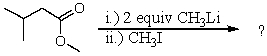
(Essay)
4.8/5 (79)
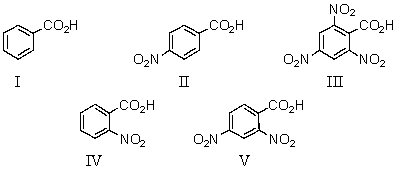
(79) 
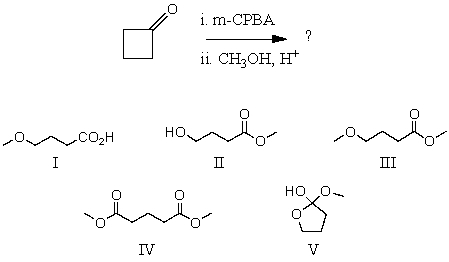
What is the expected product,A,of the following reaction sequence? 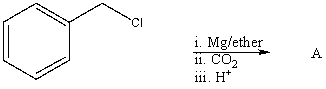
(Multiple Choice)
4.9/5 (84)
(84) Which of the following structures is 3,4-dimethylpentyl chloroformate? 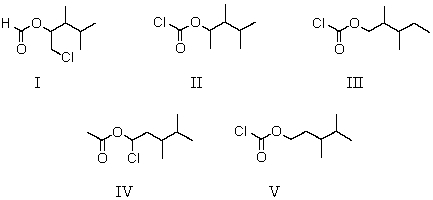
(Multiple Choice)
4.8/5 (81)
(81) Which of the following would serve as a synthesis of 2,2-dimethylpropanoic acid?
(Multiple Choice)
4.9/5 (70)
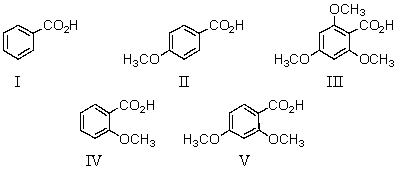
(70) 

Filters
- Essay(0)
- Multiple Choice(0)
- Short Answer(0)
- True False(0)
- Matching(0)