



 Chat with AI
Exam 17: Carboxylic Acids and Their Derivatives

Exam 1: The Basics158 Questions
Exam 2: Families of Carbon151 Questions
Exam 3: Acids and Bases149 Questions
Exam 4: Nomenclature and Conformations of Alkanes and Cycloalkanes163 Questions
Exam 5: Stereochemistry179 Questions
Exam 6: Nucleophilic Reactions91 Questions
Exam 7: Alkenes and Alkynes I220 Questions
Exam 8: Alkenes and Alkynes II163 Questions
Exam 9: Nuclear Magnetic Resonance and Mass Spectrometry158 Questions
Exam 10: Radical Reactions148 Questions
Exam 11: Alcohols and Ethers256 Questions
Exam 12: Alcohols From Carbonyl Compounds210 Questions
Exam 13: Conjugated Unsaturated Systems201 Questions
Exam 14: Aromatic Compounds186 Questions
Exam 15: Reactions of Aromatic Compounds207 Questions
Exam 16: Aldehydes and Ketones189 Questions
Exam 17: Carboxylic Acids and Their Derivatives213 Questions
Exam 18: Reactions at the Α Carbon of Carbonyl Compounds190 Questions
Exam 19: Condensation and Conjugate Addition Reactions of Carbonyl Compounds182 Questions
Exam 20: Amines207 Questions
Exam 21: Transition Metal Complexes86 Questions
Exam 22: Carbohydrates124 Questions
Exam 23: Lipids127 Questions
Exam 24: Amino Acids and Proteins135 Questions
Exam 25: Nucleic Acids and Protein Synthesis126 Questions
Select questions type


What would be the final organic product of the following reaction? 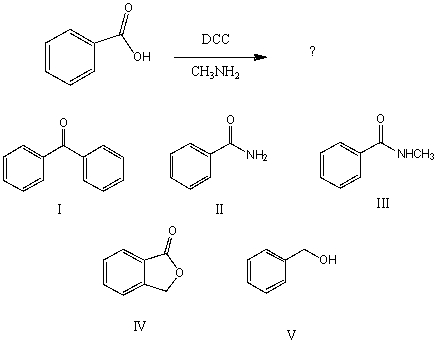
(Multiple Choice)
4.8/5  (79)
(79) What would be the final organic product of the following reaction? 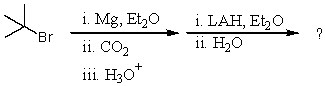
(Multiple Choice)
4.8/5 (87)
(87) Complete the following reaction sequence,giving details of all significant intermediates. 
(Essay)
4.9/5 (82)
(82) (R)-3-Hexanol is subjected to the following sequence of reactions: i)acetyl chloride,pyridine; ii)NaOH(aq),heat.What is(are)the likely final product(s)?
(Multiple Choice)
4.7/5 (80)
(80) 
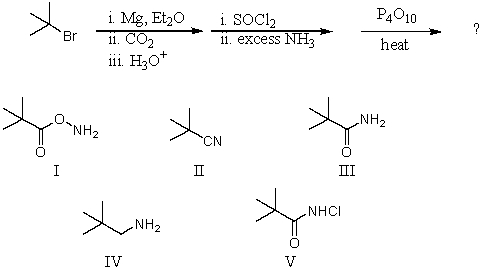
Which of the following would serve as syntheses of (CH3)3CCO2H?
(Multiple Choice)
4.8/5 (83)
(83) What would be the final product,F,of the following sequence of reactions? 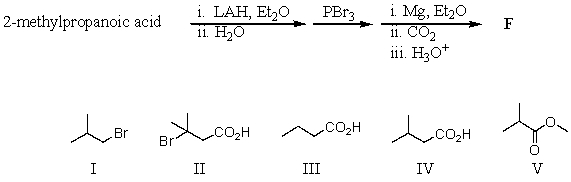
(Multiple Choice)
5.0/5 (83)
(83) Predict the major organic product of the reaction sequence below: 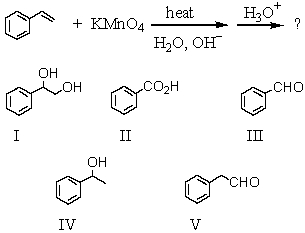
(Multiple Choice)
4.9/5 (83)
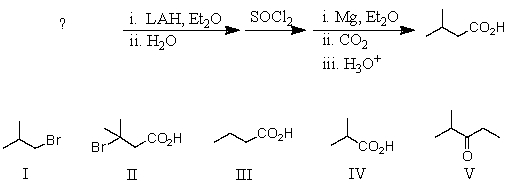
(83) Which reactant is unlikely to produce the indicated product upon strong heating?
(Multiple Choice)
4.7/5 (79)
(79) 
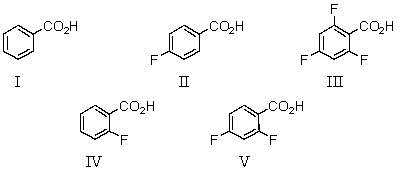
Which of the following acids would have the largest value for pKa?
(Multiple Choice)
4.7/5 (77)
(77) The correct structure for methyl bicyclo[2.2.2]octane-1-carboxylate is: 
(Multiple Choice)
4.8/5 (77)
(77) Reasoning by analogy,one would predict that the reaction of carbon disulfide with sec-butylmagnesium bromide should yield which of the following (after acidification)? 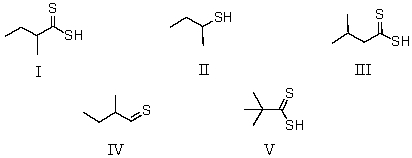
(Multiple Choice)
4.9/5 (72)
(72) The correct structure for bicyclo[1.1.1]pentane-2-carboxylic acid is: 
(Multiple Choice)
4.7/5 (73)
(73) Which of the following acids would have the smallest value for pKa1?
(Multiple Choice)
4.9/5 (79)
(79) 
Filters
- Essay(0)
- Multiple Choice(0)
- Short Answer(0)
- True False(0)
- Matching(0)