



 Chat with AI
Exam 9: Nuclear Magnetic Resonance and Mass Spectrometry

Exam 1: The Basics158 Questions
Exam 2: Families of Carbon151 Questions
Exam 3: Acids and Bases149 Questions
Exam 4: Nomenclature and Conformations of Alkanes and Cycloalkanes163 Questions
Exam 5: Stereochemistry179 Questions
Exam 6: Nucleophilic Reactions91 Questions
Exam 7: Alkenes and Alkynes I220 Questions
Exam 8: Alkenes and Alkynes II163 Questions
Exam 9: Nuclear Magnetic Resonance and Mass Spectrometry158 Questions
Exam 10: Radical Reactions148 Questions
Exam 11: Alcohols and Ethers256 Questions
Exam 12: Alcohols From Carbonyl Compounds210 Questions
Exam 13: Conjugated Unsaturated Systems201 Questions
Exam 14: Aromatic Compounds186 Questions
Exam 15: Reactions of Aromatic Compounds207 Questions
Exam 16: Aldehydes and Ketones189 Questions
Exam 17: Carboxylic Acids and Their Derivatives213 Questions
Exam 18: Reactions at the Α Carbon of Carbonyl Compounds190 Questions
Exam 19: Condensation and Conjugate Addition Reactions of Carbonyl Compounds182 Questions
Exam 20: Amines207 Questions
Exam 21: Transition Metal Complexes86 Questions
Exam 22: Carbohydrates124 Questions
Exam 23: Lipids127 Questions
Exam 24: Amino Acids and Proteins135 Questions
Exam 25: Nucleic Acids and Protein Synthesis126 Questions
Select questions type


For the compound dimedone,how many different signals would you see in the 13C NMR? (Assume that you can see them all.) 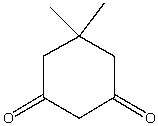

Free
(Multiple Choice)
5.0/5  (69)
(69) Correct Answer: Verified
C
All of the hydrogen atoms in a molecule of cyclohexane are homotopic.
Free
(True/False)
4.9/5 (82)
(82) Correct Answer:Verified
VerifiedTrue
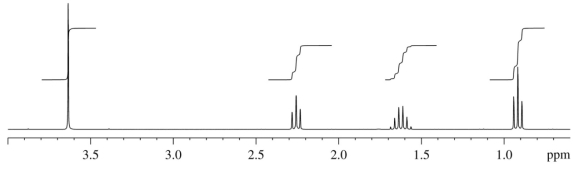
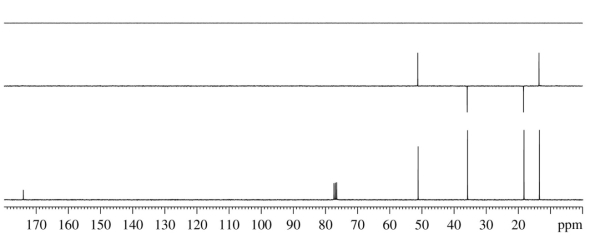
An unknown compound,L,has the formula C5H10O2.Elucidate the structure of L by scrutinizing its IR,1H NMR and 13C NMR spectra,shown below. 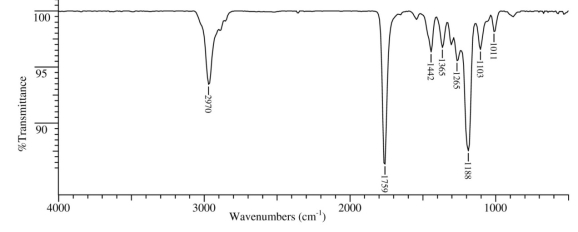
Free
(Essay)
4.8/5 (72)
(72) Correct Answer:Verified
Verified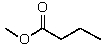 Methyl butyrate
Which compound below would not give rise to 4 signals in the proton NMR spectrum and 3 signals in the carbon NMR spectrum? (Assume you can separate and see all peaks.) 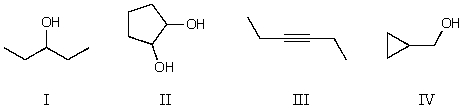
(Multiple Choice)
4.8/5 (78)
(78) A compound with the molecular formula C3H6Cl2 gave a 1H NMR spectrum consisting only of a triplet centered at 3.7 and a quintet centered at 2.2.The most likely structure for the compound is:
(Multiple Choice)
4.8/5 (84)
(84) The broadband proton-decoupled 13C NMR spectrum of a hexyl chloride exhibits five signals.Which of these structures could be the correct one for the compound?
(Multiple Choice)
4.8/5 (85)
(85) Which compound below would give rise to 3 signals in the proton NMR spectrum and 4 signals in the carbon NMR spectrum? (Assume you can separate and see all peaks.) 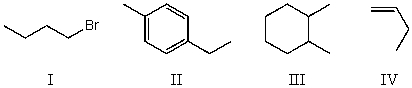
(Multiple Choice)
4.9/5 (82)
(82) 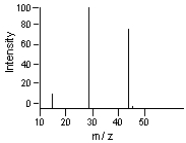
What is the structure of the compound in the following 1H-NMR spectrum with the molecular formula C9H10O2? Relative integration is shown. 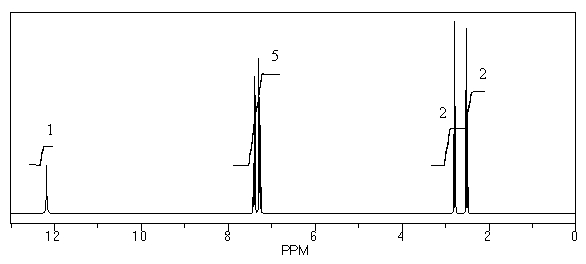
(Multiple Choice)
4.9/5 (75)
(75) What is the structure of the compound in the following 1H-NMR spectrum with the molecular formula C6H10O2? The 13C-NMR shows characteristic chemical shifts at 22.3,31.1,117.3,157.7,and 171.6 ppm.Relative integration is shown. 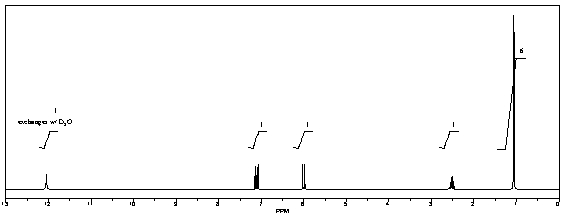
(Multiple Choice)
4.7/5 (89)
(89) Which one of the following best represents the predicted approximate chemical shift and coupling for the hydrogen(s)indicated with the arrow? 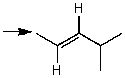
(Multiple Choice)
4.9/5 (72)
(72) Which one of the following best represents the predicted approximate chemical shift and coupling for the hydrogen(s)indicated with the arrow? 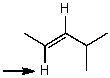
(Multiple Choice)
4.8/5 (67)
(67) The 1H NMR spectrum of which of the compounds below,all of formula C7H12O2,would consist of two singlets only? 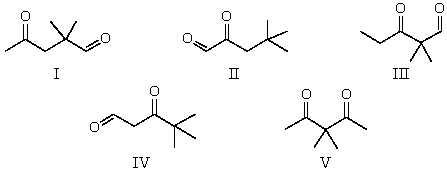
(Multiple Choice)
4.8/5 (69)
(69) How many 1H NMR signals would trans-1,2-dichlorocyclopropane give?
(Multiple Choice)
4.8/5 (78)
(78) Predict the number of signals in the 1H NMR spectrum of 2-methyl-2-pentanol.
(Essay)
4.7/5 (84)
(84) How many 1H NMR signals would you expect from this compound? 
(Multiple Choice)
4.8/5 (75)
(75) Which compound below would give rise to 4 signals in the proton NMR spectrum and 6 signals in the carbon NMR spectrum? (Assume you can separate and see all peaks.) 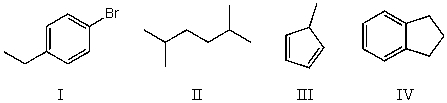
(Multiple Choice)
4.8/5 (79)
(79) What is the structure of the compound in the following 1H-NMR spectrum with the molecular formula C11H14O2? Looking at the 13C-NMR you notice a peak at 174 ppm.Relative integration is shown. 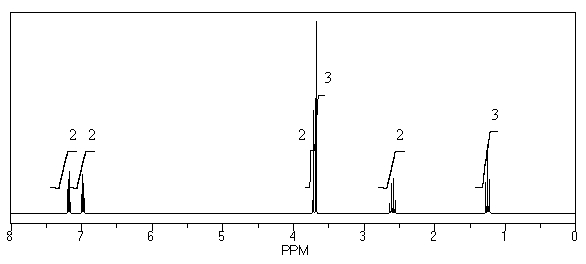
(Multiple Choice)
4.8/5 (90)
(90) 
Filters
- Essay(0)
- Multiple Choice(0)
- Short Answer(0)
- True False(0)
- Matching(0)