



 Chat with AI
Exam 9: Nuclear Magnetic Resonance and Mass Spectrometry

Exam 1: The Basics158 Questions
Exam 2: Families of Carbon151 Questions
Exam 3: Acids and Bases149 Questions
Exam 4: Nomenclature and Conformations of Alkanes and Cycloalkanes163 Questions
Exam 5: Stereochemistry179 Questions
Exam 6: Nucleophilic Reactions91 Questions
Exam 7: Alkenes and Alkynes I220 Questions
Exam 8: Alkenes and Alkynes II163 Questions
Exam 9: Nuclear Magnetic Resonance and Mass Spectrometry158 Questions
Exam 10: Radical Reactions148 Questions
Exam 11: Alcohols and Ethers256 Questions
Exam 12: Alcohols From Carbonyl Compounds210 Questions
Exam 13: Conjugated Unsaturated Systems201 Questions
Exam 14: Aromatic Compounds186 Questions
Exam 15: Reactions of Aromatic Compounds207 Questions
Exam 16: Aldehydes and Ketones189 Questions
Exam 17: Carboxylic Acids and Their Derivatives213 Questions
Exam 18: Reactions at the Α Carbon of Carbonyl Compounds190 Questions
Exam 19: Condensation and Conjugate Addition Reactions of Carbonyl Compounds182 Questions
Exam 20: Amines207 Questions
Exam 21: Transition Metal Complexes86 Questions
Exam 22: Carbohydrates124 Questions
Exam 23: Lipids127 Questions
Exam 24: Amino Acids and Proteins135 Questions
Exam 25: Nucleic Acids and Protein Synthesis126 Questions
Select questions type


Consider the expected splitting of the C2 proton signal in the 1H NMR spectrum of 2-ethyl-1,3-propanediol.Presuming that the coupling constants for neighboring protons are sufficiently different,and that the instrument has sufficient resolving power,what is the theoretical multiplicity of the C2 proton signal?
(Multiple Choice)
4.7/5  (77)
(77) Briefly explain how you might distinguish between the following substances by comparing their 1H-NMR spectra: 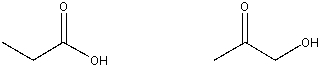
(Essay)
4.7/5 (75)
(75) For the following compound how many different signals would you see in the proton NMR? (Assume that you can see them all.) 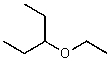
(Multiple Choice)
4.8/5 (69)
(69) Consider the expected splitting of signal "b" in the 1H NMR spectrum of 1,1-dichloro-3-methylbutane,shown below.Presuming that Jab is sufficiently different from Jbc and that the instrument has sufficient resolving power,what is the theoretical multiplicity of signal "b"? 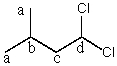
(Multiple Choice)
4.9/5 (79)
(79) A compound with the molecular formula C6H15N gave the following 1H NMR spectrum: triplet, 0 0.90
Quartet, 2.4
There were no other signals.The most likely structure for the compound is:
(Multiple Choice)
4.7/5 (89)
(89) Which form of electromagnetic radiation possesses the least energy?
(Short Answer)
4.9/5 (83)
(83) Consider the expected splitting of signal "c" in the 1H NMR spectrum of 2-ethyl-1-butanol,shown below.Presuming that Jbc is sufficiently different from Jcd and that the instrument has sufficient resolving power,what is the theoretical multiplicity of signal "c"? 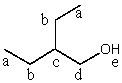
(Multiple Choice)
4.9/5 (79)
(79) An acceptable solvent to use for a deuterium exchange experiment with an alcohol would be CDCl3.
(True/False)
4.7/5 (77)
(77) What is the structure of the compound in the following 1H-NMR spectrum with the molecular formula C6H12O which shows no characteristic stretches in the IR between 3600-3300 cm-1,but does around 1600 cm-1? Relative integration is shown. 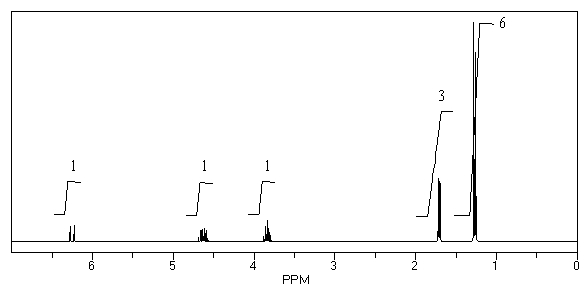
(Multiple Choice)
4.8/5 (81)
(81) For the compound adamantine,how many different signals would you see in the proton NMR? (Assume that you can see them all.) 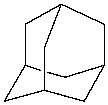
(Multiple Choice)
4.9/5 (88)
(88) 
For the following compound how many different signals would you see in the carbon NMR? (Assume that you can see them all.) 
(Multiple Choice)
4.9/5 (77)
(77) An unknown compound,F,has the formula C3H6O2.Elucidate the structure of F by scrutinizing its IR,1H NMR and 13C NMR spectra,shown below. 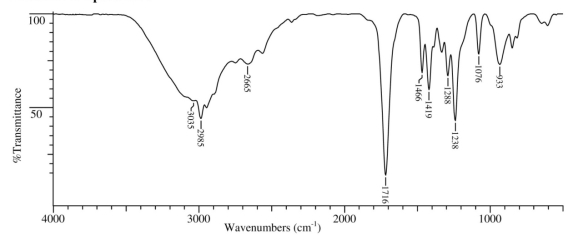
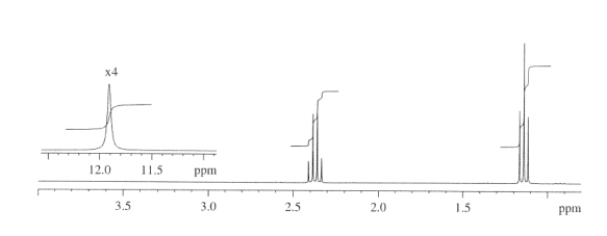
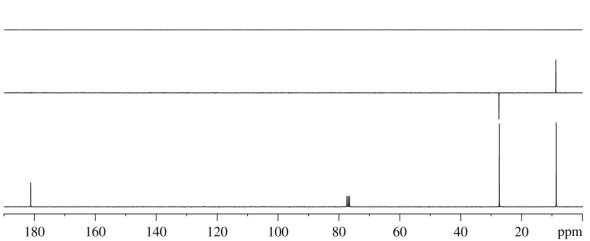
(Essay)
4.7/5 (82)
(82) 
What is the structure of the compound in the following 1H-NMR spectrum with the molecular formula C8H14? Relative integration is shown. 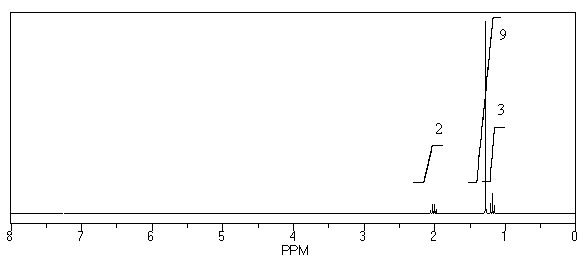
(Multiple Choice)
4.9/5 (85)
(85) 
What is the structure of the compound in the following 1H-NMR spectrum with the molecular formula C5H11NO? In the 13C-NMR spectrum you notice that the farthest peak downfield has a chemical shift of 173 ppm.Relative integration is shown. 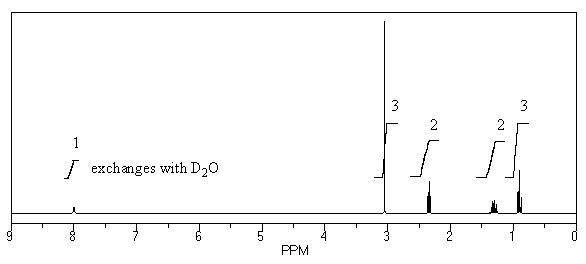
(Multiple Choice)
4.9/5 (78)
(78) Predict the splitting pattern you would observe for the proton at C1 of 2,3-dimethyl-2-phenylbutane. 
(Multiple Choice)
4.9/5 (89)
(89) How many 1H NMR signals would cis-1,2-dichlorocyclopropane give?
(Multiple Choice)
4.7/5 (87)
(87) Which one of the following best represents the predicted approximate chemical shift and coupling for the hydrogen(s)indicated with the arrow? 
(Multiple Choice)
4.8/5 (73)
(73) 
Filters
- Essay(0)
- Multiple Choice(0)
- Short Answer(0)
- True False(0)
- Matching(0)