



 Chat with AI
Exam 11: Alcohols and Ethers

Exam 1: The Basics158 Questions
Exam 2: Families of Carbon151 Questions
Exam 3: Acids and Bases149 Questions
Exam 4: Nomenclature and Conformations of Alkanes and Cycloalkanes163 Questions
Exam 5: Stereochemistry179 Questions
Exam 6: Nucleophilic Reactions91 Questions
Exam 7: Alkenes and Alkynes I220 Questions
Exam 8: Alkenes and Alkynes II163 Questions
Exam 9: Nuclear Magnetic Resonance and Mass Spectrometry158 Questions
Exam 10: Radical Reactions148 Questions
Exam 11: Alcohols and Ethers256 Questions
Exam 12: Alcohols From Carbonyl Compounds210 Questions
Exam 13: Conjugated Unsaturated Systems201 Questions
Exam 14: Aromatic Compounds186 Questions
Exam 15: Reactions of Aromatic Compounds207 Questions
Exam 16: Aldehydes and Ketones189 Questions
Exam 17: Carboxylic Acids and Their Derivatives213 Questions
Exam 18: Reactions at the Α Carbon of Carbonyl Compounds190 Questions
Exam 19: Condensation and Conjugate Addition Reactions of Carbonyl Compounds182 Questions
Exam 20: Amines207 Questions
Exam 21: Transition Metal Complexes86 Questions
Exam 22: Carbohydrates124 Questions
Exam 23: Lipids127 Questions
Exam 24: Amino Acids and Proteins135 Questions
Exam 25: Nucleic Acids and Protein Synthesis126 Questions
Select questions type


The reaction between 4-methyl-1-pentanol and HBr to yield 4-methyl-1-pentene is probably:

Free
(Multiple Choice)
4.9/5  (72)
(72) Correct Answer: Verified
D
Propose a structure for the compound with the following formula that is consistent with the IR and 1H NMR data shown:
C6H14O
IR - 1120cm−1,strong,broad
6H triplet at 0.9
4H sextet at 1.5
4H triplet at 3.4
Free
(Essay)
4.8/5 (68)
(68) Correct Answer:Verified
Verified
The conversion of 3-methyl-1-octanol to 1-chloro-3-methyloctane is best achieved through use of which of these reagents?
Free
(Multiple Choice)
5.0/5 (76)
(76) Correct Answer:Verified
VerifiedD
What is the relationship between alcohols I and II?  They are:
 (Multiple Choice)
4.9/5 (80)
(80) Select the potential energy diagram that best represents the following reaction: 
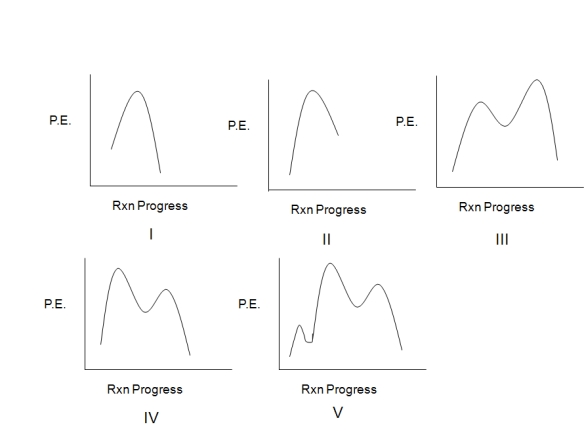
(Multiple Choice)
4.9/5 (87)
(87)  is properly named:
What would be the major product of the following reaction sequence? 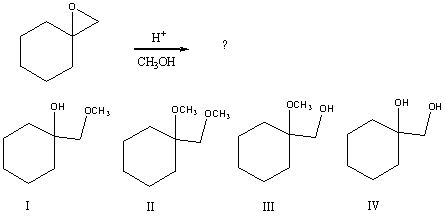
(Multiple Choice)
4.9/5 (87)
(87)  is properly named:
Epoxidation followed by reaction with aqueous base converts cyclopentene into which of these? 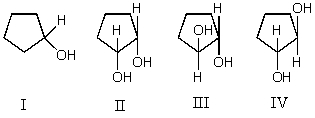
(Multiple Choice)
4.9/5 (79)
(79) What is the relationship between alcohols I and II?  They are:
 (Multiple Choice)
4.8/5 (67)
(67) Complete the following reaction sequence,giving structural details of all key intermediates: 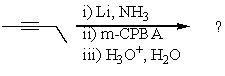
(Essay)
4.8/5 (79)
(79) 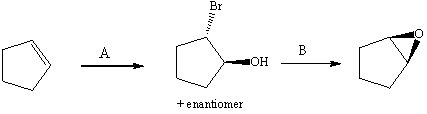
What is the relationship between alcohols I and II?  They are:
 (Multiple Choice)
4.8/5 (72)
(72) What is the relationship between alcohols I and II?  They are:
 (Multiple Choice)
4.9/5 (81)
(81)  is:
What would be the major product of the following reaction sequence? 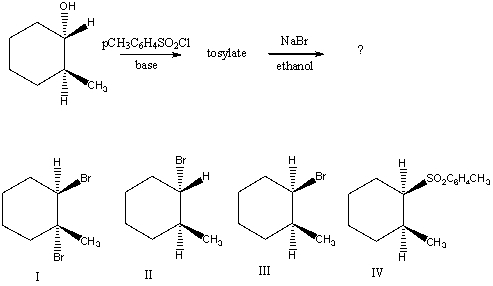
(Multiple Choice)
4.8/5 (63)
(63) Provide a reasonable synthetic strategy for the synthesis of a racemic mixture of (1R,2R)and (1S,2S)-2-bromo-1-methylcyclopentanol from methylcyclopentane:
(Essay)
4.8/5 (94)
(94) Which statement is true concerning the formation of alcohols by the hydroboration-oxidation sequence?
(Multiple Choice)
4.9/5 (67)
(67) 
Filters
- Essay(0)
- Multiple Choice(0)
- Short Answer(0)
- True False(0)
- Matching(0)