



 Chat with AI
Exam 11: Alcohols and Ethers

Exam 1: The Basics158 Questions
Exam 2: Families of Carbon151 Questions
Exam 3: Acids and Bases149 Questions
Exam 4: Nomenclature and Conformations of Alkanes and Cycloalkanes163 Questions
Exam 5: Stereochemistry179 Questions
Exam 6: Nucleophilic Reactions91 Questions
Exam 7: Alkenes and Alkynes I220 Questions
Exam 8: Alkenes and Alkynes II163 Questions
Exam 9: Nuclear Magnetic Resonance and Mass Spectrometry158 Questions
Exam 10: Radical Reactions148 Questions
Exam 11: Alcohols and Ethers256 Questions
Exam 12: Alcohols From Carbonyl Compounds210 Questions
Exam 13: Conjugated Unsaturated Systems201 Questions
Exam 14: Aromatic Compounds186 Questions
Exam 15: Reactions of Aromatic Compounds207 Questions
Exam 16: Aldehydes and Ketones189 Questions
Exam 17: Carboxylic Acids and Their Derivatives213 Questions
Exam 18: Reactions at the Α Carbon of Carbonyl Compounds190 Questions
Exam 19: Condensation and Conjugate Addition Reactions of Carbonyl Compounds182 Questions
Exam 20: Amines207 Questions
Exam 21: Transition Metal Complexes86 Questions
Exam 22: Carbohydrates124 Questions
Exam 23: Lipids127 Questions
Exam 24: Amino Acids and Proteins135 Questions
Exam 25: Nucleic Acids and Protein Synthesis126 Questions
Select questions type


What is the relationship between alcohols I and II?  They are:
 (Multiple Choice)
4.8/5  (77)
(77) Which compound would have the greatest solubility in water?
(Multiple Choice)
4.7/5 (80)
(80) The reaction between 1-pentanol and HBr to yield 1-bromopentanol is probably:
(Multiple Choice)
4.8/5 (92)
(92) Provide a reasonable synthetic strategy for the synthesis of trans-1,2-cyclohexanediol from bromocyclohexane
(Essay)
4.8/5 (70)
(70) The total number of primary alcohols corresponding to the formula C6H14O,counting stereoisomers separately,is:
(Multiple Choice)
4.8/5 (63)
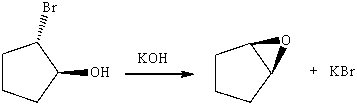
(63) 

Give the correct IUPAC name corresponding to the following structure: 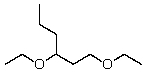
(Short Answer)
4.9/5 (84)
(84) What would be the major product(s)of the following reaction 
(Multiple Choice)
4.9/5 (89)
(89) What would be the major product of the following reaction sequence? 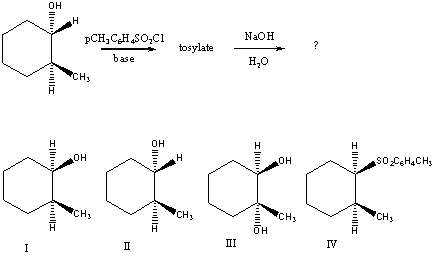
(Multiple Choice)
4.9/5 (84)
(84) Select the potential energy diagram that best represents the following reaction: 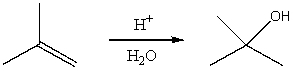
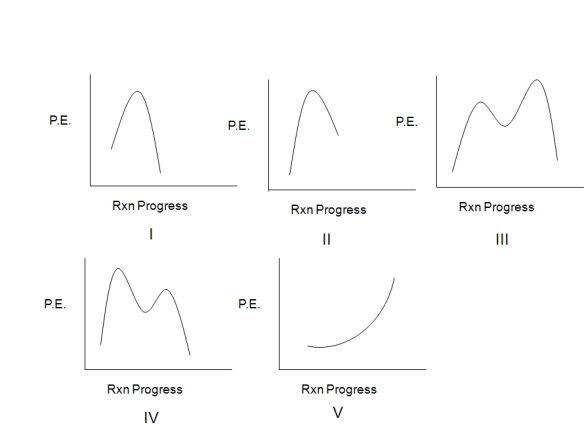
(Multiple Choice)
4.9/5 (77)
(77) What is the relationship between (1S,2R)-2-methylcyclohexanol and (1R,2S)-2-methylcyclohexanol? They are:
(Multiple Choice)
4.7/5 (78)
(78) A compound has the formula C6H14O.The 13C and 1H NMR spectral data for this compound are:
13C NMR
Broadband decoupled 13C NMR: 29.7,29.8,46.4,60.0 δ
DEPT-90: no peaks
DEPT-135: positive peak at 29.8 δ; negative peaks at 29.7,60.0 δ
1H NMR
0.91 δ,singlet (9H)
1.53 δ,triplet (2H)J = 7.3 Hz
2.13 δ,broad singlet (exchangeable,1H)
3.70 δ,triplet (2H)J = 7.3 Hz
(Essay)
4.9/5 (83)
(83) What is the relationship between alcohols I and II?  They are:
 (Multiple Choice)
4.9/5 (82)
(82) cis-3-Hexene is treated with meta-chloroperbenzoic acid and the product is then subjected to acid-catalyzed hydrolysis.What is the final product? 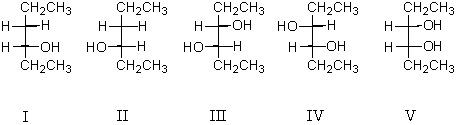
(Multiple Choice)
4.9/5 (86)
(86) What is the relationship between (1R,2R)-2-methylcyclohexanol and (1R,2S)-2-methylcyclohexanol? They are:
(Multiple Choice)
4.8/5 (79)
(79) Draw all of the primary alcohols corresponding to the formula C5H12O,including stereoisomers.
(Essay)
4.9/5 (77)
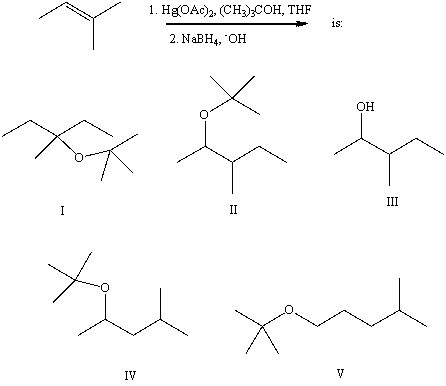
(77) 

Filters
- Essay(0)
- Multiple Choice(0)
- Short Answer(0)
- True False(0)
- Matching(0)