



 Chat with AI
Exam 10: Radical Reactions

Exam 1: The Basics158 Questions
Exam 2: Families of Carbon151 Questions
Exam 3: Acids and Bases149 Questions
Exam 4: Nomenclature and Conformations of Alkanes and Cycloalkanes163 Questions
Exam 5: Stereochemistry179 Questions
Exam 6: Nucleophilic Reactions91 Questions
Exam 7: Alkenes and Alkynes I220 Questions
Exam 8: Alkenes and Alkynes II163 Questions
Exam 9: Nuclear Magnetic Resonance and Mass Spectrometry158 Questions
Exam 10: Radical Reactions148 Questions
Exam 11: Alcohols and Ethers256 Questions
Exam 12: Alcohols From Carbonyl Compounds210 Questions
Exam 13: Conjugated Unsaturated Systems201 Questions
Exam 14: Aromatic Compounds186 Questions
Exam 15: Reactions of Aromatic Compounds207 Questions
Exam 16: Aldehydes and Ketones189 Questions
Exam 17: Carboxylic Acids and Their Derivatives213 Questions
Exam 18: Reactions at the Α Carbon of Carbonyl Compounds190 Questions
Exam 19: Condensation and Conjugate Addition Reactions of Carbonyl Compounds182 Questions
Exam 20: Amines207 Questions
Exam 21: Transition Metal Complexes86 Questions
Exam 22: Carbohydrates124 Questions
Exam 23: Lipids127 Questions
Exam 24: Amino Acids and Proteins135 Questions
Exam 25: Nucleic Acids and Protein Synthesis126 Questions
Select questions type


Which of the following would be the major product in the following reaction sequence? 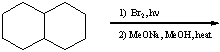
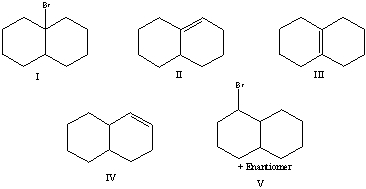

Free
(Multiple Choice)
4.8/5  (94)
(94) Correct Answer: Verified
C
Select the structure of the major product formed in the following reaction. 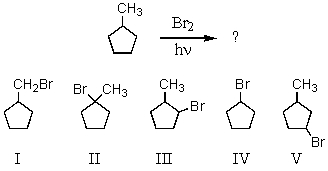
Free
(Multiple Choice)
4.9/5 (93)
(93) Correct Answer:Verified
VerifiedB
Consider the light-initiated chlorination of (S)-2-chlorobutane followed by careful fractional distillation (or separation by GLC)of all of the products with the formula C4H8Cl2.How many fractions (in total)would be obtained and how many of these fractions would be optically active?
(Multiple Choice)
4.9/5 (80)
(80) Draw bond-line formulas of all dichloro derivatives that might be formed when 1-chloro-2,2,3,3-tetramethylpentane is allowed to react with Cl2 under UV irradiation.For each structure,indicate,with an asterisk,any stereocenters that might be present.
(Essay)
4.8/5 (76)
(76) What is the product for the following three-step reaction sequence? 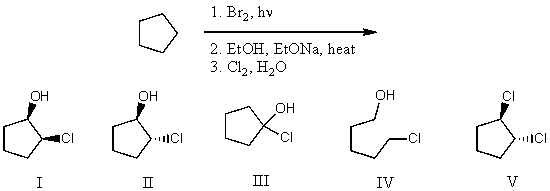
(Multiple Choice)
4.9/5 (92)
(92) Which would be the best way to carry out the following synthesis? 
(Multiple Choice)
4.8/5 (68)
(68) Which hydrogen atom(s)of 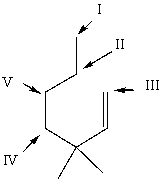 is/are least susceptible to abstraction by free radicals?
 (Multiple Choice)
4.8/5 (81)
(81) What would be the major product of the following reaction sequence? 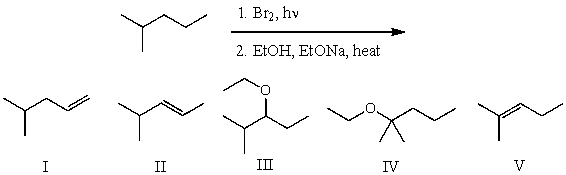
(Multiple Choice)
4.8/5 (82)
(82) What is the product for the following three-step reaction sequence? 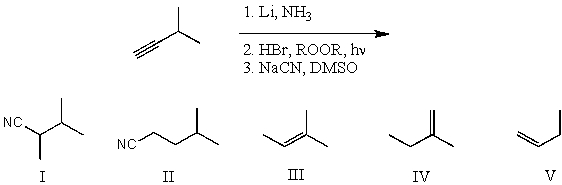
(Multiple Choice)
4.8/5 (67)
(67) In the presence of light,ethane (1 mol)reacts with chlorine (1 mol)to form which product(s)?
(Multiple Choice)
5.0/5 (82)
(82) The hybridization state of the carbon of a methyl radical is:
(Multiple Choice)
4.9/5 (82)
(82) The free radical chlorination of pentane produces this number of monochloro compounds,including stereoisomers.
(Multiple Choice)
4.8/5 (91)
(91) Which of the following would be the major product in the following reaction sequence? 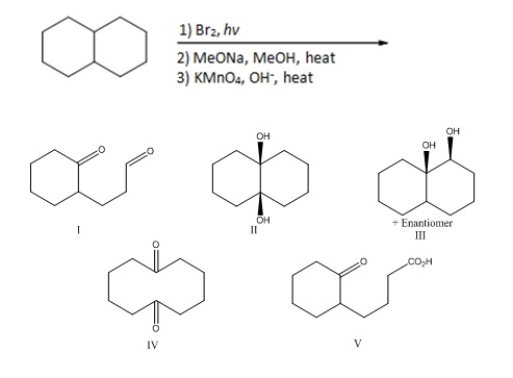
(Multiple Choice)
4.9/5 (73)
(73) What is the major product obtained from the following reaction sequence? 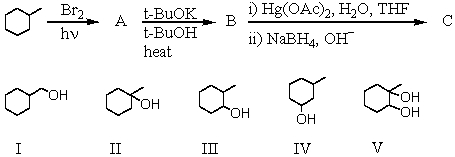
(Multiple Choice)
4.9/5 (78)
(78) What would be the major product of the following reaction sequence? 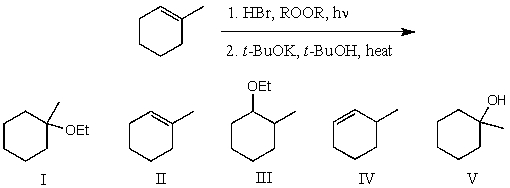
(Multiple Choice)
4.8/5 (83)
(83) What is the major product obtained from the following reaction sequence? 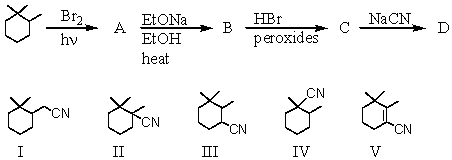
(Multiple Choice)
4.9/5 (82)
(82) What is the product for the following three-step reaction sequence? 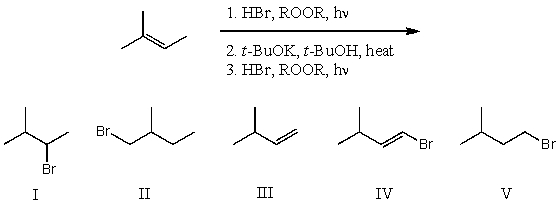
(Multiple Choice)
5.0/5 (77)
(77) Which hydrogen would be abstracted first when mono-brominating with Br2 and light? 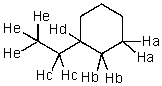
(Multiple Choice)
4.8/5 (92)
(92) 
Filters
- Essay(0)
- Multiple Choice(0)
- Short Answer(0)
- True False(0)
- Matching(0)