



 Chat with AI
Exam 10: Radical Reactions

Exam 1: The Basics158 Questions
Exam 2: Families of Carbon151 Questions
Exam 3: Acids and Bases149 Questions
Exam 4: Nomenclature and Conformations of Alkanes and Cycloalkanes163 Questions
Exam 5: Stereochemistry179 Questions
Exam 6: Nucleophilic Reactions91 Questions
Exam 7: Alkenes and Alkynes I220 Questions
Exam 8: Alkenes and Alkynes II163 Questions
Exam 9: Nuclear Magnetic Resonance and Mass Spectrometry158 Questions
Exam 10: Radical Reactions148 Questions
Exam 11: Alcohols and Ethers256 Questions
Exam 12: Alcohols From Carbonyl Compounds210 Questions
Exam 13: Conjugated Unsaturated Systems201 Questions
Exam 14: Aromatic Compounds186 Questions
Exam 15: Reactions of Aromatic Compounds207 Questions
Exam 16: Aldehydes and Ketones189 Questions
Exam 17: Carboxylic Acids and Their Derivatives213 Questions
Exam 18: Reactions at the Α Carbon of Carbonyl Compounds190 Questions
Exam 19: Condensation and Conjugate Addition Reactions of Carbonyl Compounds182 Questions
Exam 20: Amines207 Questions
Exam 21: Transition Metal Complexes86 Questions
Exam 22: Carbohydrates124 Questions
Exam 23: Lipids127 Questions
Exam 24: Amino Acids and Proteins135 Questions
Exam 25: Nucleic Acids and Protein Synthesis126 Questions
Select questions type


The reaction of 1-butene with HBr in the presence of peroxides yields 1-bromobutane.The mechanism for the reaction involves:
(Multiple Choice)
4.8/5  (95)
(95) The terms "chain reaction" refer to a process where a long sequence of various intermediates are generated to arrive at the formation of a single product.
(True/False)
4.9/5 (84)
(84) What is the total number of trichloropropanes which can be produced by free radical chlorination of propane? Include all stereoisomers.
(Multiple Choice)
4.9/5 (87)
(87) Which of the following would be the major product in the following reaction sequence? 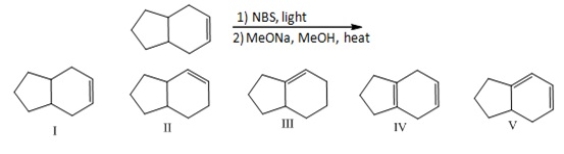
(Multiple Choice)
4.8/5 (69)
(69) Which of these molecules is not expected to arise as a product of the high temperature chlorination of methane?
(Multiple Choice)
4.8/5 (76)
(76) In the presence of light at 25 °C,isobutane (1 mol)and bromine (1 mol)yield which monobromo product(s)?
(Multiple Choice)
4.9/5 (87)
(87) 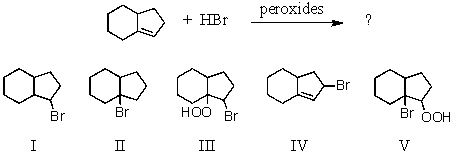
If chlorocyclopentane were chlorinated to form all possible dichloro compounds and the product mixture subjected to precise fractional distillation,how many fractions would be obtained (ideally)?
(Multiple Choice)
4.9/5 (77)
(77) Which statement best describes the reaction of bromine with isobutane?
(Multiple Choice)
4.9/5 (74)
(74) What is the product for the following three-step reaction sequence? 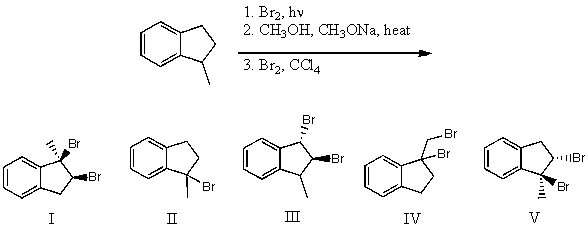
(Multiple Choice)
4.8/5 (87)
(87) Draw bond-line formulas of all monochloro derivatives that might be formed when 3-ethylhexane is allowed to react with Cl2 under UV irradiation.For each structure,indicate,with an asterisk,any stereocenters that might be present.
(Essay)
4.8/5 (73)
(73) Mono-bromination of the following alkane, 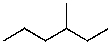 ,(using Br2 with light)would give?

,(using Br2 with light)would give? (Multiple Choice)
4.9/5 (84)
(84) The mechanism for a free-radical reaction consists of three types of steps.These are: ___.
(Essay)
4.9/5 (75)
(75) Radical chlorinations are for the most part not synthetically practical due to high reactivity of the chlorine radical.
(True/False)
4.8/5 (84)
(84) What feature would you expect to see in the 1H NMR spectrum of B after subjecting A to the following reaction? 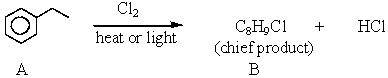
(Multiple Choice)
4.7/5 (71)
(71) What would be the major product of the following reaction sequence? 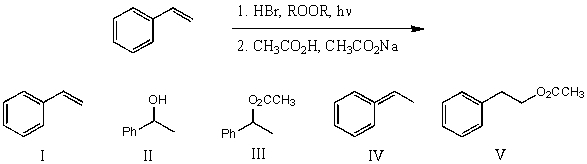
(Multiple Choice)
4.8/5 (79)
(79) What is the final product,C,obtained via the following reaction sequence? 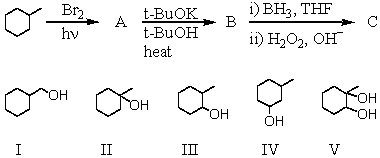
(Multiple Choice)
4.8/5 (81)
(81) Draw bond-line formulas of all monochloro derivatives that might be formed when 1,1-dimethylcyclobutane is allowed to react with Cl2 under UV irradiation.For each structure,indicate,with an asterisk,any stereocenters that might be present.
(Essay)
4.8/5 (87)
(87) Mono-bromination of the following alkane,  ,(using Br2 with light)would give?

,(using Br2 with light)would give? (Multiple Choice)
5.0/5 (93)
(93) 
Filters
- Essay(0)
- Multiple Choice(0)
- Short Answer(0)
- True False(0)
- Matching(0)