



 Chat with AI
Exam 10: Radical Reactions

Exam 1: The Basics158 Questions
Exam 2: Families of Carbon151 Questions
Exam 3: Acids and Bases149 Questions
Exam 4: Nomenclature and Conformations of Alkanes and Cycloalkanes163 Questions
Exam 5: Stereochemistry179 Questions
Exam 6: Nucleophilic Reactions91 Questions
Exam 7: Alkenes and Alkynes I220 Questions
Exam 8: Alkenes and Alkynes II163 Questions
Exam 9: Nuclear Magnetic Resonance and Mass Spectrometry158 Questions
Exam 10: Radical Reactions148 Questions
Exam 11: Alcohols and Ethers256 Questions
Exam 12: Alcohols From Carbonyl Compounds210 Questions
Exam 13: Conjugated Unsaturated Systems201 Questions
Exam 14: Aromatic Compounds186 Questions
Exam 15: Reactions of Aromatic Compounds207 Questions
Exam 16: Aldehydes and Ketones189 Questions
Exam 17: Carboxylic Acids and Their Derivatives213 Questions
Exam 18: Reactions at the Α Carbon of Carbonyl Compounds190 Questions
Exam 19: Condensation and Conjugate Addition Reactions of Carbonyl Compounds182 Questions
Exam 20: Amines207 Questions
Exam 21: Transition Metal Complexes86 Questions
Exam 22: Carbohydrates124 Questions
Exam 23: Lipids127 Questions
Exam 24: Amino Acids and Proteins135 Questions
Exam 25: Nucleic Acids and Protein Synthesis126 Questions
Select questions type


How many monochloro derivatives,including stereoisomers,can be formed in the chlorination of 1-bromobutane?
(Multiple Choice)
4.8/5  (84)
(84) Mono-bromination of the following alkane,  ,(using Br2 with light)would give?

,(using Br2 with light)would give? (Multiple Choice)
4.8/5 (76)
(76) Which hydrogen atom(s)of 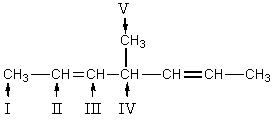 is/are most susceptible to abstraction by free radicals?
 (Multiple Choice)
4.8/5 (81)
(81) Draw bond-line formulas of all monochloro derivatives that might be formed when 2,3-dimethylbutane is allowed to react with Cl2 under UV irradiation.For each structure,indicate,with an asterisk,any stereocenters that might be present.
(Essay)
4.9/5 (71)
(71) Which of the following combinations of reactants can provide a demonstrable example of anti-Markovnikov addition?
(Multiple Choice)
4.9/5 (80)
(80) What would be the major product of the following reaction sequence? 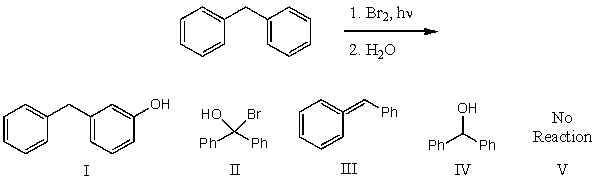
(Multiple Choice)
4.9/5 (69)
(69) Provide a reasonable mechanistic explanation for the formation of small amounts of 3,3,4,4-tetramethylhexane during the free-radical bromination of 2-methylbutane.
(Essay)
4.7/5 (94)
(94) Two radicals that are very important in biological processes are ___ and ___.
(Short Answer)
4.7/5 (96)
(96) Chlorofluorocarbons,or freons,diffuse into the upper atmosphere.There,ultraviolet light initiates a radical chain reaction that has been shown to cause extreme damage to ___.
(Short Answer)
4.9/5 (73)
(73) What is the product for the following three-step reaction sequence? 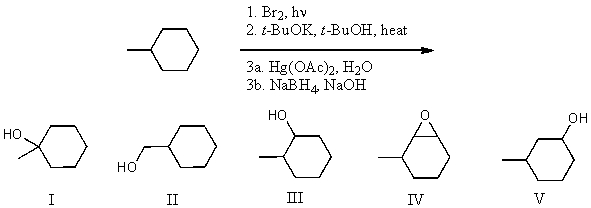
(Multiple Choice)
4.8/5 (67)
(67) Deduce the structure of a substance,C8H18,which gives only a single monochloro derivative upon reaction with Cl2 under UV irradiation.
(Essay)
4.8/5 (80)
(80) Complete the following reaction sequence: indicate regiochemical/stereochemical details as relevant. 
(Essay)
4.8/5 (87)
(87) The free radical chlorination of (R)-2-chloropentane forms a mixture of dichloropentanes which includes:
(Multiple Choice)
4.9/5 (82)
(82) What would be the major product of the following reaction sequence? 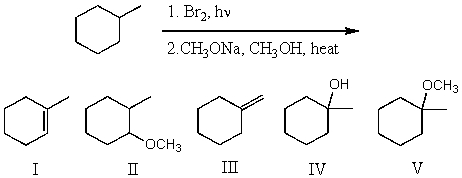
(Multiple Choice)
4.8/5 (75)
(75) Which of the following would be the major product in the following reaction sequence? 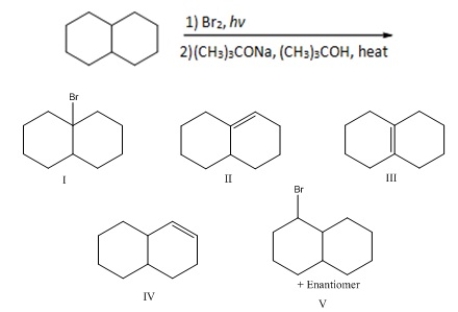
(Multiple Choice)
5.0/5 (71)
(71) What is the product for the following three-step reaction sequence? 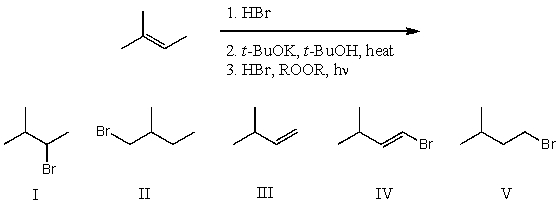
(Multiple Choice)
4.9/5 (72)
(72) Macromolecules made up of many repeating subunits are called ___.
(Short Answer)
4.8/5 (77)
(77) At some temperatures,the relative reactivities of 3°,2° and 1° alkane hydrogens in free radical chlorination are in the ratio of 5:3:1.Thus,monochlorination of isopentane should produce these percentages of 2-chloro-2-methylbutane (A),combined 1-chloro-2-methylbutane and 1-chloro-3-methylbutane (B),and 2-chloro-3-methylbutane (C):
(Multiple Choice)
4.8/5 (96)
(96) Which carbon of 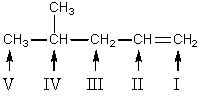 is predicted to be the major site of substitution when this alkene reacts with chlorine at 400 C?
 (Multiple Choice)
4.9/5 (94)
(94) The reason why ___ and ___ radicals are more stable than alkyl radicals is due to electron delocalization through resonance.
(Short Answer)
4.8/5 (80)
(80) 
Filters
- Essay(0)
- Multiple Choice(0)
- Short Answer(0)
- True False(0)
- Matching(0)