



 Chat with AI
Exam 10: Radical Reactions

Exam 1: The Basics158 Questions
Exam 2: Families of Carbon151 Questions
Exam 3: Acids and Bases149 Questions
Exam 4: Nomenclature and Conformations of Alkanes and Cycloalkanes163 Questions
Exam 5: Stereochemistry179 Questions
Exam 6: Nucleophilic Reactions91 Questions
Exam 7: Alkenes and Alkynes I220 Questions
Exam 8: Alkenes and Alkynes II163 Questions
Exam 9: Nuclear Magnetic Resonance and Mass Spectrometry158 Questions
Exam 10: Radical Reactions148 Questions
Exam 11: Alcohols and Ethers256 Questions
Exam 12: Alcohols From Carbonyl Compounds210 Questions
Exam 13: Conjugated Unsaturated Systems201 Questions
Exam 14: Aromatic Compounds186 Questions
Exam 15: Reactions of Aromatic Compounds207 Questions
Exam 16: Aldehydes and Ketones189 Questions
Exam 17: Carboxylic Acids and Their Derivatives213 Questions
Exam 18: Reactions at the Α Carbon of Carbonyl Compounds190 Questions
Exam 19: Condensation and Conjugate Addition Reactions of Carbonyl Compounds182 Questions
Exam 20: Amines207 Questions
Exam 21: Transition Metal Complexes86 Questions
Exam 22: Carbohydrates124 Questions
Exam 23: Lipids127 Questions
Exam 24: Amino Acids and Proteins135 Questions
Exam 25: Nucleic Acids and Protein Synthesis126 Questions
Select questions type


Hydrogen atom abstraction from which position would yield the most stable free radical intermediate during the reaction of bromine with 2,2,3-trimethylpentane?
(Multiple Choice)
5.0/5  (82)
(82) What is the product for the following three-step reaction sequence? 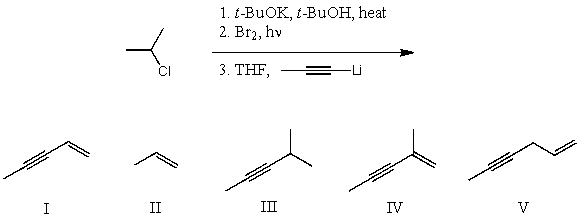
(Multiple Choice)
4.8/5 (80)
(80) Which hydrogen would be abstracted first when mono-brominating with Br2 and light? 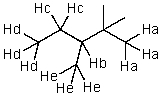
(Multiple Choice)
4.8/5 (85)
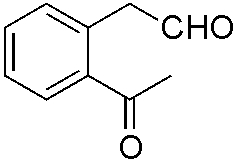
(85) What is the product for the following three-step reaction sequence? 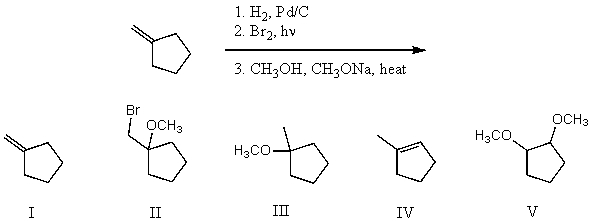
(Multiple Choice)
4.8/5 (79)
(79) 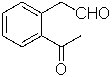

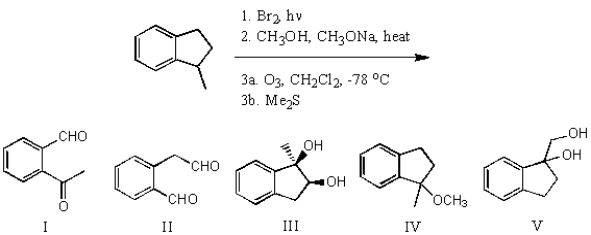
What is the product for the following three-step reaction sequence? 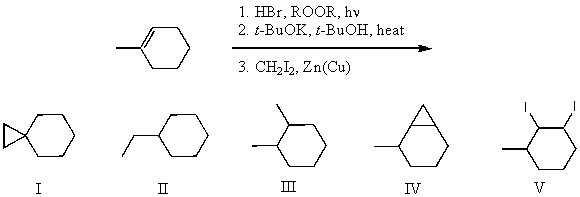
(Multiple Choice)
4.9/5 (82)
(82) In a competition reaction,equimolar amounts of five alkanes compete for a deficiency of chlorine at 300 °C.The greatest amount of reaction would occur in the case of which of these alkanes?
(Multiple Choice)
4.7/5 (78)
(78) What would be the major product of the following reaction sequence? 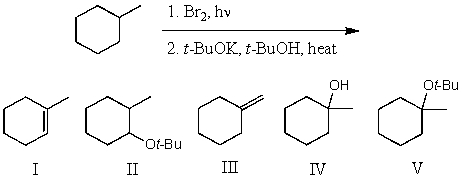
(Multiple Choice)
4.7/5 (61)
(61) A covalent bond breaking so that each of the resulting intermediates bears a single unpaired electron is an example of ___ bond cleavage.
(Short Answer)
4.8/5 (84)
(84) What is the product for the following three-step reaction sequence? 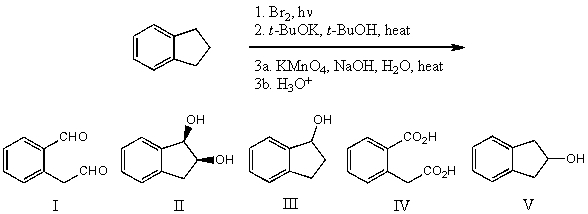
(Multiple Choice)
4.8/5 (82)
(82) Determine the identification of compounds W,X,Y and Z using the structural information shown below. 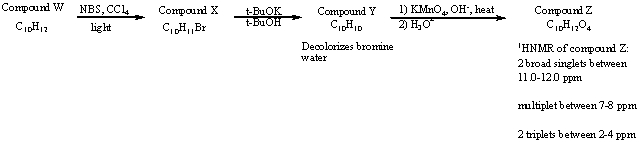
(Essay)
4.8/5 (82)
(82) Draw bond-line formulas of all monochloro derivatives that might be formed when 2,2,4-trimethylpentane is allowed to react with Cl2 under UV irradiation.For each structure,indicate,with an asterisk,any stereocenters that might be present.
(Essay)
4.9/5 (75)
(75) While the electrophilic addition of HBr to an alkene is ionic and follows Markovnikov's rule,if the reaction is done in the presence of peroxides it becomes a ___ reaction and is ___ in regiochemistry.
(Short Answer)
4.8/5 (91)
(91) What is the product for the following three-step reaction sequence? 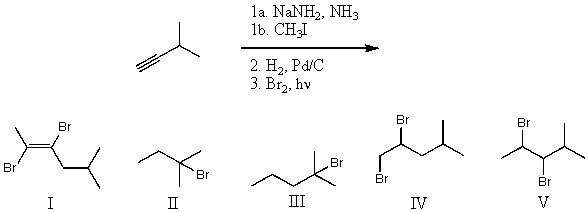
(Multiple Choice)
4.8/5 (79)
(79) 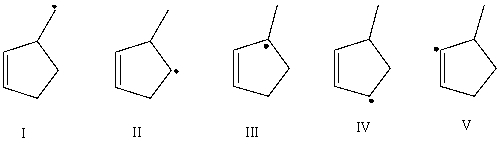
What is the product for the following three-step reaction sequence? 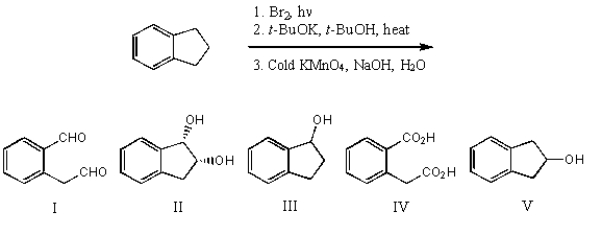
(Multiple Choice)
4.9/5 (83)
(83) The p orbital of a methyl radical carbon,CH3·,contains how many electrons?
(Multiple Choice)
4.8/5 (88)
(88) How many different monochlorobutanes (including stereoisomers)are formed in the free radical chlorination of butane?
(Multiple Choice)
4.8/5 (70)
(70) The reaction between cyclopropane and one equivalent of bromine when exposed to light would yield how many different compounds (including stereoisomers)?
(Multiple Choice)
4.8/5 (78)
(78) 
Filters
- Essay(0)
- Multiple Choice(0)
- Short Answer(0)
- True False(0)
- Matching(0)