



 Chat with AI
Exam 17: Carboxylic Acids and Their Derivatives

Exam 1: The Basics158 Questions
Exam 2: Families of Carbon151 Questions
Exam 3: Acids and Bases149 Questions
Exam 4: Nomenclature and Conformations of Alkanes and Cycloalkanes163 Questions
Exam 5: Stereochemistry179 Questions
Exam 6: Nucleophilic Reactions91 Questions
Exam 7: Alkenes and Alkynes I220 Questions
Exam 8: Alkenes and Alkynes II163 Questions
Exam 9: Nuclear Magnetic Resonance and Mass Spectrometry158 Questions
Exam 10: Radical Reactions148 Questions
Exam 11: Alcohols and Ethers256 Questions
Exam 12: Alcohols From Carbonyl Compounds210 Questions
Exam 13: Conjugated Unsaturated Systems201 Questions
Exam 14: Aromatic Compounds186 Questions
Exam 15: Reactions of Aromatic Compounds207 Questions
Exam 16: Aldehydes and Ketones189 Questions
Exam 17: Carboxylic Acids and Their Derivatives213 Questions
Exam 18: Reactions at the Α Carbon of Carbonyl Compounds190 Questions
Exam 19: Condensation and Conjugate Addition Reactions of Carbonyl Compounds182 Questions
Exam 20: Amines207 Questions
Exam 21: Transition Metal Complexes86 Questions
Exam 22: Carbohydrates124 Questions
Exam 23: Lipids127 Questions
Exam 24: Amino Acids and Proteins135 Questions
Exam 25: Nucleic Acids and Protein Synthesis126 Questions
Select questions type


Complete the following reaction sequence,giving details of all significant intermediates. 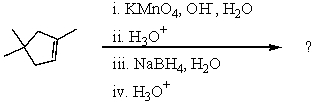
(Essay)
4.9/5  (70)
(70) N,N-Dimethylbenzamide can be made from which of the following?
(Multiple Choice)
4.9/5 (80)
(80) Which compound would be most reactive toward nucleophilic acyl addition-elimination?
(Multiple Choice)
4.8/5 (90)
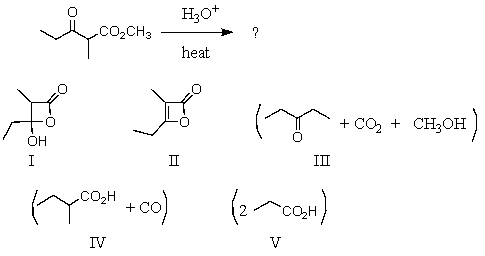
(90) 
Carbonation of a Grignard reagent or the SN2 displacement of an organic halide with cyanide ion followed hydrolysis are both good methods for the conversion of organic halides to carboxylic acids of one more carbon atom.For the following reaction,which of these two procedures would be the process of choice and why? 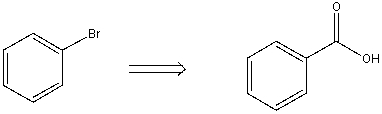
(Essay)
4.8/5 (97)
(97) A compound has the molecular formula,C6H12O2.Its IR spectrum shows a strong absorption band near 1740 cm-1; its 1H NMR spectrum consists of two singlets,at 1.4 and 2.0.The most likely structure for this compound is: 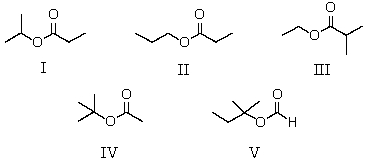
(Multiple Choice)
4.9/5 (79)
(79) Which of the following acids would be expected to have the largest value for pKa?
(Multiple Choice)
4.9/5 (80)
(80) What would be the final organic product of the following reaction? 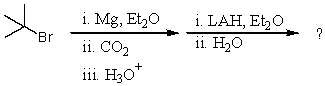
(Multiple Choice)
4.8/5 (83)
(83) The correct structure for ethyl 2-chloropentanoyl chloride is: 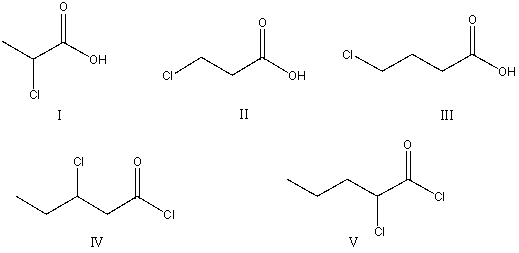
(Multiple Choice)
4.8/5 (76)
(76) While the IUPAC name for HCO2H is methanoic acid,it is commonly known as ___.
(Short Answer)
4.7/5 (84)
(84) Carbonation of a Grignard reagent or the SN2 displacement of an organic halide with cyanide ion followed hydrolysis are both good methods for the conversion of organic halides to carboxylic acids of one more carbon atom.For the following reaction,which of these two procedures would be the process of choice and why? 
(Essay)
4.8/5 (89)
(89) What is the ultimate product of this sequence of reactions? 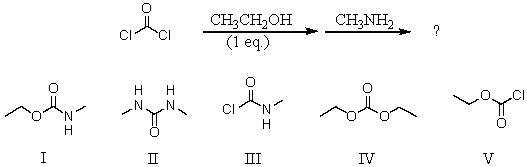
(Multiple Choice)
4.8/5 (88)
(88) Choose the reagent(s)that would bring about the following reaction: CH3CH2CH2CO2CH3 CH3CH2CH2CHO
(Multiple Choice)
4.9/5 (81)
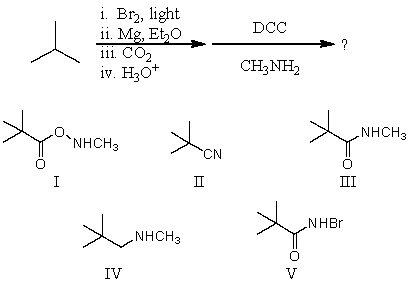
(81) 
In which of the following sequences are the compounds listed in order of decreasing acidity?
(Multiple Choice)
4.9/5 (80)
(80) The correct structure for methyl bicyclo[1.1.0]butane-2-carboxylate is: 
(Multiple Choice)
4.8/5 (68)
(68) Which carboxylic acid would decarboxylate when heated to 100-150 C? 
(Multiple Choice)
4.7/5 (90)
(90) What is the product of the reaction of 1-propanol with phenyl isocyanate,C6H5N=C=O?
(Multiple Choice)
4.9/5 (73)
(73) Predict the final product likely to be obtained when (S)-2-methyl-3-pentanol is subjected to the following sequence of reactions: i)benzoyl chloride; ii)NaOH(aq),heat.
(Multiple Choice)
4.7/5 (63)
(63) 

Filters
- Essay(0)
- Multiple Choice(0)
- Short Answer(0)
- True False(0)
- Matching(0)