



 Chat with AI
Exam 23: Lipids

Exam 1: Carbon Compounds and Chemical Bonds134 Questions
Exam 2: Representative Carbon Compounds: Functional Groups, Intermolecular Forces, and Infrared Ir Spectroscopy114 Questions
Exam 3: An Introduction to Organic Reactions: Acids and Bases47 Questions
Exam 4: Alkanes: Nomenclature, Conformational Analysis, and an Introduction to Synthesis125 Questions
Exam 5: Stereochemistry: Chiral Molecules150 Questions
Exam 6: Ionic Reactions - Nucleophilic Substitution and Elimination Reactions of Alkyl Halides146 Questions
Exam 7: Alkenes and Alkynes I: Properties and Synthesis, Elimination Reactions of Alkyl Halides99 Questions
Exam 8: Alkenes and Alkynes Ii: Addition Reactions140 Questions
Exam 9: Nuclear Magnetic Resonance and Mass Spectrometry: Tools for Structure Determination94 Questions
Exam 10: Radical Reactions114 Questions
Exam 11: Alcohols and Ethers172 Questions
Exam 12: Alcohols From Carbonyl Compounds Oxidation-Reduction and Organometallic Compounds147 Questions
Exam 13: Conjugated Unsaturated Systems166 Questions
Exam 14: Aromatic Compounds151 Questions
Exam 15: Reactions of Aromatic Compounds173 Questions
Exam 16: Aldehydes and Ketones I Nucleophilic Addition to the Carbonyl Group165 Questions
Exam 17: Aldehydes and Ketones Ii Aldol Reactions131 Questions
Exam 18: Carboxylic Acids and Their Derivatives Nucleophilic Addition - Elimination at the Acyl Carbon124 Questions
Exam 19: Synthesis and Reactions of Beta-Dicarbonyl Compounds: More Chemistry of Enolate Ions131 Questions
Exam 20: Amines148 Questions
Exam 21: Phenols and Aryl Halides: Nucleophilic Aromatic Substitution87 Questions
Exam 22: Carbohydrates104 Questions
Exam 23: Lipids99 Questions
Exam 24: Amino Acids and Proteins94 Questions
Exam 25: Nucleic Acids and Protein Synthesis89 Questions
Select questions type


What product would you expect when progesterone is treated with one molar equivalent of hydrogen in the presence of a platinum catalyst? 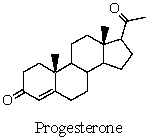
(Multiple Choice)
4.8/5  (77)
(77) Which of the following statements regarding lipids is not true?
(Multiple Choice)
4.9/5 (64)
(64) Suggest a mechanism by which ψ-ionone is transformed into β-ionone on treatment with acid.
(Essay)
4.8/5 (71)
(71) To which class of terpenes does the terpene shown below,bisabolene,belong? 
(Multiple Choice)
5.0/5 (81)
(81) Draw the structures of the following substances,in which the alkyl portion is CH3(CH2)12-:
sodium carboxylate,
sodium alkanesulfonate and
sodium alkyl sulfate
Explain why these substances may be useful as "dirt removers".
(Essay)
5.0/5 (87)
(87) How many isomers,including stereoisomers,exist for the triacylglycerol which,on saponification,gives 2 molar equivalents of palmitate and 1 molar equivalent of stearate?
(Multiple Choice)
5.0/5 (63)
(63) Which is an untrue statement concerning the fatty acid moieties of naturally-occurring triacylglycerols?
(Multiple Choice)
4.8/5 (81)
(81) Which of the following characteristics are found in the class of C20 carboxylic acids called prostaglandins?
(Multiple Choice)
4.9/5 (85)
(85) Indicate by asterisks the chiral centers present in each of three terpenes shown below: 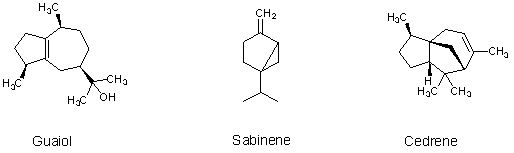 How many stereoisomers of each are theoretically possible?
 (Essay)
4.8/5 (90)
(90) The synthesis of cortisone required placing a ketone function at the 11-position of a steroid.Where is position 11? 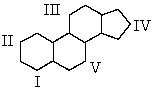
(Multiple Choice)
4.8/5 (86)
(86) Which fatty acid is not likely to occur commonly in natural sources?
(Multiple Choice)
4.9/5 (74)
(74) Sphingolipids,proteins,and polysaccharides make up ___________,the protective coating around nerve fibers.
(Short Answer)
4.9/5 (83)
(83) Which reagent might be used to convert 5 -cholest-1-en-3-ol into 5 -cholestan-3-ol?
(Multiple Choice)
4.7/5 (71)
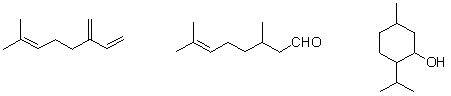
(71) 
Prolonged heating of naturally occurring polyunsaturated fats may cause the stereochemistry of the double bonds to change from ___________.
(Short Answer)
4.7/5 (79)
(79) One of the intermediates in a prostaglandin synthesis is shown below. 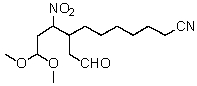 Which reaction might be employed to make this molecule from 1,1-dimethoxy-3-nitropropane and an appropriate , -unsaturated aldehyde? Show the structural details of the reagents as well as any catalysts that might be needed.
 (Essay)
4.7/5 (61)
(61) Draw the most stable chair conformation of mentol and label each substituents as axial or equatorial.
(Essay)
4.9/5 (92)
(92) 
Filters
- Essay(0)
- Multiple Choice(0)
- Short Answer(0)
- True False(0)
- Matching(0)