



 Chat with AI
Exam 23: Lipids

Exam 1: Carbon Compounds and Chemical Bonds134 Questions
Exam 2: Representative Carbon Compounds: Functional Groups, Intermolecular Forces, and Infrared Ir Spectroscopy114 Questions
Exam 3: An Introduction to Organic Reactions: Acids and Bases47 Questions
Exam 4: Alkanes: Nomenclature, Conformational Analysis, and an Introduction to Synthesis125 Questions
Exam 5: Stereochemistry: Chiral Molecules150 Questions
Exam 6: Ionic Reactions - Nucleophilic Substitution and Elimination Reactions of Alkyl Halides146 Questions
Exam 7: Alkenes and Alkynes I: Properties and Synthesis, Elimination Reactions of Alkyl Halides99 Questions
Exam 8: Alkenes and Alkynes Ii: Addition Reactions140 Questions
Exam 9: Nuclear Magnetic Resonance and Mass Spectrometry: Tools for Structure Determination94 Questions
Exam 10: Radical Reactions114 Questions
Exam 11: Alcohols and Ethers172 Questions
Exam 12: Alcohols From Carbonyl Compounds Oxidation-Reduction and Organometallic Compounds147 Questions
Exam 13: Conjugated Unsaturated Systems166 Questions
Exam 14: Aromatic Compounds151 Questions
Exam 15: Reactions of Aromatic Compounds173 Questions
Exam 16: Aldehydes and Ketones I Nucleophilic Addition to the Carbonyl Group165 Questions
Exam 17: Aldehydes and Ketones Ii Aldol Reactions131 Questions
Exam 18: Carboxylic Acids and Their Derivatives Nucleophilic Addition - Elimination at the Acyl Carbon124 Questions
Exam 19: Synthesis and Reactions of Beta-Dicarbonyl Compounds: More Chemistry of Enolate Ions131 Questions
Exam 20: Amines148 Questions
Exam 21: Phenols and Aryl Halides: Nucleophilic Aromatic Substitution87 Questions
Exam 22: Carbohydrates104 Questions
Exam 23: Lipids99 Questions
Exam 24: Amino Acids and Proteins94 Questions
Exam 25: Nucleic Acids and Protein Synthesis89 Questions
Select questions type


A compound "Z" (C10H16),has max at 184 nm in its UV spectrum.Catalytic hydrogenation of Z affords a mixture of diasteromers,which upon separation are identified to be cis-1-isopropyl-4-methylcyclohexane and trans-1-isopropyl-4-methylcyclohexane.Upon ozonolysis,Z yields formaldehyde and 3-acetyl-6-oxoheptanal.Suggest a structure for Z that is consistent with all of the above data,clearly explaining your rationale.
(Essay)
4.9/5  (81)
(81) In -carotene,how many tail-to-tail links of isoprene units are there? 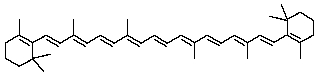
(Multiple Choice)
4.8/5 (83)
(83) Which of these is most likely to have properties resembling natural waxes? 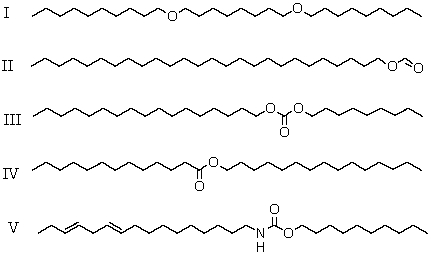
(Multiple Choice)
4.8/5 (85)
(85) The ozonolysis of a fatty acid produces these fragments:  What is the identity of the fatty acid?
 (Multiple Choice)
4.9/5 (77)
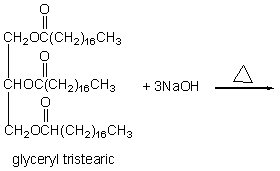
(77) 
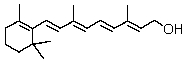
Identify the bonds that link the isoprene units in -farnesene,shown below.How are these units linked: head to head,tail to head or tail to tail ? 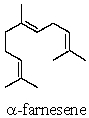
(Essay)
4.8/5 (82)
(82) Myelin,the protective coating around nerve fibers,is made up of ___________.
(Essay)
4.9/5 (85)
(85) Unsaturated fatty acids have a bend in the carbon chain that interferes with packing.Therefore the corresponding triacylglycerols are generally __________ at room temperature and are called _______.
(Short Answer)
4.7/5 (88)
(88) The biosynthesis of one series of prostaglandins begins with which of these fatty acids?
(Multiple Choice)
4.9/5 (73)
(73) Which fatty acid is not likely to occur commonly in natural sources?
(Multiple Choice)
4.9/5 (61)
(61) Of the saturated fatty acids found in fats and oils,this one normally is the most abundant:
(Multiple Choice)
4.8/5 (83)
(83) In naturally occurring polyunsaturated fatty acids,the stereochemistry of the double bonds is rarely ___________.
(Short Answer)
4.8/5 (66)
(66) How could you synthesize stearolic acid,CH3(CH2)7C C(CH2)7COOH from oleic acid,CH3(CH2)7CH=CH(CH2)7COOH?
(Multiple Choice)
4.8/5 (88)
(88) Fats can be either optically active or inactive,depending on their structure.Draw the structure of an optically active fat that yields 2 equiv of stearic acid and 1 equiv of oleic acid on hydrolysis.Draw the structure of an optically inactive fat that yields the same products.
(Essay)
4.9/5 (78)
(78) 
Filters
- Essay(0)
- Multiple Choice(0)
- Short Answer(0)
- True False(0)
- Matching(0)