



 Chat with AI
Exam 16: Aldehydes and Ketones I Nucleophilic Addition to the Carbonyl Group

Exam 1: Carbon Compounds and Chemical Bonds134 Questions
Exam 2: Representative Carbon Compounds: Functional Groups, Intermolecular Forces, and Infrared Ir Spectroscopy114 Questions
Exam 3: An Introduction to Organic Reactions: Acids and Bases47 Questions
Exam 4: Alkanes: Nomenclature, Conformational Analysis, and an Introduction to Synthesis125 Questions
Exam 5: Stereochemistry: Chiral Molecules150 Questions
Exam 6: Ionic Reactions - Nucleophilic Substitution and Elimination Reactions of Alkyl Halides146 Questions
Exam 7: Alkenes and Alkynes I: Properties and Synthesis, Elimination Reactions of Alkyl Halides99 Questions
Exam 8: Alkenes and Alkynes Ii: Addition Reactions140 Questions
Exam 9: Nuclear Magnetic Resonance and Mass Spectrometry: Tools for Structure Determination94 Questions
Exam 10: Radical Reactions114 Questions
Exam 11: Alcohols and Ethers172 Questions
Exam 12: Alcohols From Carbonyl Compounds Oxidation-Reduction and Organometallic Compounds147 Questions
Exam 13: Conjugated Unsaturated Systems166 Questions
Exam 14: Aromatic Compounds151 Questions
Exam 15: Reactions of Aromatic Compounds173 Questions
Exam 16: Aldehydes and Ketones I Nucleophilic Addition to the Carbonyl Group165 Questions
Exam 17: Aldehydes and Ketones Ii Aldol Reactions131 Questions
Exam 18: Carboxylic Acids and Their Derivatives Nucleophilic Addition - Elimination at the Acyl Carbon124 Questions
Exam 19: Synthesis and Reactions of Beta-Dicarbonyl Compounds: More Chemistry of Enolate Ions131 Questions
Exam 20: Amines148 Questions
Exam 21: Phenols and Aryl Halides: Nucleophilic Aromatic Substitution87 Questions
Exam 22: Carbohydrates104 Questions
Exam 23: Lipids99 Questions
Exam 24: Amino Acids and Proteins94 Questions
Exam 25: Nucleic Acids and Protein Synthesis89 Questions
Select questions type


Predict the major organic product of the following reaction: 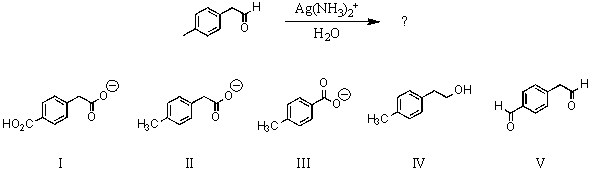
(Multiple Choice)
4.7/5  (75)
(75) What is the correct structure for (R)-5-bromo-2-heptanone? 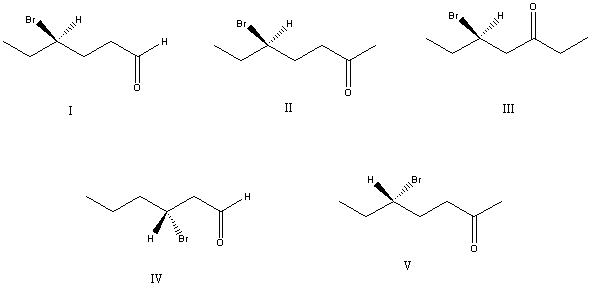
(Multiple Choice)
4.8/5 (80)
(80) 
Select the structure of the major product in the following reaction. 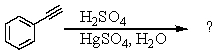
(Multiple Choice)
4.8/5 (76)
(76) Which of the following procedures would not yield 3-pentanone as a major product?
(Multiple Choice)
4.8/5 (77)
(77) The product,E,of the following reaction sequence,  would be:

would be: (Multiple Choice)
4.8/5 (101)
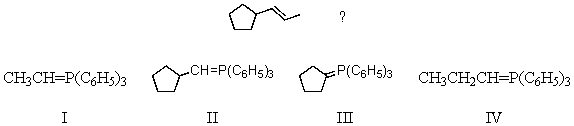
(101) 
The conversion of a trans epoxide to a cis alkene using triphenylphosphine is an example
of a ______________reaction.
(Short Answer)
4.9/5 (74)
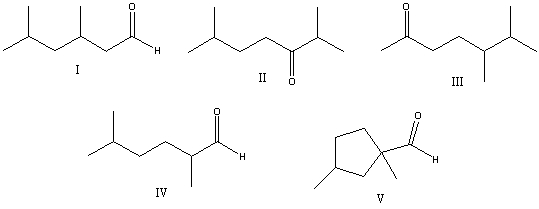
(74) 
Complete the following reaction sequence,giving structural details of all significant intermediates and the final product. 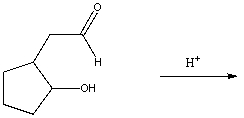
(Essay)
4.9/5 (82)
(82) Which reagent will not differentiate between 3-butenal and 2-butanone?
(Multiple Choice)
4.8/5 (80)
(80) The reaction between a phosphorus ylide and an aldehyde or ketone is called the ___________ reaction.
(Short Answer)
4.9/5 (77)
(77) The product,E,of the following sequence of reactions  would be:
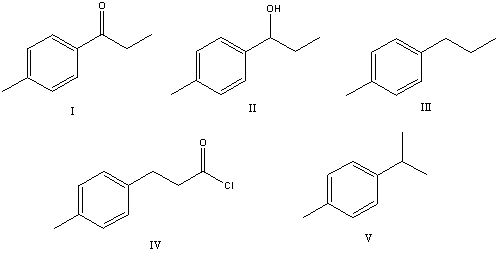
would be: (Multiple Choice)
5.0/5 (74)
(74) Propose a structure that fits the following spectroscopic data:
C4H8O
IR: 1737 cm−1
Broadband decoupled 13C NMR: 15.48,41.07,204.86
DEPT Experiments show: signal at 41.07 as CH and signal at 15.48 as CH3
(Essay)
4.9/5 (82)
(82) Suggest a synthetic strategy for the synthesis of 4-methylpentanal from 3-methyl-1-bromobutane.
(Essay)
4.9/5 (85)
(85) Draw a complete mechanism,using arrow convention to indicate electron movement,
for the following transformation: 
(Essay)
4.8/5 (70)
(70) Propose a structure that fits the following spectroscopic data:
C6H12O
IR: 1708 cm−1
Broadband decoupled 13C NMR: 24.61,26.42,44.31,213.81
DEPT Experiments show: signals at 24.61,26.42 as CH3
(Essay)
4.8/5 (83)
(83) Cis-stilbene (cis-1,2-diphenylethene)can be prepared in high yield from its trans
diastereomer.Propose a reasonable synthesis. 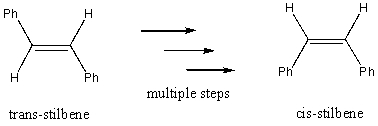
(Essay)
4.8/5 (86)
(86) What is the correct IUPAC name for the following compound? 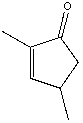
(Multiple Choice)
4.8/5 (82)
(82) 
Filters
- Essay(0)
- Multiple Choice(0)
- Short Answer(0)
- True False(0)
- Matching(0)