



 Chat with AI
Exam 13: Conjugated Unsaturated Systems

Exam 1: Carbon Compounds and Chemical Bonds134 Questions
Exam 2: Representative Carbon Compounds: Functional Groups, Intermolecular Forces, and Infrared Ir Spectroscopy114 Questions
Exam 3: An Introduction to Organic Reactions: Acids and Bases47 Questions
Exam 4: Alkanes: Nomenclature, Conformational Analysis, and an Introduction to Synthesis125 Questions
Exam 5: Stereochemistry: Chiral Molecules150 Questions
Exam 6: Ionic Reactions - Nucleophilic Substitution and Elimination Reactions of Alkyl Halides146 Questions
Exam 7: Alkenes and Alkynes I: Properties and Synthesis, Elimination Reactions of Alkyl Halides99 Questions
Exam 8: Alkenes and Alkynes Ii: Addition Reactions140 Questions
Exam 9: Nuclear Magnetic Resonance and Mass Spectrometry: Tools for Structure Determination94 Questions
Exam 10: Radical Reactions114 Questions
Exam 11: Alcohols and Ethers172 Questions
Exam 12: Alcohols From Carbonyl Compounds Oxidation-Reduction and Organometallic Compounds147 Questions
Exam 13: Conjugated Unsaturated Systems166 Questions
Exam 14: Aromatic Compounds151 Questions
Exam 15: Reactions of Aromatic Compounds173 Questions
Exam 16: Aldehydes and Ketones I Nucleophilic Addition to the Carbonyl Group165 Questions
Exam 17: Aldehydes and Ketones Ii Aldol Reactions131 Questions
Exam 18: Carboxylic Acids and Their Derivatives Nucleophilic Addition - Elimination at the Acyl Carbon124 Questions
Exam 19: Synthesis and Reactions of Beta-Dicarbonyl Compounds: More Chemistry of Enolate Ions131 Questions
Exam 20: Amines148 Questions
Exam 21: Phenols and Aryl Halides: Nucleophilic Aromatic Substitution87 Questions
Exam 22: Carbohydrates104 Questions
Exam 23: Lipids99 Questions
Exam 24: Amino Acids and Proteins94 Questions
Exam 25: Nucleic Acids and Protein Synthesis89 Questions
Select questions type


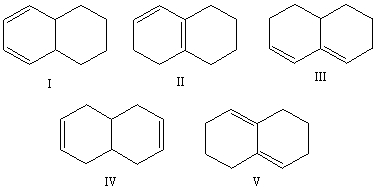
Which diene and dienophile would you choose to synthesize the following compound? 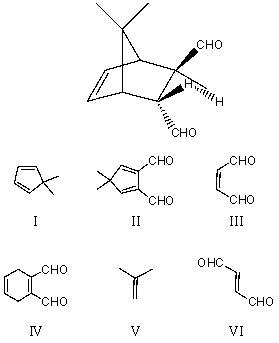
(Multiple Choice)
4.9/5  (62)
(62) 
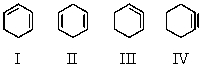
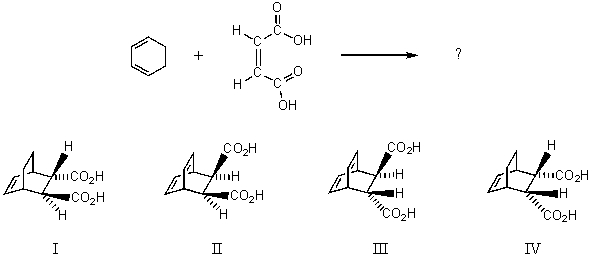
The alkaloid colchicine is used in the treatment of gout.The first synthetic colchine
involved the preparation of the key intermediate shown.Which combination of diene and
dieneophile will result in its preparation? 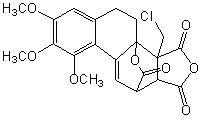
(Essay)
4.9/5 (86)
(86) Draw arrows to indicate electron movement that explains the formation of the products
shown for the following retro-Diels-Alder reaction: 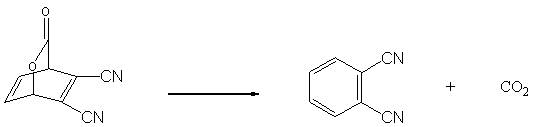
(Essay)
4.8/5 (64)
(64) When the product distribution for a particular reaction reflects the relative stabilities of the products,the reaction is said to be under ______________ control.
(Short Answer)
4.8/5 (86)
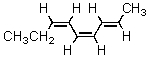
(86) Considering both configurational and conformational factors,select the least stable form of 2,4-hexadiene. 
(Multiple Choice)
4.9/5 (85)
(85) Which hydrogen atom(s)of 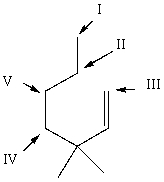 is/are least susceptible to abstraction by free radicals?
 (Multiple Choice)
4.8/5 (81)
(81) Polyenes in which single and double bonds alternate along the carbon chain are called ___________.
(Short Answer)
4.8/5 (71)
(71) Which of the following compounds is not formed as a result of a chain-termination step in the free radical chlorination of propene?
(Multiple Choice)
4.9/5 (77)
(77) 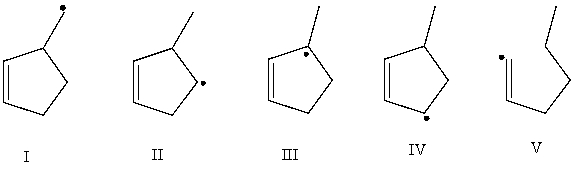
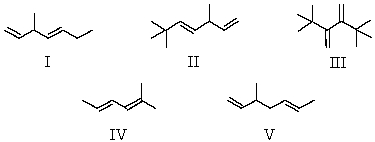
Arrange these hexadienes in order of expected decreasing stability. 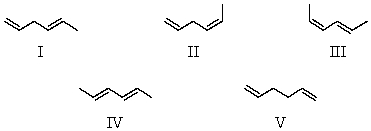
(Multiple Choice)
4.8/5 (76)
(76) 
The allyl radical has how many electrons in non-bonding molecular orbitals?
(Multiple Choice)
5.0/5 (94)
(94) Which reagent would convert 1,3-pentadiene into 3-penten-2-ol?
(Multiple Choice)
4.9/5 (93)
(93) Estimate the stabilization energy for 1,3-pentadiene using the heats of hydrogenation in Table 1. Table 1.
Heats of Hydrogenation for Selected Compounds
Compound
Moles H2
H(kJ mol-1)
1-Butene
1
-127
1-Pentene
Trans-2-pentene
1
1
-126
-115
1,3-Butadiene
2
-239
Trans-1,3-Pentadiene
2
-226
(Multiple Choice)
4.8/5 (95)
(95) 
Filters
- Essay(0)
- Multiple Choice(0)
- Short Answer(0)
- True False(0)
- Matching(0)