



 Chat with AI
Exam 8: Alkenes and Alkynes Ii: Addition Reactions

Exam 1: Carbon Compounds and Chemical Bonds134 Questions
Exam 2: Representative Carbon Compounds: Functional Groups, Intermolecular Forces, and Infrared Ir Spectroscopy114 Questions
Exam 3: An Introduction to Organic Reactions: Acids and Bases47 Questions
Exam 4: Alkanes: Nomenclature, Conformational Analysis, and an Introduction to Synthesis125 Questions
Exam 5: Stereochemistry: Chiral Molecules150 Questions
Exam 6: Ionic Reactions - Nucleophilic Substitution and Elimination Reactions of Alkyl Halides146 Questions
Exam 7: Alkenes and Alkynes I: Properties and Synthesis, Elimination Reactions of Alkyl Halides99 Questions
Exam 8: Alkenes and Alkynes Ii: Addition Reactions140 Questions
Exam 9: Nuclear Magnetic Resonance and Mass Spectrometry: Tools for Structure Determination94 Questions
Exam 10: Radical Reactions114 Questions
Exam 11: Alcohols and Ethers172 Questions
Exam 12: Alcohols From Carbonyl Compounds Oxidation-Reduction and Organometallic Compounds147 Questions
Exam 13: Conjugated Unsaturated Systems166 Questions
Exam 14: Aromatic Compounds151 Questions
Exam 15: Reactions of Aromatic Compounds173 Questions
Exam 16: Aldehydes and Ketones I Nucleophilic Addition to the Carbonyl Group165 Questions
Exam 17: Aldehydes and Ketones Ii Aldol Reactions131 Questions
Exam 18: Carboxylic Acids and Their Derivatives Nucleophilic Addition - Elimination at the Acyl Carbon124 Questions
Exam 19: Synthesis and Reactions of Beta-Dicarbonyl Compounds: More Chemistry of Enolate Ions131 Questions
Exam 20: Amines148 Questions
Exam 21: Phenols and Aryl Halides: Nucleophilic Aromatic Substitution87 Questions
Exam 22: Carbohydrates104 Questions
Exam 23: Lipids99 Questions
Exam 24: Amino Acids and Proteins94 Questions
Exam 25: Nucleic Acids and Protein Synthesis89 Questions
Select questions type


Which reagent(s)given below could be used to synthesize cis-1,2-cycloheptanediol from cycloheptene?
(Multiple Choice)
4.8/5  (78)
(78) 
Hydroboration-oxidation is a reaction with _________ stereochemistry and ________________ regiochemistry.
(Short Answer)
4.8/5 (88)
(88) What is the major product of the following reaction sequence? 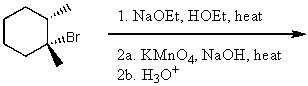
(Multiple Choice)
4.9/5 (72)
(72) 
The "decolorization" of molecular bromine is often used as a functional group test to detect the presence of ________________.
(Essay)
4.7/5 (84)
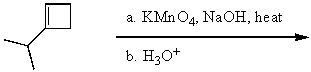
(84) 
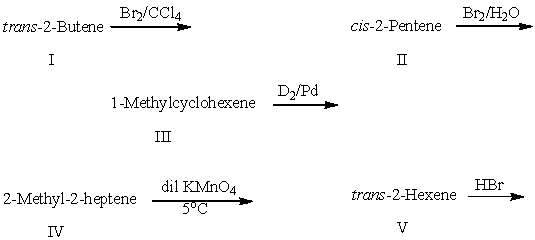
An optically active compound,A,with the molecular formula C7H12 reacts with cold dilute KMnO4 and gives IR absorption at about 3300 cm-1.On catalytic hydrogenation,A is converted to B (C7H16)and B is also optically active.Which is a possible structure for A? 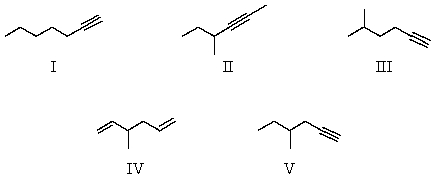
(Multiple Choice)
4.9/5 (86)
(86) Which of these is not a possible product when cyclopentene reacts with an aqueous solution of bromine? 
(Multiple Choice)
4.8/5 (81)
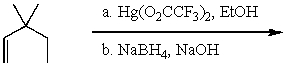
(81) What is the major product of the following reaction sequence? 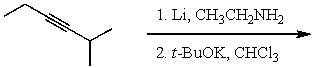
(Multiple Choice)
4.8/5 (82)
(82) Cyclohexene reacts with bromine to yield 1,2-dibromocyclohexane.Molecules of the product would:
(Multiple Choice)
4.8/5 (81)
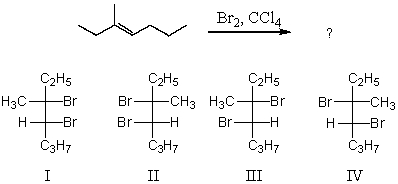
(81) Select the structure of the major product formed in the following reaction. 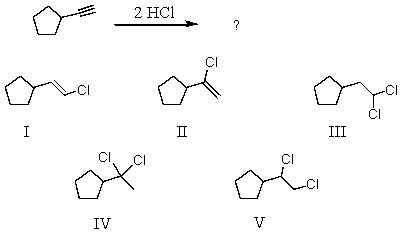
(Multiple Choice)
4.8/5 (74)
(74) When a particular stereoisomer reacts in such a way that it gives a particular stereoisomer as a product,even if more than one stereoisomer is theoretically possible,the reaction is said to be _____________.
(Short Answer)
4.9/5 (69)
(69) The most resistant compound to the action of hot alkaline KMnO4 is:
(Multiple Choice)
4.9/5 (90)
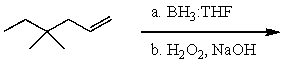
(90) What is the major product of the following reaction sequence? 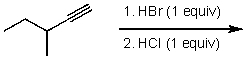
(Multiple Choice)
4.9/5 (81)
(81) What is the major product of the following reaction sequence? 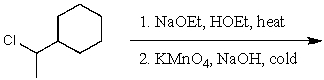
(Multiple Choice)
4.8/5 (79)
(79) Draw Fischer projection formula(s)of the major product(s)of the reaction between Z-3-methyl-3-hexene and cold,alkaline KMnO4.
(Essay)
4.8/5 (91)
(91) 
Filters
- Essay(0)
- Multiple Choice(0)
- Short Answer(0)
- True False(0)
- Matching(0)