



 Chat with AI
Exam 8: Alkenes and Alkynes Ii: Addition Reactions

Exam 1: Carbon Compounds and Chemical Bonds134 Questions
Exam 2: Representative Carbon Compounds: Functional Groups, Intermolecular Forces, and Infrared Ir Spectroscopy114 Questions
Exam 3: An Introduction to Organic Reactions: Acids and Bases47 Questions
Exam 4: Alkanes: Nomenclature, Conformational Analysis, and an Introduction to Synthesis125 Questions
Exam 5: Stereochemistry: Chiral Molecules150 Questions
Exam 6: Ionic Reactions - Nucleophilic Substitution and Elimination Reactions of Alkyl Halides146 Questions
Exam 7: Alkenes and Alkynes I: Properties and Synthesis, Elimination Reactions of Alkyl Halides99 Questions
Exam 8: Alkenes and Alkynes Ii: Addition Reactions140 Questions
Exam 9: Nuclear Magnetic Resonance and Mass Spectrometry: Tools for Structure Determination94 Questions
Exam 10: Radical Reactions114 Questions
Exam 11: Alcohols and Ethers172 Questions
Exam 12: Alcohols From Carbonyl Compounds Oxidation-Reduction and Organometallic Compounds147 Questions
Exam 13: Conjugated Unsaturated Systems166 Questions
Exam 14: Aromatic Compounds151 Questions
Exam 15: Reactions of Aromatic Compounds173 Questions
Exam 16: Aldehydes and Ketones I Nucleophilic Addition to the Carbonyl Group165 Questions
Exam 17: Aldehydes and Ketones Ii Aldol Reactions131 Questions
Exam 18: Carboxylic Acids and Their Derivatives Nucleophilic Addition - Elimination at the Acyl Carbon124 Questions
Exam 19: Synthesis and Reactions of Beta-Dicarbonyl Compounds: More Chemistry of Enolate Ions131 Questions
Exam 20: Amines148 Questions
Exam 21: Phenols and Aryl Halides: Nucleophilic Aromatic Substitution87 Questions
Exam 22: Carbohydrates104 Questions
Exam 23: Lipids99 Questions
Exam 24: Amino Acids and Proteins94 Questions
Exam 25: Nucleic Acids and Protein Synthesis89 Questions
Select questions type



Predict the product(s)of the oxidation of 2,3,4-trimethyl-1,5-heptadiene with hot,alkaline KMnO4.
(Essay)
4.8/5  (92)
(92) Which alkene would you expect to be most reactive toward acid-catalyzed hydration?
(Multiple Choice)
4.8/5 (88)
(88) Which reaction sequence would convert cis-2-butene to trans-2-butene?
(Multiple Choice)
4.8/5 (82)
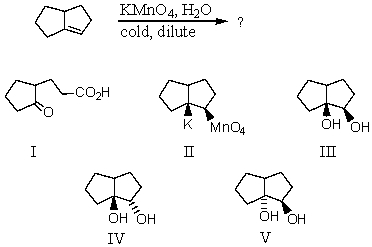
(82) 
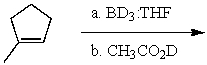
Carbenes are frequently produced by -elimination reactions.These are reactions in which the proton being lost and the leaving group are ___________.
(Essay)
4.8/5 (77)
(77) Which of the following reactions would yield the final product as a racemic form?
(Multiple Choice)
4.9/5 (91)
(91) Select the structure of the major product formed in the following reaction. 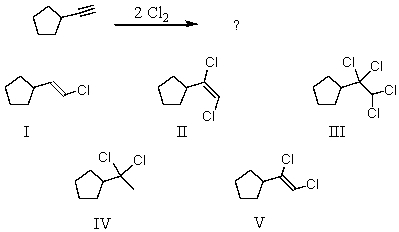
(Multiple Choice)
4.9/5 (68)
(68) Which reagent or test could be used to distinguish between 3-pentyne and 1-pentyne?
(Multiple Choice)
4.8/5 (84)
(84) 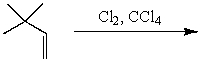
Consider the addition of HCl to 3-methyl-1-butene.The major product of the reaction would be:
(Multiple Choice)
4.7/5 (84)
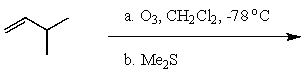
(84) 
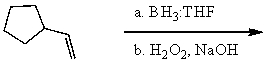
The rule that correctly predicts the regiochemistry of most ionic additions to alkenes is called ____________________.
(Essay)
4.8/5 (80)
(80) 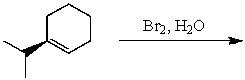
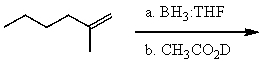
What is the major product of the following reaction sequence? 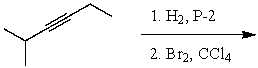
(Multiple Choice)
4.9/5 (74)
(74) Which of these compounds belongs to the class of substances commonly known as "halohydrins"?
(Multiple Choice)
4.9/5 (73)
(73) 
Filters
- Essay(0)
- Multiple Choice(0)
- Short Answer(0)
- True False(0)
- Matching(0)