



 Chat with AI
Exam 7: Financial Assets

Exam 1: Accounting: Information for Decision Making135 Questions
Exam 2: Basic Financial Statements158 Questions
Exam 3: The Accounting Cycle: Capturing Economic Events161 Questions
Exam 4: The Accounting Cycle: Accruals and Deferrals160 Questions
Exam 5: The Accounting Cycle: Reporting Financial Results136 Questions
Exam 6: Merchandising Activities144 Questions
Exam 7: Financial Assets233 Questions
Exam 8: Inventories and the Cost of Goods Sold169 Questions
Exam 9: Plant and Intangible Assets154 Questions
Exam 10: Liabilities221 Questions
Exam 11: Stockholders Equity: Paid-In Capital166 Questions
Exam 12: Income and Changes in Retained Earnings153 Questions
Exam 13: Statement of Cash Flows181 Questions
Exam 14: Financial Statement Analysis165 Questions
Exam 15: Global Business and Accounting95 Questions
Exam 16: Management Accounting: a Business Partner124 Questions
Exam 17: Job Order Cost Systems and Overhead Allocations116 Questions
Exam 18: Process Costing103 Questions
Exam 19: Costing and the Value Chain89 Questions
Exam 20: Cost-Volume-Profit Analysis147 Questions
Exam 21: Incremental Analysis119 Questions
Exam 22: Responsibility Accounting and Transfer Pricing108 Questions
Exam 23: Operational Budgeting115 Questions
Exam 24: Standard Cost Systems130 Questions
Exam 25: Rewarding Business Performance71 Questions
Exam 26: Capital Budgeting125 Questions
Exam 28: Forms of Business Organization52 Questions
Exam 27: The Time Value of Money: Future Amounts and Present Values Answer Key49 Questions
Select questions type


Management may wish to overstate a company's income because bonus plans and stock options are related to reported earnings.
(True/False)
4.7/5  (81)
(81) Which of the following activities affects net income, but has no immediate impact upon cash flows?
(Multiple Choice)
4.7/5 (79)
(79) Each of the following measures strengthens internal control over cash receipts except:
(Multiple Choice)
5.0/5 (80)
(80) Which of the following practices contributes to efficient cash management?
(Multiple Choice)
4.8/5 (81)
(81) Match the following terms with the explanations below. If no term fits the explanation write none
Accounts Receivable Turnover Rate Financial Assets Allowance for Doubtful Accounts Marketable Securities Cash Equivalents Mark-to-Market Direct Write Off Method Unrealized Gain
_______ (1) A means of accounting for uncollectibles which does not recognize any expense until specific receivables are determined to be worthless.
_______ (2) An account showing the amount of estimated uncollectible receivables.
_______ (3 ) The process of estimating uncollectible accounts by classifying accounts receivables by age groups.
_______ (4) Dividing net sales by average receivables to create a ratio to measure the liquidity of accounts receivable.
_______ (5) Very short-term liquid investments which must mature within 90 days of acquisition.
_______ (6) Cash and assets convertible directly into known amounts of cash.
_______ (7) An account showing the difference between the cost of an investment in marketable securities and its market value.
_______ (8) The value of a note at its maturity date.
_______ (9) Highly liquid investments that can be sold in organized securities exchanges.
(Essay)
4.8/5 (75)
(75) A note receivable which is not collected promptly at the maturity date should be written off the books by a debit to Accounts Receivable and a credit to Notes Receivable.
(True/False)
5.0/5 (77)
(77) Puget Sound Co. sold available-for-sale marketable securities costing $80,000 for $92,000 cash. In the company's income statement and statement of cash flows, respectively, this will appear as:
(Multiple Choice)
4.7/5 (77)
(77) Which of the following actions is least likely to increase a company's accounts receivable turnover?
(Multiple Choice)
4.8/5 (80)
(80) At December 31, 2009, Laconia Industries' portfolio of investments in available-for-sale marketable securities consisted of the following:
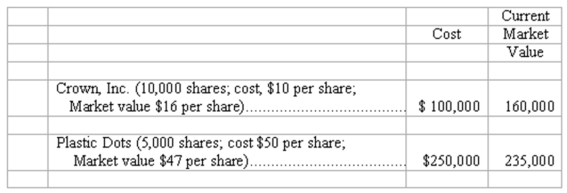 (a.) Illustrate the presentation of marketable securities and unrealized holding gain (or loss) in Laconia's financial statements at December 31, 2009. Indicate the financial statement and section in which each item appears.
(b.) Assume that on March 15, 2010, Laconia made the following sales of securities:
(1) Sold 5,000 shares of its investment in Crown, Inc., at a price of $20 per share.
(2) Sold 1,000 shares of its investment in Plastic Dots at a price of $45 per share.
Compute the gain or loss recognized in Laconia's 2010 income statement for each sale:
(1). Sale of 5,000 shares of Crown: $____________ Gain/Loss
(2). Sale of 1,000 shares of Plastic Dots: $____________ Gain/Loss
(c.) At December 31, 2010, the market values of these stocks are: Crown, $21 per share; Plastic Dots, $42 per share. Complete the following schedule showing cost and current market value of securities owned by Laconia at the end of 2010.
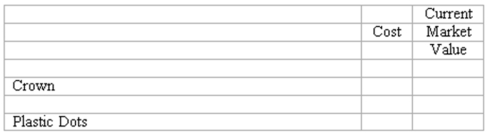 (d.) Illustrate the presentation of marketable securities and unrealized holding gain (or loss) in Laconia's financial statements at December 31, 2010. (Follow same format as in part
(a.) Illustrate the presentation of marketable securities and unrealized holding gain (or loss) in Laconia's financial statements at December 31, 2009. Indicate the financial statement and section in which each item appears.
(b.) Assume that on March 15, 2010, Laconia made the following sales of securities:
(1) Sold 5,000 shares of its investment in Crown, Inc., at a price of $20 per share.
(2) Sold 1,000 shares of its investment in Plastic Dots at a price of $45 per share.
Compute the gain or loss recognized in Laconia's 2010 income statement for each sale:
(1). Sale of 5,000 shares of Crown: $____________ Gain/Loss
(2). Sale of 1,000 shares of Plastic Dots: $____________ Gain/Loss
(c.) At December 31, 2010, the market values of these stocks are: Crown, $21 per share; Plastic Dots, $42 per share. Complete the following schedule showing cost and current market value of securities owned by Laconia at the end of 2010.
(d.) Illustrate the presentation of marketable securities and unrealized holding gain (or loss) in Laconia's financial statements at December 31, 2010. (Follow same format as in part (Essay)
4.9/5 (67)
(67) With available-for-sale securities, unrealized holding gains and losses are:
(Multiple Choice)
4.9/5 (80)
(80) The aging of the accounts receivable approach to estimating uncollectible accounts does not:
(Multiple Choice)
4.8/5 (78)
(78) Internal control over cash transactions
(a.) Describe three measures contributing to strong internal control over cash receipts.
(b.) Describe three measures contributing to effective internal control over cash disbursements.
(Essay)
4.8/5 (88)
(88) Under the direct write-off method of accounting for uncollectible accounts:
(Multiple Choice)
4.8/5 (74)
(74) Petty cash fund
E-Z Productions established a petty cash fund of $650 on January 1. On January 28, the fund was replenished for the payments made to date as shown by the following petty cash vouchers: postage, $145; telephone expense, $62.80; repairs, $79.20; office supplies, $67.20; and miscellaneous expense, $56. Prepare journal entries in general journal form to record the establishment of the fund on January 1 and its replenishment on January 28.
(Essay)
4.9/5 (83)
(83) Dorfmann Industries has an accounts receivable turnover rate of 12. Which of the following statements is not true?
(Multiple Choice)
4.8/5 (69)
(69) The accounts receivable turnover rate for Baldwin Corporation is 8, and for Basinger Company is 10. These statistics indicate that:
(Multiple Choice)
4.9/5 (80)
(80) To "write-off" an account receivable is to reduce the balance of the customer's account to zero.
(True/False)
4.8/5 (82)
(82) The income statement approach used to estimate uncollectible receivables uses a percentage of net sales without considering the current balance in the Allowance account.
(True/False)
4.9/5 (75)
(75) 
Filters
- Essay(0)
- Multiple Choice(0)
- Short Answer(0)
- True False(0)
- Matching(0)