



 Chat with AI
Exam 3: The Accounting Cycle: Capturing Economic Events

Exam 1: Accounting: Information for Decision Making135 Questions
Exam 2: Basic Financial Statements158 Questions
Exam 3: The Accounting Cycle: Capturing Economic Events161 Questions
Exam 4: The Accounting Cycle: Accruals and Deferrals160 Questions
Exam 5: The Accounting Cycle: Reporting Financial Results136 Questions
Exam 6: Merchandising Activities144 Questions
Exam 7: Financial Assets233 Questions
Exam 8: Inventories and the Cost of Goods Sold169 Questions
Exam 9: Plant and Intangible Assets154 Questions
Exam 10: Liabilities221 Questions
Exam 11: Stockholders Equity: Paid-In Capital166 Questions
Exam 12: Income and Changes in Retained Earnings153 Questions
Exam 13: Statement of Cash Flows181 Questions
Exam 14: Financial Statement Analysis165 Questions
Exam 15: Global Business and Accounting95 Questions
Exam 16: Management Accounting: a Business Partner124 Questions
Exam 17: Job Order Cost Systems and Overhead Allocations116 Questions
Exam 18: Process Costing103 Questions
Exam 19: Costing and the Value Chain89 Questions
Exam 20: Cost-Volume-Profit Analysis147 Questions
Exam 21: Incremental Analysis119 Questions
Exam 22: Responsibility Accounting and Transfer Pricing108 Questions
Exam 23: Operational Budgeting115 Questions
Exam 24: Standard Cost Systems130 Questions
Exam 25: Rewarding Business Performance71 Questions
Exam 26: Capital Budgeting125 Questions
Exam 28: Forms of Business Organization52 Questions
Exam 27: The Time Value of Money: Future Amounts and Present Values Answer Key49 Questions
Select questions type


The journal entry to record a particular business transaction includes a credit to the Cash account. This transaction is most likely also to include:

Free
(Multiple Choice)
5.0/5  (69)
(69) Correct Answer: Verified
C
The collection of accounts receivable is recorded by a:
Free
(Multiple Choice)
4.8/5 (86)
(86) Correct Answer:Verified
VerifiedC
Capital Financial Advisors, Inc. had the following transactions during January, its first month of operations:
a. Issued to Marvin Tycoon 9,000 shares of capital stock in exchange for his investment of $45,000 cash.
b. Borrowed $30,000 from a bank and signed a note payable due in three months.
c. Purchased office furniture costing $19,750; paid $6,000 cash and charged the balance on account.
d. Paid $6,000 of the amount owed for office furniture.
e. Issued an additional 2,000 shares of capital stock to an individual who invests $10,000 in the business.
Instructions
Record the above transactions directly in the T accounts below. Identify each entry in a T account with the letter shown for the transaction.
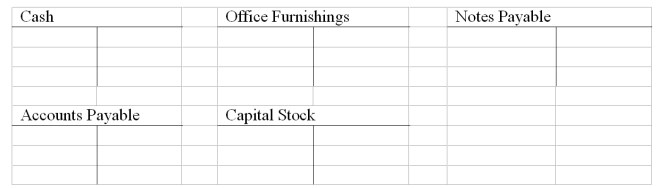
Free
(Essay)
4.7/5 (75)
(75) Correct Answer:Verified
Verified 
Accounting terminology
Listed below are nine technical accounting terms introduced in this chapter:
(A.) The accounting record in which transactions are initially recorded.
(B.) A concept designed to avoid overstatement of the financial strength of a company.
(C.) A schedule prepared to determine the equality of the debit and credit amounts in the ledger.
(D.) An amount entered in the right side of a ledger account.
(E.) The sequence of procedures involved in recording transactions, processing the information in the accounting system, and summarizing the information in the form of financial statements.
(F.) The accounting record that contains a separate account for each type of asset and liability, and for each element of owners' equity appearing in the balance sheet.
(G.) The system of accounting in which every business transaction is recorded by equal dollar amounts of debit and credit entries.
Matching principle Debit Trial balance Double-entry Credit Joumal Accounting cycle Ledger Conservatism
(Essay)
4.9/5 (71)
(71) Preparing a journal entry in proper form involves all the following except:
(Multiple Choice)
4.7/5 (88)
(88) Effects of a series of transactions on balance sheet items
Clark Plumbing had the following transactions during the month of June, the first month of operations for the business:
* The corporation issued 12,000 shares of capital stock to Bill Clark in exchange for his investment of $72,000 cash.
* Purchased $36,000 of equipment; made an $8,000 down payment and signed a note payable for the balance.
* Made payment of $4,000 on the amount owed for equipment.
(A.) Compute the balance in the Cash account at the end of June.
(B.) What are the total assets of Clark Plumbing at the end of June?
(C.) Compute the balance in the Notes Payable account at the end of June.
(D.) What is the total amount of owners' equity at the end of June?
(Essay)
4.8/5 (85)
(85) What is the balance in the Note Payable account at the end of March?
(Multiple Choice)
4.9/5 (83)
(83) A transaction is first recorded in which of the following accounting records?
(Multiple Choice)
4.9/5 (72)
(72) Sunset Tours has a $3,500 account receivable from the Del Mar Rotary. On January 20, the Rotary makes a partial payment of $2,100 to Sunset Tours. The journal entry made on January 20 by Sunset Tours to record this transaction includes:
(Multiple Choice)
4.9/5 (90)
(90) The reason that both expenses and dividends are recorded by debit entries is that:
(Multiple Choice)
4.8/5 (81)
(81) What is the total of Precision's liabilities at the end of June?
(Multiple Choice)
4.9/5 (77)
(77) Dividends are an expense to a corporation and appear on the income statement.
(True/False)
4.7/5 (82)
(82) The statement "This business produced net income of $520,000" is unclear because it failed to specify:
(Multiple Choice)
4.8/5 (73)
(73) Accounts are usually arranged in the ledger in financial statement order, that is, assets first, followed by liabilities, owners' equity, expenses, and revenues.
(True/False)
4.9/5 (75)
(75) Increases in owners' equity are recorded by credits; increases in assets and in liabilities are recorded by debits.
(True/False)
4.8/5 (82)
(82) The accrual basis of accounting recognizes expenses only when they are paid.
(True/False)
4.8/5 (78)
(78) Rules of debit and credit as applied to balance sheet accounts
Items in the balance sheet are classified into three categories: assets, liabilities, and owners' equity.
(A.) Identify by name two ledger accounts in each of the first two categories above (assets and liabilities) and one owners' equity account. State whether each account would normally have a debit or credit balance.
(B.) Describe briefly the rules of debits and credits as applied to the three categories of balance sheet accounts: asset accounts, liability accounts, and owners' equity accounts.
(Essay)
4.8/5 (66)
(66) Earning revenue increases owners' equity and expenses reduce owners' equity, therefore, revenues are recorded with debit entries and expenses are recorded with credit entries.
(True/False)
4.9/5 (79)
(79) 
Filters
- Essay(0)
- Multiple Choice(0)
- Short Answer(0)
- True False(0)
- Matching(0)