



 Chat with AI
Exam 9: Plant and Intangible Assets

Exam 1: Accounting: Information for Decision Making135 Questions
Exam 2: Basic Financial Statements158 Questions
Exam 3: The Accounting Cycle: Capturing Economic Events161 Questions
Exam 4: The Accounting Cycle: Accruals and Deferrals160 Questions
Exam 5: The Accounting Cycle: Reporting Financial Results136 Questions
Exam 6: Merchandising Activities144 Questions
Exam 7: Financial Assets233 Questions
Exam 8: Inventories and the Cost of Goods Sold169 Questions
Exam 9: Plant and Intangible Assets154 Questions
Exam 10: Liabilities221 Questions
Exam 11: Stockholders Equity: Paid-In Capital166 Questions
Exam 12: Income and Changes in Retained Earnings153 Questions
Exam 13: Statement of Cash Flows181 Questions
Exam 14: Financial Statement Analysis165 Questions
Exam 15: Global Business and Accounting95 Questions
Exam 16: Management Accounting: a Business Partner124 Questions
Exam 17: Job Order Cost Systems and Overhead Allocations116 Questions
Exam 18: Process Costing103 Questions
Exam 19: Costing and the Value Chain89 Questions
Exam 20: Cost-Volume-Profit Analysis147 Questions
Exam 21: Incremental Analysis119 Questions
Exam 22: Responsibility Accounting and Transfer Pricing108 Questions
Exam 23: Operational Budgeting115 Questions
Exam 24: Standard Cost Systems130 Questions
Exam 25: Rewarding Business Performance71 Questions
Exam 26: Capital Budgeting125 Questions
Exam 28: Forms of Business Organization52 Questions
Exam 27: The Time Value of Money: Future Amounts and Present Values Answer Key49 Questions
Select questions type


Refer to the information above. Assume that in its financial statements, Victor uses straight-line depreciation and the half-year convention. Depreciation recognized on this equipment in 2009 and 2010 will be:

Free
(Multiple Choice)
4.7/5  (91)
(91) Correct Answer: Verified
C
Various depreciation methods-first year
On March 24, 2009 Tastee Ice Cream Co. purchased equipment costing $140,000, with an estimated life of 5 years and an estimated salvage value of $20,000. Compute the depreciation expense Tastee would recognize on this equipment in 2009, assuming:
(a) Straight-line depreciation using the half-year convention \_ (b) 200\% declining balance with fractional periods rounded to the nearest full month. \ \_\_\_ (c) 150\% -declining-balance, using the half-year convention \_
Free
(Essay)
4.8/5 (87)
(87) Correct Answer:Verified
Verified
U. S. GAAP requires that a company should capitalize goodwill and adjust its value if subject to impairment.
Free
(True/False)
4.9/5 (68)
(68) Correct Answer:Verified
VerifiedTrue
Mayer Instrumentation sold a depreciable asset for cash of $300,000. The original cost of the asset was $1,200,000. Mayer recognized a gain of $45,000 on the sale. What was the amount of accumulated depreciation on the asset at the time of its sale?
(Multiple Choice)
4.9/5 (71)
(71) When a company uses straight-line depreciation and the half-year convention, assets with a five-year life:
(Multiple Choice)
4.8/5 (91)
(91) Cranston Instrumentation sold a depreciable asset for cash of $150,000. The original cost of the asset was $600,000. Cranston recognized a gain of $22,500 on the sale. What was the amount of accumulated depreciation on the asset at the time of its sale?
(Multiple Choice)
4.7/5 (76)
(76) Most companies benefit by using accelerated depreciation methods for income tax purposes.
(True/False)
4.8/5 (85)
(85) The gain or loss on the disposal of a depreciable asset reported in financial statements often differs from that reported for income tax purposes. The principal reason for the difference is:
(Multiple Choice)
4.7/5 (78)
(78) The systematic write-off of intangible assets to expense is called depletion.
(True/False)
4.7/5 (81)
(81) Ladd Company sold a plant asset that originally had cost $50,000 for $22,000 cash. If Ladd correctly reports a $5,000 gain on this sale, the accumulated depreciation on the asset at the date of sale must have been:
(Multiple Choice)
4.9/5 (67)
(67) Just as there are depreciation methods to calculate the decline in value of assets, there are appreciation methods to record the increase in value of assets.
(True/False)
4.9/5 (65)
(65) When a depreciable asset is sold at a price equal to its book value, a journal entry would include:
(Multiple Choice)
4.9/5 (86)
(86) An asset which costs $14,400 and has accumulated depreciation of $8,000 is sold for $5,600. What amount of gain or loss will be recognized when the asset is sold?
(Multiple Choice)
4.8/5 (82)
(82) Charging an expenditure directly to an expense account is based on the assumption that the benefits of that expenditure have been used up in the current period.
(True/False)
4.8/5 (77)
(77) Machinery acquired new on January 1 at a cost of $80,000 was estimated to have a useful life of 10 years and a residual salvage value of $20,000. Straight-line depreciation was used. On January 1, following six full years of use of the machinery, management decided that the estimate of useful life had been too long and that the machinery would have to be retired after three years, that is, at the end of the ninth year of service. Under this revised estimate, the depreciation expense for the seventh year of use would be:
(Multiple Choice)
4.9/5 (81)
(81) 
Caan purchased the Stokes Mine for $60 million. The mine was estimated to contain 6 million tons of anthracite coal and to have a residual value of $12 million. During the first year of mining operations of the Stokes Mine, 800,000 tons of anthracite were mined of which 600,000 tons was sold.
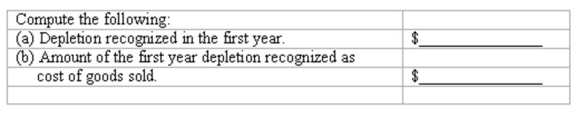
(Essay)
4.9/5 (74)
(74) For financial reporting purposes, the gain or loss on the sale of a plant asset is determined by comparing the asset's:
(Multiple Choice)
4.8/5 (72)
(72) 
Filters
- Essay(0)
- Multiple Choice(0)
- Short Answer(0)
- True False(0)
- Matching(0)