



 Chat with AI
Exam 9: Plant and Intangible Assets

Exam 1: Accounting: Information for Decision Making135 Questions
Exam 2: Basic Financial Statements158 Questions
Exam 3: The Accounting Cycle: Capturing Economic Events161 Questions
Exam 4: The Accounting Cycle: Accruals and Deferrals160 Questions
Exam 5: The Accounting Cycle: Reporting Financial Results136 Questions
Exam 6: Merchandising Activities144 Questions
Exam 7: Financial Assets233 Questions
Exam 8: Inventories and the Cost of Goods Sold169 Questions
Exam 9: Plant and Intangible Assets154 Questions
Exam 10: Liabilities221 Questions
Exam 11: Stockholders Equity: Paid-In Capital166 Questions
Exam 12: Income and Changes in Retained Earnings153 Questions
Exam 13: Statement of Cash Flows181 Questions
Exam 14: Financial Statement Analysis165 Questions
Exam 15: Global Business and Accounting95 Questions
Exam 16: Management Accounting: a Business Partner124 Questions
Exam 17: Job Order Cost Systems and Overhead Allocations116 Questions
Exam 18: Process Costing103 Questions
Exam 19: Costing and the Value Chain89 Questions
Exam 20: Cost-Volume-Profit Analysis147 Questions
Exam 21: Incremental Analysis119 Questions
Exam 22: Responsibility Accounting and Transfer Pricing108 Questions
Exam 23: Operational Budgeting115 Questions
Exam 24: Standard Cost Systems130 Questions
Exam 25: Rewarding Business Performance71 Questions
Exam 26: Capital Budgeting125 Questions
Exam 28: Forms of Business Organization52 Questions
Exam 27: The Time Value of Money: Future Amounts and Present Values Answer Key49 Questions
Select questions type


In which of the following situations would Martinez Industries include goodwill in its balance sheet?
(Multiple Choice)
5.0/5  (89)
(89) Assume Lloyd uses 150%-declining-balance depreciation with the half-year convention. Depreciation expense to be recognized in 2009 (the year of purchase) is:
(Multiple Choice)
4.9/5 (79)
(79) The term accumulated depreciation, as used in accounting, is best defined as:
(Multiple Choice)
4.7/5 (81)
(81) Responsibility for selection of the depreciation methods used in financial reporting rests with:
(Multiple Choice)
4.7/5 (78)
(78) Research and development-financial reporting
Alert Industries has spent $5 billion over the last three years in developing a new drug labeled BJ13. FDA approval is expected by the end of the month, at which time the drug will be available for sale. None of Alert's competitors has a product similar to BJ13, and the medical community is anxiously awaiting availability of this drug. Although BJ13 promises to be a "wonder drug" with huge financial success, Alert's income statements for the last few years have shown substantial losses and Alert's balance sheet does not include product BJ13 among the assets of the business.
Explain why one of Alert's seemingly most valuable assets apparently has been omitted from the balance sheet, and why Alert's income statements for the past few years reported substantial losses.
(Essay)
4.9/5 (69)
(69) When comparing the units-of-output method of depreciation with straight-line depreciation:
(Multiple Choice)
4.8/5 (97)
(97) Accounting terminology. Listed below are nine technical accounting terms introduced in this chapter:
 Each of the following statements may (or may not) describe one of these technical terms. In the space provided below each statement, indicate the accounting term described, or Answer "None" if the statement does not correctly describe any of the terms.
____ (a.) An expenditure to pay an expense of the current period.
____ (b.) The accelerated depreciation system used in federal income tax returns for depreciable assets purchased after 1986.
____ (c.) A policy that fractional-period depreciation on assets acquired or sold during the period should be computed to the nearest month.
____ (d.) An intangible asset representing the present value of future earnings in excess of normal return on net identifiable assets.
____ (e.) Expenditures that could lead to the introduction of new products, but which, according to the FASB, should be viewed as an expense of the current accounting period.
____ (f.) Depreciation methods that take less depreciation in the early years of an asset's useful life, and more depreciation in the later years.
____ (g.) An account showing the portion of the cost of a plant asset that has been written off to date as depreciation expense.
Each of the following statements may (or may not) describe one of these technical terms. In the space provided below each statement, indicate the accounting term described, or Answer "None" if the statement does not correctly describe any of the terms.
____ (a.) An expenditure to pay an expense of the current period.
____ (b.) The accelerated depreciation system used in federal income tax returns for depreciable assets purchased after 1986.
____ (c.) A policy that fractional-period depreciation on assets acquired or sold during the period should be computed to the nearest month.
____ (d.) An intangible asset representing the present value of future earnings in excess of normal return on net identifiable assets.
____ (e.) Expenditures that could lead to the introduction of new products, but which, according to the FASB, should be viewed as an expense of the current accounting period.
____ (f.) Depreciation methods that take less depreciation in the early years of an asset's useful life, and more depreciation in the later years.
____ (g.) An account showing the portion of the cost of a plant asset that has been written off to date as depreciation expense. (Essay)
4.9/5 (87)
(87) Effects of depreciation on income and cash flows
In its financial statements, Flysafe Airlines has for many years depreciated its aircraft over an estimated useful life of 12 years. In preparing this year's financial statements, management decided to revise the estimate from 12 years to 15. Briefly explain how this revision in estimated life is likely to affect this year's:
(a) Net income.
(b) Net cash flow.
(c) Taxable income.
(Essay)
4.7/5 (83)
(83) Book value represents the cost of an asset that is yet to be allocated to expense.
(True/False)
4.9/5 (75)
(75) Armstrong Company recently acquired a new computer system. Which of the following costs associated with the computer should not be debited to the Equipment account?
(Multiple Choice)
4.9/5 (86)
(86) The rule of consistency does not require a company to use the same method of depreciation from year to year for all assets.
(True/False)
4.8/5 (84)
(84) On April 8, 2009, Jupitor Corp. acquired equipment at a cost of $480,000. The equipment is to be depreciated by the straight-line method over six years with no provision for salvage value. Depreciation for fractional years is computed by rounding the ownership period to the nearest month. Depreciation expense recognized in 2009 will be:
(Multiple Choice)
4.8/5 (81)
(81) Depreciation in financial statements
Dynasty Co. uses straight-line depreciation in its financial statements, with depreciation for a partial year rounded to the nearest full month.
On September 28, 2006 Dynasty purchased equipment at a cost of $140,000. For financial reporting purposes, the useful life of this equipment was estimated at 5 years, with a $30,000 salvage value.
Compute the depreciation expense relating to this equipment that Dynasty will recognize in its financial statements in the following years. If no depreciation will be recognized in a particular year, write zero.
Year Amount 2006 \ \_\_\_ 2007 \ \_\_\_ 2008 \ \_\_\_ 2009 \ \_\_\_ 2010 \ \_\_\_ 2011 \ \_\_\_
(Essay)
4.9/5 (70)
(70) In accounting, depreciation refers to a decline in the asset's current market value, not the allocation of the cost of an asset to expense.
(True/False)
4.7/5 (71)
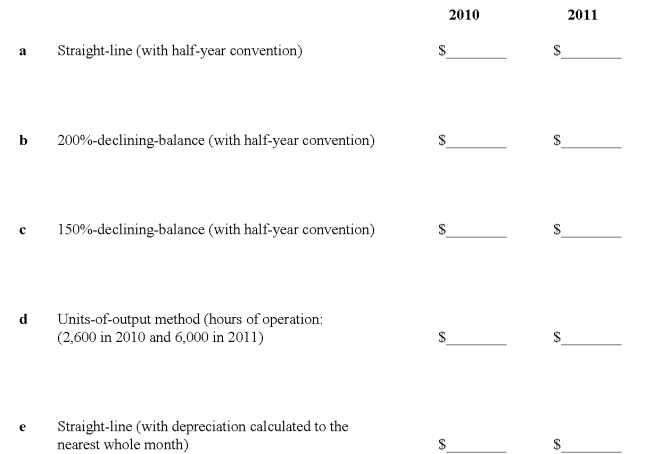
(71) On April 8, 2010, Dreamland Park purchased a ferris wheel for $300,000. The estimated life of the ferris wheel was 10 years, with an estimated residual value of $60,000. The service life in terms of output is estimated at 30,000 hours of operation.
Compute the depreciation on this ferris wheel in 2010 and 2011 using the following methods.
-
(Essay)
4.7/5 (69)
(69) Various depreciation methods-first year
On September 5, 2009, Apollo purchased equipment costing $40,000, with an estimated life of 6 years and an estimated salvage value of $4,000.
Compute the depreciation expense Apollo would recognize on this equipment in 2009, assuming:
(a) Straight-line depreciation with fractional periods rounded to the nearest full month \_ (b) 200\% -declining-balance, using the half-year convention \_ (c) 150\% -declining-balance with fractional periods rounded to the nearest full month \_
(Essay)
4.8/5 (60)
(60) Land is purchased for $256,000. Additional costs include a $15,300 fee to a broker, a survey fee of $2,400, $1,750 to construct a fence, and a legal fee of $8,500. What is the cost of the land?
(Multiple Choice)
4.8/5 (70)
(70) An asset which costs $18,800 and has accumulated depreciation of $6,000 is sold for $11,600. What amount of gain or loss will be recognized when the asset is sold?
(Multiple Choice)
4.8/5 (79)
(79) 
Filters
- Essay(0)
- Multiple Choice(0)
- Short Answer(0)
- True False(0)
- Matching(0)