



 Chat with AI
Exam 9: Plant and Intangible Assets

Exam 1: Accounting: Information for Decision Making135 Questions
Exam 2: Basic Financial Statements158 Questions
Exam 3: The Accounting Cycle: Capturing Economic Events161 Questions
Exam 4: The Accounting Cycle: Accruals and Deferrals160 Questions
Exam 5: The Accounting Cycle: Reporting Financial Results136 Questions
Exam 6: Merchandising Activities144 Questions
Exam 7: Financial Assets233 Questions
Exam 8: Inventories and the Cost of Goods Sold169 Questions
Exam 9: Plant and Intangible Assets154 Questions
Exam 10: Liabilities221 Questions
Exam 11: Stockholders Equity: Paid-In Capital166 Questions
Exam 12: Income and Changes in Retained Earnings153 Questions
Exam 13: Statement of Cash Flows181 Questions
Exam 14: Financial Statement Analysis165 Questions
Exam 15: Global Business and Accounting95 Questions
Exam 16: Management Accounting: a Business Partner124 Questions
Exam 17: Job Order Cost Systems and Overhead Allocations116 Questions
Exam 18: Process Costing103 Questions
Exam 19: Costing and the Value Chain89 Questions
Exam 20: Cost-Volume-Profit Analysis147 Questions
Exam 21: Incremental Analysis119 Questions
Exam 22: Responsibility Accounting and Transfer Pricing108 Questions
Exam 23: Operational Budgeting115 Questions
Exam 24: Standard Cost Systems130 Questions
Exam 25: Rewarding Business Performance71 Questions
Exam 26: Capital Budgeting125 Questions
Exam 28: Forms of Business Organization52 Questions
Exam 27: The Time Value of Money: Future Amounts and Present Values Answer Key49 Questions
Select questions type


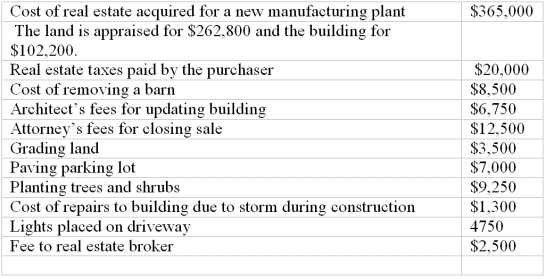
The following expenditures are related to land, land improvements, and buildings, which were acquired on November 1, 2009.
 Required:
Determine the cost of the land, the building and the improvements (Round to the nearest dollar)
Prepare journal entries on December 31, 2009 for depreciation assuming the building will have a useful life of 20 years and no residual value. Use double declining balance method and the half-year convention. Depreciate the land improvements using straight-line method, a 5 year life, to the nearest month with zero residual value (to the nearest dollar).
Required:
Determine the cost of the land, the building and the improvements (Round to the nearest dollar)
Prepare journal entries on December 31, 2009 for depreciation assuming the building will have a useful life of 20 years and no residual value. Use double declining balance method and the half-year convention. Depreciate the land improvements using straight-line method, a 5 year life, to the nearest month with zero residual value (to the nearest dollar). (Essay)
4.9/5  (89)
(89) Straight-line is the most widely used depreciation method in financial statements, and MACRS is the most widely used method in federal income tax returns.
(True/False)
4.9/5 (83)
(83) Under the half-year convention, six months' depreciation is recorded on an asset in the year of acquisition and in the year of retirement regardless of the month in which the asset is actually purchased or retired.
(True/False)
4.9/5 (83)
(83) In which of the following situations should the named company not record any depreciation expense on the asset described?
(Multiple Choice)
4.8/5 (83)
(83) Revenue expenditures are a part of selling and administrative expenses.
(True/False)
4.9/5 (74)
(74) Early in the current year, Tokay Co. purchased the Silverton Mine at a cost of $20,000,000. The mine was estimated to contain 200,000 tons of ore and to have a residual value of $5,000,000 after mining operations are completed. During the year, 105,000 tons of ore were removed from the mine. At year-end, the book value of the mine (cost minus accumulated depletion) is:
(Multiple Choice)
4.8/5 (86)
(86) Refer to the information above. Assume that in its financial statements, Tilton Products uses the 150%-declining-balance method and the half-year convention. Depreciation expense in 2009 and 2010 will be:
(Multiple Choice)
4.9/5 (74)
(74) Annual depreciation expense is increased when salvage values are small.
(True/False)
4.8/5 (77)
(77) The application of the matching principle to depreciation of plant and equipment can best be described as:
(Multiple Choice)
4.9/5 (91)
(91) Incidental costs incurred in the purchase of land that are charged to Land Improvements will affect net income at some future time.
(True/False)
4.8/5 (90)
(90) In its financial statements, Shoreham uses straight-line depreciation with the half-year convention. The book value of the equipment at December 31, 2009, will be:
(Multiple Choice)
4.8/5 (74)
(74) The book value of an asset in the plant and equipment category is:
(Multiple Choice)
5.0/5 (84)
(84) On March 2, 2009, Glen Industries purchased a fleet of automobiles at a cost of $550,000. The cars are to be depreciated by the straight-line method over five years with no salvage value. Glen uses the half-year convention to compute depreciation for fractional periods. The book value of the fleet of automobiles at December 31, 2010, will be:
(Multiple Choice)
4.8/5 (87)
(87) Depreciation; gains and losses in financial statements
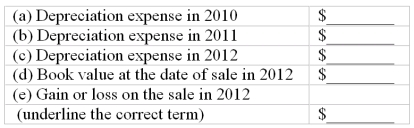
In 2010, Amalfi, Inc. purchased equipment with an estimated 10-year life for $42,600. The residual value was estimated at $9,900. Amalfi uses straight-line depreciation and applies the half-year convention.
On April 18, 2012, Amalfi closed one of its plants and sold this equipment for $33,600. Under these assumptions, compute the following for this equipment:
(Essay)
5.0/5 (90)
(90) The half-year convention allows us to take six months depreciation during the first year of an asset's life even if the asset was purchased on January 25th.
(True/False)
4.9/5 (82)
(82) Refer to the information above. Assume that in its financial statements, Tilton Products uses straight-line depreciation and rounds depreciation for fractional years to the nearest month. Depreciation expense recognized on this machinery in 2009 and 2010 will be:
(Multiple Choice)
4.8/5 (70)
(70) It is an acceptable accounting practice to treat an expenditure that is not material in dollar amount as an expense of the current period even though the expenditure may benefit several periods.
(True/False)
4.8/5 (83)
(83) 
Filters
- Essay(0)
- Multiple Choice(0)
- Short Answer(0)
- True False(0)
- Matching(0)