



 Chat with AI
Exam 24: Standard Cost Systems

Exam 1: Accounting: Information for Decision Making135 Questions
Exam 2: Basic Financial Statements158 Questions
Exam 3: The Accounting Cycle: Capturing Economic Events161 Questions
Exam 4: The Accounting Cycle: Accruals and Deferrals160 Questions
Exam 5: The Accounting Cycle: Reporting Financial Results136 Questions
Exam 6: Merchandising Activities144 Questions
Exam 7: Financial Assets233 Questions
Exam 8: Inventories and the Cost of Goods Sold169 Questions
Exam 9: Plant and Intangible Assets154 Questions
Exam 10: Liabilities221 Questions
Exam 11: Stockholders Equity: Paid-In Capital166 Questions
Exam 12: Income and Changes in Retained Earnings153 Questions
Exam 13: Statement of Cash Flows181 Questions
Exam 14: Financial Statement Analysis165 Questions
Exam 15: Global Business and Accounting95 Questions
Exam 16: Management Accounting: a Business Partner124 Questions
Exam 17: Job Order Cost Systems and Overhead Allocations116 Questions
Exam 18: Process Costing103 Questions
Exam 19: Costing and the Value Chain89 Questions
Exam 20: Cost-Volume-Profit Analysis147 Questions
Exam 21: Incremental Analysis119 Questions
Exam 22: Responsibility Accounting and Transfer Pricing108 Questions
Exam 23: Operational Budgeting115 Questions
Exam 24: Standard Cost Systems130 Questions
Exam 25: Rewarding Business Performance71 Questions
Exam 26: Capital Budgeting125 Questions
Exam 28: Forms of Business Organization52 Questions
Exam 27: The Time Value of Money: Future Amounts and Present Values Answer Key49 Questions
Select questions type


Volume variances
Consider the following statement: "No manager should be held responsible for a volume variance." Briefly explain why a volume variance should not be investigated and viewed as the responsibility of some manager in an organization.

Free
(Essay)
4.8/5  (86)
(86) Correct Answer: Verified
As long as the production departments of an organization are producing the desired number of units, the volume variance does not indicate either efficient or inefficient production. The volume variance arises from fluctuations in the level of production from month to month. Such fluctuations may occur for a variety of reasons such as seasonal demand, scheduled vacation time, etc. Unless the producing departments fail to produce the scheduled number of units, no manager should be viewed as responsible for the volume variance.
Which of the following is not an advantage of using a standard cost system?
Free
(Multiple Choice)
4.8/5 (83)
(83) Correct Answer:Verified
VerifiedA
Standard cost system-overhead variances
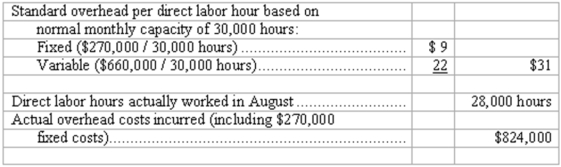
Assume the following data for John Company's August operations.
(a) Compute the amount of overhead applied to Work-in-Process during August. $________________
(b) Compute the total manufacturing overhead budgeted based on hours worked during August. $________________
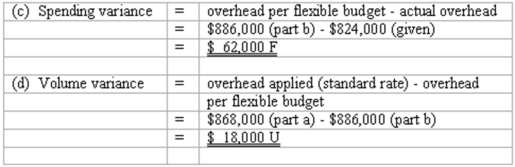
(c) Compute the overhead spending variance for August. Indicate whether favorable (F) or unfavorable (U). $________________
(d) Compute the overhead volume variance for August. Indicate whether favorable (F) or unfavorable (U). $________________
Free
(Essay)
4.9/5 (70)
(70) Correct Answer:Verified
Verified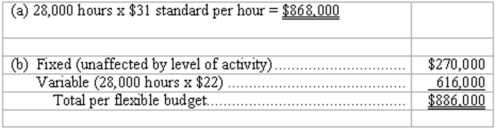
The labor rate variance is determined by multiplying the difference between the actual labor rate and the standard labor rate by:
(Multiple Choice)
4.7/5 (75)
(75) If the actual number of direct labor hours used exceeds the standard direct labor hours allowed, this indicates:
(Multiple Choice)
4.9/5 (80)
(80) The use of excessive quantities of material in manufacturing a product causes an unfavorable materials quantity variance.
(True/False)
4.9/5 (80)
(80) Standard costs are established only for direct labor and direct materials.
(True/False)
4.7/5 (84)
(84) Standard cost system labor variance
The following computations of March labor variances for Sam's Supply Company are incomplete. The missing items are labeled (a) through (d).
Labor rate variance = 4,800 hours x [(a) - $8.50] = $350 favorable
Labor efficiency variance = (b) x [(c) - 5,000 hours] = $(d)
On the appropriately labeled line, identify each missing item by name (a through c) and show the missing value (a through d). Show supporting computations in the space provided.
(a) _________________________ $________________
(b) _________________________ $________________
(c) _________________________ ____________________ hours
(d) $_______________ F or U (Circle the correct term.)
(e) During March, the supervisor left for vacation without arranging for a replacement. Which variances would have been most affected by this situation? _________________________ Computations
(Essay)
4.9/5 (82)
(82) Excessive overtime hours worked by direct labor workers often results in:
(Multiple Choice)
4.9/5 (75)
(75) A favorable variance would be credited to a cost variance account.
(True/False)
4.9/5 (83)
(83) If fewer units are produced than had been estimated when standard unit costs were determined, there would normally be:
(Multiple Choice)
4.7/5 (69)
(69) A standard cost is predetermined, that is, determined before actual costs of the current period have been computed.
(True/False)
4.9/5 (75)
(75) If the standard quantity of materials is 84,500 units @ $0.15 per unit and the actual quantity is 95,000 units @ $0.12 per unit, then the materials price variance is:
(Multiple Choice)
4.9/5 (80)
(80) An unfavorable labor rate variance could most likely result from all of the following except:
(Multiple Choice)
4.9/5 (80)
(80) Which of the following is the most likely explanation for the types of labor variances resulting from Roman's July operations?
(Multiple Choice)
4.9/5 (77)
(77) A labor efficiency (usage) variance is most likely to occur if:
(Multiple Choice)
4.8/5 (69)
(69) Using more direct labor hours for units produced than the amount allowed by the standard results in:
(Multiple Choice)
4.9/5 (65)
(65) The journal entry to record direct labor costs relating to work performed in April includes:
(Multiple Choice)
4.7/5 (74)
(74) 
Filters
- Essay(0)
- Multiple Choice(0)
- Short Answer(0)
- True False(0)
- Matching(0)