



 Chat with AI
Exam 4: The Accounting Cycle: Accruals and Deferrals

Exam 1: Accounting: Information for Decision Making135 Questions
Exam 2: Basic Financial Statements158 Questions
Exam 3: The Accounting Cycle: Capturing Economic Events161 Questions
Exam 4: The Accounting Cycle: Accruals and Deferrals160 Questions
Exam 5: The Accounting Cycle: Reporting Financial Results136 Questions
Exam 6: Merchandising Activities144 Questions
Exam 7: Financial Assets233 Questions
Exam 8: Inventories and the Cost of Goods Sold169 Questions
Exam 9: Plant and Intangible Assets154 Questions
Exam 10: Liabilities221 Questions
Exam 11: Stockholders Equity: Paid-In Capital166 Questions
Exam 12: Income and Changes in Retained Earnings153 Questions
Exam 13: Statement of Cash Flows181 Questions
Exam 14: Financial Statement Analysis165 Questions
Exam 15: Global Business and Accounting95 Questions
Exam 16: Management Accounting: a Business Partner124 Questions
Exam 17: Job Order Cost Systems and Overhead Allocations116 Questions
Exam 18: Process Costing103 Questions
Exam 19: Costing and the Value Chain89 Questions
Exam 20: Cost-Volume-Profit Analysis147 Questions
Exam 21: Incremental Analysis119 Questions
Exam 22: Responsibility Accounting and Transfer Pricing108 Questions
Exam 23: Operational Budgeting115 Questions
Exam 24: Standard Cost Systems130 Questions
Exam 25: Rewarding Business Performance71 Questions
Exam 26: Capital Budgeting125 Questions
Exam 28: Forms of Business Organization52 Questions
Exam 27: The Time Value of Money: Future Amounts and Present Values Answer Key49 Questions
Select questions type


The book value of an asset may also be called the market value of the asset.

Free
(True/False)
4.9/5  (87)
(87) Correct Answer: Verified
False
Materiality is a matter of professional judgment.
Free
(True/False)
5.0/5 (80)
(80) Correct Answer:Verified
VerifiedTrue
An adjusting entry involving recognition of accrued revenue is necessary at the end of March in which of the following situations?
Free
(Multiple Choice)
4.8/5 (77)
(77) Correct Answer:Verified
VerifiedB
Materiality
(A.) Identify several factors considered by an accountant in deciding whether an item is "material."
(B.) Does the concept of materiality complicate or simplify the process of making adjusting entries? Give an illustration to support your answer.
(Essay)
4.9/5 (81)
(81) Under accrual accounting, salaries earned by employees but not yet paid should be expensed:
(Multiple Choice)
4.9/5 (90)
(90) At January 31, the amount of supplies still on hand was determined to be $675. What amount should be reported in the January income statement for supplies expense? $__________
(Short Answer)
4.8/5 (67)
(67) How much depreciation expense should be recognized for December?
(Multiple Choice)
4.9/5 (77)
(77) Failure to make the appropriate adjustment to the Salary Expense account will:
(Multiple Choice)
4.8/5 (80)
(80) On December 31, Louis Jeweler's made an adjusting entry to record $4,200 accrued interest payable on its mortgage. On January 10, the mortgage payment was made. This payment included interest charges of $6,300, $2,100 of which were applicable to the period from January 1 through January 10. When recording this mortgage payment, the accountant should:
(Multiple Choice)
4.9/5 (78)
(78) Which of the following accounting principles is concerned with offsetting revenue with the expenses incurred in producing that revenue?
(Multiple Choice)
4.7/5 (78)
(78) Which of the following would not be a proper application of the concept of materiality by Millridge Corporation?
(Multiple Choice)
4.8/5 (75)
(75) The CPA firm auditing Indian Company found that net income had been overstated. Which of the following errors could be the cause?
(Multiple Choice)
4.9/5 (95)
(95) Adjusting entries-effect on elements of financial statements
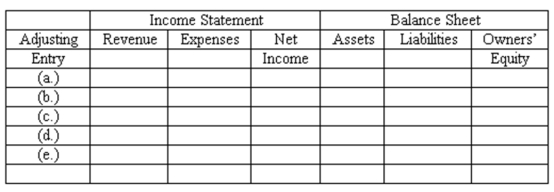
Galaxy Entertainment prepares monthly financial statements. On July 31, the accountant made adjusting entries to record:
(A.) Depreciation for the month of July.
(B.) The portion of prepaid rent for outdoor stage and seating which had expired in July.
(C.) Earning of ticket revenue for July which had been subscribed in advance. (When patrons purchase the Summer Jazz Series tickets in advance, the accountant credits Unearned Ticket Revenue.)
(D.) Amount owed to Universal from the caterer who sold food and beverages during the July performances. The amount due will be paid to the company on August 8.
(E.) Amount owed to the musicians which had accrued since the last pay day in July.
Indicate the effect of each of these adjusting entries on the major elements of the company's financial statements-that is, on revenue, expenses, net income, assets, liabilities, and owners' equity. Organize your answer in tabular form, using the column headings shown below and the symbols + for increase, - for decrease, and NE for no effect.
(Essay)
5.0/5 (83)
(83) Adjusting entries-effect on elements of financial statements
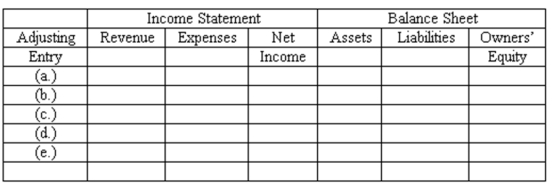
Whoop-It-Up, Inc. prepares monthly financial statements. On March 31, the company's accountant made adjusting entries to record:
(A) Depreciation for the month of March.
(B) Amount owed to Whoop-It-Up, Inc for March from the concessionaire operating a juice bar in the facility. The amount due will be remitted to Whoop-It-Up, Inc during the first week in April.
(C) Cost of supplies used in March. (When purchased, the cost of supplies is debited to an asset account.)
(D) Earning of a portion of annual membership fees which had been collected in advance. (When customers purchase annual memberships, an Unearned Revenue account is credited.)
(E) Accrued interest for March owed on a bank loan obtained March 1. No interest expense has yet been recorded.
Indicate the effect of each of these adjusting entries on the major elements of the company's financial statements-that is, on revenue, expenses, net income, assets, liabilities, and owner's equity. Organize your answer in tabular form, using the column headings shown below and the symbols + for increase, - for decrease, and NE for no effect.
(Essay)
4.9/5 (73)
(73) If an asset was purchased on January 1, 2006 for $140,000 with an estimated life of 5 years, what is the accumulated depreciation at December 31, 2009?
(Multiple Choice)
4.7/5 (87)
(87) Before month-end adjustments are made, the January 31 trial balance of Rover Excursions contains revenue of $27,900 and expenses of $17,340. Adjustments are necessary for the following items: Portion of prepaid rent applicable to January: $2,700.
Depreciation for January: $1,440.
Portion of fees collected in advance earned in January: $3,300.
Fees earned in January; not yet billed to customers: $1,950.
Net income for January is:
(Multiple Choice)
4.8/5 (76)
(76) 
Filters
- Essay(0)
- Multiple Choice(0)
- Short Answer(0)
- True False(0)
- Matching(0)