



 Chat with AI
Exam 7: Financial Assets

Exam 1: Accounting: Information for Decision Making135 Questions
Exam 2: Basic Financial Statements158 Questions
Exam 3: The Accounting Cycle: Capturing Economic Events161 Questions
Exam 4: The Accounting Cycle: Accruals and Deferrals160 Questions
Exam 5: The Accounting Cycle: Reporting Financial Results136 Questions
Exam 6: Merchandising Activities144 Questions
Exam 7: Financial Assets233 Questions
Exam 8: Inventories and the Cost of Goods Sold169 Questions
Exam 9: Plant and Intangible Assets154 Questions
Exam 10: Liabilities221 Questions
Exam 11: Stockholders Equity: Paid-In Capital166 Questions
Exam 12: Income and Changes in Retained Earnings153 Questions
Exam 13: Statement of Cash Flows181 Questions
Exam 14: Financial Statement Analysis165 Questions
Exam 15: Global Business and Accounting95 Questions
Exam 16: Management Accounting: a Business Partner124 Questions
Exam 17: Job Order Cost Systems and Overhead Allocations116 Questions
Exam 18: Process Costing103 Questions
Exam 19: Costing and the Value Chain89 Questions
Exam 20: Cost-Volume-Profit Analysis147 Questions
Exam 21: Incremental Analysis119 Questions
Exam 22: Responsibility Accounting and Transfer Pricing108 Questions
Exam 23: Operational Budgeting115 Questions
Exam 24: Standard Cost Systems130 Questions
Exam 25: Rewarding Business Performance71 Questions
Exam 26: Capital Budgeting125 Questions
Exam 28: Forms of Business Organization52 Questions
Exam 27: The Time Value of Money: Future Amounts and Present Values Answer Key49 Questions
Select questions type


Marketable securities are classified into three types; which one is not one of the three types?
(Multiple Choice)
4.8/5  (70)
(70) A good system of internal control will include all of the following except:
(Multiple Choice)
5.0/5 (84)
(84) Which of the following items is reported in neither the income statement nor the statement of cash flows?
(Multiple Choice)
5.0/5 (80)
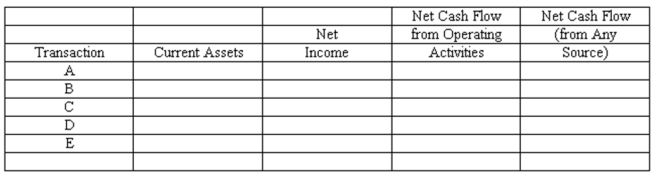
(80) Financial assets-effects of transactions
Five events involving financial assets are described below:
(a.) Sold merchandise on account.
(b.) Sold available-for-sale marketable securities at a gain. Cash proceeds from the sale were equal to the current market value of the securities reflected in the last balance sheet.
(c.) Collected an account receivable.
(d.) Adjusted the allowance for doubtful accounts to reflect the portion of accounts receivable estimated to be uncollectible at year-end.
(e.) Made mark-to-market adjustment reducing the balance in the available-for-sale marketable securities account to reflect a decrease in the market value of securities owned.
Indicate the effects of each independent transaction or adjusting entry upon the financial measurements shown in the four column headings below. Use the code letters, I for increase, D for decrease, and NE for no effect.
(Essay)
4.7/5 (88)
(88) The balance shown on a bank statement is always less than the month-end balance of a company's cash account in the general ledger.
(True/False)
4.8/5 (75)
(75) Kennedy Company uses the balance sheet approach in estimating uncollectible accounts expense. The company prepares an adjusting entry to recognize this expense at the end of each month. During the month of July, the company wrote-off a $3,500 receivable and made no recoveries of previous write-offs. Following the adjusting entry for July, the credit balance in the Allowance for Doubtful Accounts was $3,000 larger than it was on July 1. What amount of uncollectible account expense was recorded for July?
(Multiple Choice)
4.9/5 (78)
(78) Under the allowance method, when a receivable that had been previously written off is collected:
(Multiple Choice)
4.8/5 (92)
(92) In order for a company's accounting records to be up-to-date and accurate after a bank reconciliation has been completed, journal entries should be made for any service charges by the bank and for deposits-in-transit.
(True/False)
4.8/5 (88)
(88) If a 15%, 60-day note receivable is acquired from a customer in settlement of an existing account receivable of $5,000, the accounting entry for acquisition of the note will:
(Multiple Choice)
4.8/5 (76)
(76) A company with more than one bank checking account should show more than one account for Cash in its balance sheet.
(True/False)
4.7/5 (74)
(74) Gains (or losses) on sales of marketable securities, as well as any unrealized holding gains (or losses) on investments in available for sale securities, are reported in the income statement.
(True/False)
4.8/5 (83)
(83) Deegan Industries has an accounts receivable turnover rate of 8. Which of the following statements is not true?
(Multiple Choice)
4.8/5 (89)
(89) U.S. Treasury bills that mature within six months are cash equivalents.
(True/False)
4.9/5 (90)
(90) Assuming Neptune does not sell this investment, the financial statements prepared at December 31, 2011 will report:
(Multiple Choice)
4.8/5 (72)
(72) Cardinal Company's bank statement showed a balance at May 31 of $180,974. The only reconciling items consisted of a large number of outstanding checks totaling $51,847. At May 31, what balance should Cardinal's Cash account show?
(Multiple Choice)
4.8/5 (90)
(90) Deposits-in-transit would not appear on a company's bank reconciliation but would appear on the company's bank statement.
(True/False)
5.0/5 (71)
(71) The direct write-off method is more conservative than the allowance method for valuation of receivables.
(True/False)
4.9/5 (82)
(82) 
Filters
- Essay(0)
- Multiple Choice(0)
- Short Answer(0)
- True False(0)
- Matching(0)