



 Chat with AI
Exam 11: Acute Leukemias

Exam 1: Introduction to Hematology and Basic Laboratory Practice20 Questions
Exam 2: From Hematopoiesis to the Complete Blood Count20 Questions
Exam 3: Red Blood Cell Production, Function, and Relevant Red Blood Cell Morphology24 Questions
Exam 4: Hemoglobin Function and Principles of Hemolysis20 Questions
Exam 5: The Microcytic Anemias26 Questions
Exam 6: The Macrocytic Anemias17 Questions
Exam 7: Normochromic Anemias: Biochemical, Membrane, and Miscellaneous Red Blood Cell Disorders20 Questions
Exam 8: The Normochromic Anemias Caused by Hemoglobinopathies23 Questions
Exam 9: Leukopoiesis and Leukopoietic Function20 Questions
Exam 10: Abnormalities of White Blood Cells: Quantitative, Qualitative, and the Lipid Storage Diseases20 Questions
Exam 11: Acute Leukemias25 Questions
Exam 12: Chronic Myeloproliferative Disorders24 Questions
Exam 13: Lymphoproliferative Disorders and Related Plasma Cell Disorders20 Questions
Exam 14: The Myelodysplastic Syndromes20 Questions
Exam 15: Overview of Hemostasis and Platelet Physiology30 Questions
Exam 16: Quantitative and Qualitative Platelet Disorders25 Questions
Exam 17: Defects of Plasma Clotting Factors20 Questions
Exam 18: Fibrinogen, Thrombin, and the Fibrinolytic System20 Questions
Exam 19: Introduction to Thrombosis and Anticoagulant Therapy20 Questions
Select questions type


The WBC count is 20 109/L, with 89% blasts, 7% segs, and 4% monos.The blasts are relatively large and have abundant cytoplasm.More than 90% of them are positive with the NSE stain, and an occasional blast is positive with Sudan Black B.What is the possible diagnosis?
(Multiple Choice)
4.7/5  (82)
(82) The basic pathophysiology mechanism responsible for producing signs and symptoms in leukemia includes all of the following except:
(Multiple Choice)
4.8/5 (75)
(75) The leukemia with a predominance of WBC cells positive for CD41 is:
(Multiple Choice)
4.7/5 (89)
(89) 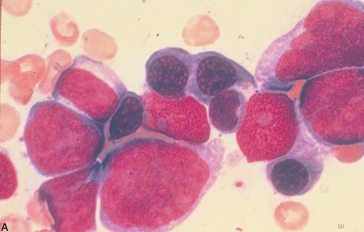 -The cells pictured above are most consistent with:

Filters
- Essay(0)
- Multiple Choice(0)
- Short Answer(0)
- True False(0)
- Matching(0)