



 Chat with AI
Exam 13: Lymphoproliferative Disorders and Related Plasma Cell Disorders

Exam 1: Introduction to Hematology and Basic Laboratory Practice20 Questions
Exam 2: From Hematopoiesis to the Complete Blood Count20 Questions
Exam 3: Red Blood Cell Production, Function, and Relevant Red Blood Cell Morphology24 Questions
Exam 4: Hemoglobin Function and Principles of Hemolysis20 Questions
Exam 5: The Microcytic Anemias26 Questions
Exam 6: The Macrocytic Anemias17 Questions
Exam 7: Normochromic Anemias: Biochemical, Membrane, and Miscellaneous Red Blood Cell Disorders20 Questions
Exam 8: The Normochromic Anemias Caused by Hemoglobinopathies23 Questions
Exam 9: Leukopoiesis and Leukopoietic Function20 Questions
Exam 10: Abnormalities of White Blood Cells: Quantitative, Qualitative, and the Lipid Storage Diseases20 Questions
Exam 11: Acute Leukemias25 Questions
Exam 12: Chronic Myeloproliferative Disorders24 Questions
Exam 13: Lymphoproliferative Disorders and Related Plasma Cell Disorders20 Questions
Exam 14: The Myelodysplastic Syndromes20 Questions
Exam 15: Overview of Hemostasis and Platelet Physiology30 Questions
Exam 16: Quantitative and Qualitative Platelet Disorders25 Questions
Exam 17: Defects of Plasma Clotting Factors20 Questions
Exam 18: Fibrinogen, Thrombin, and the Fibrinolytic System20 Questions
Exam 19: Introduction to Thrombosis and Anticoagulant Therapy20 Questions
Select questions type


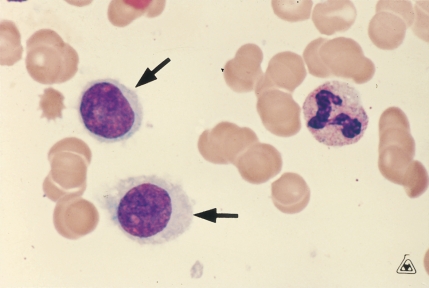 -The cells at the tip of the pointer are most frequently associated with:
Free
(Multiple Choice)
4.7/5  (73)
(73) Correct Answer: Verified
B
The most characteristic change seen in the peripheral smear of a patient with multiple myeloma is the presence of:
Free
(Multiple Choice)
5.0/5 (80)
(80) Correct Answer:Verified
VerifiedC
An increase in plasma cells can be seen in all the following except:
Free
(Multiple Choice)
4.8/5 (75)
(75) Correct Answer:Verified
VerifiedD
A new treatment for multiple myeloma that was once banned from use in pregnant women is:
(Multiple Choice)
4.8/5 (80)
(80) The CD markers associated with CLL include all of the following except:
(Multiple Choice)
4.7/5 (68)
(68) An abnormal proliferation of dysfunctional B lymphocytes is commonly associated with:
(Multiple Choice)
4.9/5 (78)
(78) Which of the following genetic alterations is associated with a poor prognosis in CLL?
(Multiple Choice)
4.9/5 (70)
(70) The immunoglobulin responsible for secondary immunological response is:
(Multiple Choice)
4.7/5 (80)
(80) Which of the following statements about Hodgkin's disease is false?
(Multiple Choice)
4.9/5 (78)
(78) Hypogammaglobulinemia is a significant feature in half of patients with CLL.This complication can lead to:
(Multiple Choice)
4.9/5 (72)
(72) 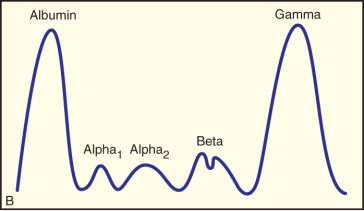 -The protein electrophoresis pattern pictured above is most frequently associated with:
 (Multiple Choice)
4.9/5 (83)
(83) All of the following are consistent with the clinical and pathological picture of Waldenström's macroglobulinemia except:
(Multiple Choice)
4.8/5 (77)
(77) A peripheral blood picture dominated by cells that appear convoluted with an ovoid nucleus and clefting would most likely be seen in:
(Multiple Choice)
4.9/5 (81)
(81) 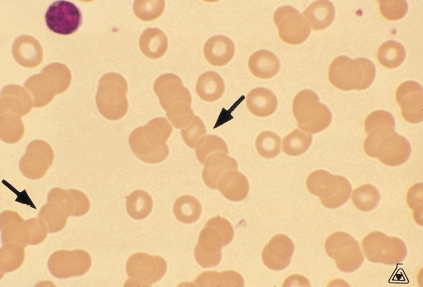 -The phenomenon pictured above is known as rouleaux and is frequently associated with:
 (Multiple Choice)
4.9/5 (82)
(82) A significant feature of hairy cell leukemia not seen is other acute leukemias is:
(Multiple Choice)
4.8/5 (67)
(67) All of the following are related to the pathophysiology of multiple myeloma except:
(Multiple Choice)
4.9/5 (76)
(76) 
Filters
- Essay(0)
- Multiple Choice(0)
- Short Answer(0)
- True False(0)
- Matching(0)