



 Chat with AI
Exam 25: Taxation of International Transactions

Exam 1: An Introduction to Taxation and Understanding the Federal Tax Law211 Questions
Exam 2: Working with the Tax Law102 Questions
Exam 3: Computing the Tax180 Questions
Exam 4: Gross Income: Concepts and Inclusions125 Questions
Exam 5: Gross Income: Exclusions113 Questions
Exam 6: Deductions and Losses: In General156 Questions
Exam 7: Deductions and Losses: Certain Business Expenses and Losses94 Questions
Exam 8: Depreciation, Cost Recovery, Amortization, and Depletion120 Questions
Exam 9: Deductions: Employee and Self-Employed-Related Expenses153 Questions
Exam 10: Deductions and Losses: Certain Itemized Deductions104 Questions
Exam 11: Investor Losses130 Questions
Exam 12: Tax Credits and Payments111 Questions
Exam 13: Property Transactions: Determination of Gain or Loss, Basis Considerations, and Nontaxable Exchanges285 Questions
Exam 14: Property Transactions: Capital Gains and Losses, Section 1231, and Recapture Provisions167 Questions
Exam 15: Taxing Business Income60 Questions
Exam 16: Accounting Periods and Methods88 Questions
Exam 17: Corporations: Introduction and Operating Rules108 Questions
Exam 18: Corporations: Organization and Capital Structure109 Questions
Exam 19: Corporations: Distributions Not in Complete Liquidation185 Questions
Exam 20: Corporations: Distributions in Complete Liquidation and an Overview of Reorganizations71 Questions
Exam 21: Partnerships248 Questions
Exam 22: S Corporations129 Questions
Exam 23: Exempt Entities153 Questions
Exam 24: Multistate Corporate Taxation204 Questions
Exam 25: Taxation of International Transactions146 Questions
Exam 26: Tax Practice and Ethics184 Questions
Exam 27: The Federal Gift and Estate Taxes141 Questions
Exam 28: Income Taxation of Trusts and Estates161 Questions
Select questions type


Jokerz, a CFC of a U.S. parent, generated $80,000 Subpart F foreign base company services income in its first year of operations. The next year, Jokerz distributes $50,000 cash to the parent, from those service profits. The parent is taxed on $0 in the first year (tax deferral rules apply) and $50,000 in the second year.
(True/False)
4.8/5  (77)
(77) Match the definition with the correct term. Not all of the terms have a match. A definition can be used more than once.
a. Foreign base company income
b. Foreign personal holding company income
c. Controlled foreign corporation
d. U.S. shareholder
e. Previously taxed income
f. More than 10 percent
g. More than 50 percent
h. More than 80 percent
-Portfolio income treated as Subpart F income.
(Short Answer)
4.7/5 (80)
(80) AirCo, a domestic corporation, purchases inventory for resale from unrelated distributors within the United States and resells this inventory to customers outside the United States, with title passing outside the United States. What is the sourcing of AirCo's inventory sales income?
(Multiple Choice)
4.8/5 (87)
(87) Match the definition with the correct term.
a. Inbound
b. Outbound
c. Allocation and apportionment
d. Qualified business unit
e. Tax haven
f. Income tax treaty
g. Section 482
-Method for sourcing income and deductions.
(Short Answer)
4.9/5 (79)
(79) The transfer of the assets of a U.S. corporation's foreign branch to a newly formed foreign corporation is always tax deferred under § 351.
(True/False)
4.7/5 (84)
(84) Without the foreign tax credit, double taxation would result when:
(Multiple Choice)
4.8/5 (71)
(71) Dark, Inc., a U.S. corporation, operates Dunkel, an unincorporated branch manufacturing operation in Germany. Dark reports $100,000 of taxable income from Dunkel on its U.S. tax return, along with $400,000 of taxable income from its U.S. operations. Dark paid $30,000 in German income taxes related to the $100,000 of Dunkel income. Assuming a U.S. tax rate of 21%, what is Dark's U.S. tax liability after any allowable foreign tax credits?
(Multiple Choice)
4.9/5 (92)
(92) Which of the following situations requires the filing of an information return with the U.S. government?
(Multiple Choice)
4.9/5 (83)
(83) Which of the following statements regarding foreign persons not engaged in a U.S. trade or business is true?
(Multiple Choice)
4.8/5 (65)
(65) Yvonne is a citizen of France and does not have permanent resident status in the United States. During the last three years she has spent a number of days in the United States. Current year - 150 days First prior year - 150 days Second prior year - 90 days
Is Yvonne treated as a U.S. resident for the current year?
(Multiple Choice)
4.8/5 (83)
(83) A domestic corporation is one whose assets are primarily located in the U.S. For this purpose, the primarily located test (greater than 50%) applies.
(True/False)
4.8/5 (75)
(75) Which of the following determinations requires knowing the amount of one's foreign-source gross income?
(Multiple Choice)
4.7/5 (77)
(77) A deferral of Federal corporate income taxes by a multinational taxpayer is possible by using:
(Multiple Choice)
4.8/5 (79)
(79) Match the definition with the correct term.
a. Expatriate
b. Resident
c. Nonresident alien
d. U.S. trade or business
e. Branch profits tax
f. Effectively connected income
-Individual who is not a U.S. citizen or resident.
(Short Answer)
4.9/5 (78)
(78) Goolsbee, Inc., a U.S. corporation, generates U.S.-source and foreign-source gross income. Goolsbee's assets (tax basis) are as follows.
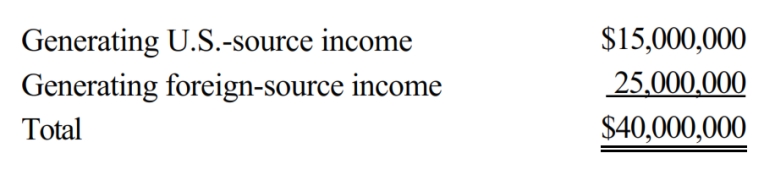 Goolsbee incurs interest expense of $200,000. Apportion interest expense to foreign-source income.
 (Essay)
4.8/5 (88)
(88) In working with the foreign tax credit, a U.S. corporation may be able to alleviate the problem of excess foreign taxes by:
(Multiple Choice)
4.9/5 (67)
(67) ForCo, a foreign corporation, receives interest income of $50,000 from USCo, an unrelated domestic corporation. USCo historically has earned 79% of its gross income from active foreign-source business income. What amount of ForCo's interest income is U.S.-source?
(Multiple Choice)
4.8/5 (69)
(69) 
Filters
- Essay(0)
- Multiple Choice(0)
- Short Answer(0)
- True False(0)
- Matching(0)