



 Chat with AI
Exam 22: S Corporations

Exam 1: An Introduction to Taxation and Understanding the Federal Tax Law211 Questions
Exam 2: Working with the Tax Law102 Questions
Exam 3: Computing the Tax180 Questions
Exam 4: Gross Income: Concepts and Inclusions125 Questions
Exam 5: Gross Income: Exclusions113 Questions
Exam 6: Deductions and Losses: In General156 Questions
Exam 7: Deductions and Losses: Certain Business Expenses and Losses94 Questions
Exam 8: Depreciation, Cost Recovery, Amortization, and Depletion120 Questions
Exam 9: Deductions: Employee and Self-Employed-Related Expenses153 Questions
Exam 10: Deductions and Losses: Certain Itemized Deductions104 Questions
Exam 11: Investor Losses130 Questions
Exam 12: Tax Credits and Payments111 Questions
Exam 13: Property Transactions: Determination of Gain or Loss, Basis Considerations, and Nontaxable Exchanges285 Questions
Exam 14: Property Transactions: Capital Gains and Losses, Section 1231, and Recapture Provisions167 Questions
Exam 15: Taxing Business Income60 Questions
Exam 16: Accounting Periods and Methods88 Questions
Exam 17: Corporations: Introduction and Operating Rules108 Questions
Exam 18: Corporations: Organization and Capital Structure109 Questions
Exam 19: Corporations: Distributions Not in Complete Liquidation185 Questions
Exam 20: Corporations: Distributions in Complete Liquidation and an Overview of Reorganizations71 Questions
Exam 21: Partnerships248 Questions
Exam 22: S Corporations129 Questions
Exam 23: Exempt Entities153 Questions
Exam 24: Multistate Corporate Taxation204 Questions
Exam 25: Taxation of International Transactions146 Questions
Exam 26: Tax Practice and Ethics184 Questions
Exam 27: The Federal Gift and Estate Taxes141 Questions
Exam 28: Income Taxation of Trusts and Estates161 Questions
Select questions type


An S corporation is limited to a theoretical maximum of _____________ shareholders.
(Short Answer)
4.8/5  (83)
(83) Some ____________________and taxation rules apply to an S corporation.
(Short Answer)
5.0/5 (89)
(89) An S corporation recognizes a ________________ on any distribution of appreciated property.
(Short Answer)
4.7/5 (80)
(80) A capital loss allocated to a shareholder always reduces the Other Adjustments Account.
(True/False)
4.8/5 (77)
(77) Claude Bergeron sold 1,000 shares of Ditta, Inc., an S corporation, for $12,000. He had owned the stock for three years and had a stock basis of $111,000 in the shares. Claude is single, and he is the original owner of the § 1244 stock shares. Calculate the appropriate tax treatment.
(Multiple Choice)
4.9/5 (84)
(84) Tax-exempt income at the corporate level flows through as exempt to S shareholders.
(True/False)
4.8/5 (69)
(69) A service-type S corporation shareholder cannot claim the 20% QBI deduction.
(True/False)
4.8/5 (78)
(78) An S shareholder who dies during the S corporation tax year must report his or her share of the pro rata income (loss) items up to the date of death, on the final individual tax return.
(True/False)
4.9/5 (84)
(84) An S corporation shareholder's stock basis includes his or her direct investments plus a ratable share of any corporate liabilities.
(True/False)
4.9/5 (82)
(82) Bidden, Inc., a calendar year S corporation, incurred the following items.
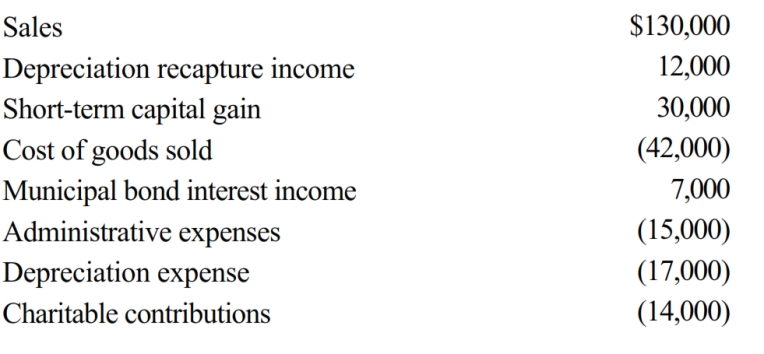 Calculate Bidden's nonseparately computed income.
 (Essay)
4.8/5 (78)
(78) If any entity electing S status is currently a C corporation, NOL carryovers from prior years generally_________________ be used in an S corporation year.
(Short Answer)
4.9/5 (78)
(78) Which, if any, of the following items decreases an S corporation's AAA?
(Multiple Choice)
4.9/5 (68)
(68) You are a 60% owner of an S corporation. Calculate your ending stock basis, based upon these facts.
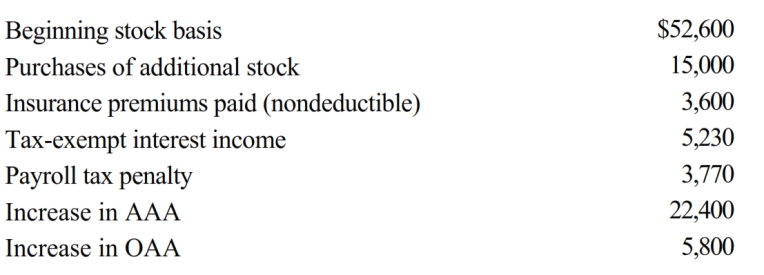
(Essay)
4.7/5 (74)
(74) During the year, Miles Nutt, the sole shareholder of a calendar year S corporation, received a distribution of $16,000. At the end of last year, his stock basis was $4,000. The corporation earned $11,000 ordinary income during the year. It has no accumulated E & P. Which statement is correct?
(Multiple Choice)
5.0/5 (82)
(82) The LIFO recapture tax is a variation of the passive investment income penalty tax.
(True/False)
4.8/5 (73)
(73) Gene Grams is a 45% owner of a calendar year S corporation during the tax year. His beginning stock basis is $230,000, and the S corporation reports the following items.
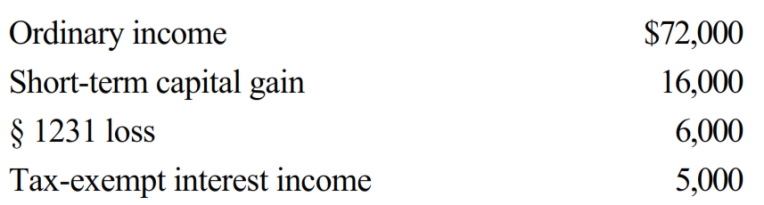 Calculate Grams's stock basis at year-end.
 (Essay)
4.9/5 (75)
(75) Which statement is incorrect with respect to an S shareholder's consent?
(Multiple Choice)
4.9/5 (75)
(75) The maximum number of actual shareholders in an S corporation is:
(Multiple Choice)
5.0/5 (65)
(65) An S corporation's LIFO recapture amount equals the excess of the inventory's value under____________________ over the ____________________ value.
(Short Answer)
5.0/5 (91)
(91) 
Filters
- Essay(0)
- Multiple Choice(0)
- Short Answer(0)
- True False(0)
- Matching(0)