



 Chat with AI
Exam 22: S Corporations

Exam 1: An Introduction to Taxation and Understanding the Federal Tax Law211 Questions
Exam 2: Working with the Tax Law102 Questions
Exam 3: Computing the Tax180 Questions
Exam 4: Gross Income: Concepts and Inclusions125 Questions
Exam 5: Gross Income: Exclusions113 Questions
Exam 6: Deductions and Losses: In General156 Questions
Exam 7: Deductions and Losses: Certain Business Expenses and Losses94 Questions
Exam 8: Depreciation, Cost Recovery, Amortization, and Depletion120 Questions
Exam 9: Deductions: Employee and Self-Employed-Related Expenses153 Questions
Exam 10: Deductions and Losses: Certain Itemized Deductions104 Questions
Exam 11: Investor Losses130 Questions
Exam 12: Tax Credits and Payments111 Questions
Exam 13: Property Transactions: Determination of Gain or Loss, Basis Considerations, and Nontaxable Exchanges285 Questions
Exam 14: Property Transactions: Capital Gains and Losses, Section 1231, and Recapture Provisions167 Questions
Exam 15: Taxing Business Income60 Questions
Exam 16: Accounting Periods and Methods88 Questions
Exam 17: Corporations: Introduction and Operating Rules108 Questions
Exam 18: Corporations: Organization and Capital Structure109 Questions
Exam 19: Corporations: Distributions Not in Complete Liquidation185 Questions
Exam 20: Corporations: Distributions in Complete Liquidation and an Overview of Reorganizations71 Questions
Exam 21: Partnerships248 Questions
Exam 22: S Corporations129 Questions
Exam 23: Exempt Entities153 Questions
Exam 24: Multistate Corporate Taxation204 Questions
Exam 25: Taxation of International Transactions146 Questions
Exam 26: Tax Practice and Ethics184 Questions
Exam 27: The Federal Gift and Estate Taxes141 Questions
Exam 28: Income Taxation of Trusts and Estates161 Questions
Select questions type


Post-termination distributions that are charged against OAA are received tax-free.
(True/False)
4.7/5  (84)
(84) Since loss property receives a __________________ in basis without any loss recognition, S corporation distributions of loss property generally should be .
(Short Answer)
4.8/5 (71)
(71) The corporate-level tax on recognized built-in gains applies when an S corporation disposes of an asset in a taxable disposition within five years after the date on which the S election took effect.
(True/False)
4.8/5 (74)
(74) Samantha owned 1,000 shares in Evita, Inc., an S corporation, that uses the calendar year. On October 11, Samantha sells all of her Evita stock. Her stock basis at the beginning of the tax year was $60,000. Evita's ordinary income for the year was $22,000 through the date of sale, and she receives a distribution of $35,000 on May 3rd. Her stock basis at the time of the sale is:
(Multiple Choice)
4.7/5 (66)
(66) Advise your client how income, expenses, gain, and losses are allocated to shareholders of an S corporation.
(Essay)
5.0/5 (67)
(67) You are given the following facts about a solely owned S corporation. What is the shareholder's ending stock basis? 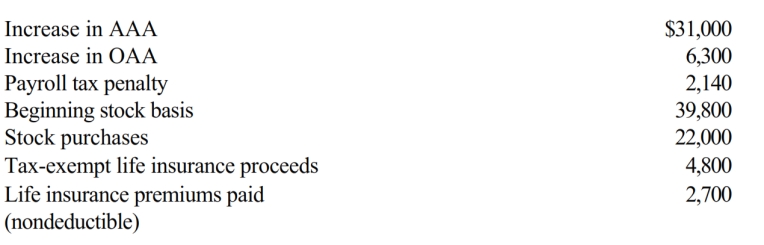
(Multiple Choice)
4.8/5 (84)
(84) Fred is the sole shareholder of an S corporation in Fort Deposit, Alabama. At a time when his stock basis is $20,000, the corporation distributes appreciated property worth $100,000 (basis of $20,000). Fred's taxable gain is:
(Multiple Choice)
4.9/5 (71)
(71) Pepper, Inc., an S corporation in Norfolk, Virginia, has revenues of $400,000, taxable interest of $380,000, operating expenses of $250,000, and deductions attributable to the interest income of $140,000. Calculate any passive investme income penalty tax payable by this corporation.
(Essay)
4.9/5 (77)
(77) If a resident alien shareholder moves outside the U.S., the S election is terminated.
(True/False)
4.7/5 (84)
(84) A distribution from the other adjustment account (OAA) is not taxable to an S shareholder.
(True/False)
4.8/5 (80)
(80) An S shareholder's basis is increased by stock purchases and capital contributions.
(True/False)
4.9/5 (84)
(84) Any distribution of cash or property by a corporation that does not exceed the balance of AAA with respect to S stock during a post-termination transition period of approximately one year is applied against and reduces the basis of the S stock.
(True/False)
4.8/5 (77)
(77) Distributions of appreciated property by an S corporation are not taxable to the entity.
(True/False)
4.8/5 (72)
(72) Kinney, Inc., an electing S corporation, holds $5,000 of AEP and $9,000 in AAA at the beginning of the calendar tax year. Kinney has two shareholders, Eric and Maria, each of whom owns 500 shares of Kinney's stock. Kinney's taxable income is $6,000 for the year. Kinney distributes $6,000 to each shareholder on February 1, and it distributes another $3,000 to each shareholder on September 1. How is Eric taxed on the distribution?
(Multiple Choice)
4.9/5 (81)
(81) At the beginning of the year, the AAA of Rose, Inc. shows a balance of $682,000. During the year, the following items occur. Compute the end-of-year AAA balance. 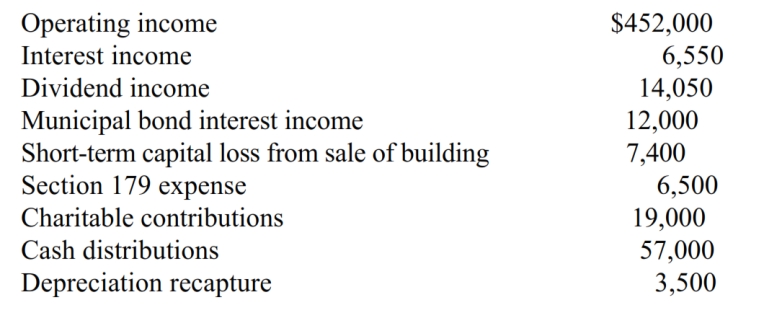
(Multiple Choice)
4.9/5 (72)
(72) On December 31, Erica Sumners owns one share of an S corporation's 10 outstanding shares of stock. The basis of Erica's share is $300. The next year the S corporation incurs a loss of $3,650. Determine the amount of the loss allocated to Erica, and calculate her stock basis at the end of the second year.
(Essay)
4.9/5 (68)
(68) 
Filters
- Essay(0)
- Multiple Choice(0)
- Short Answer(0)
- True False(0)
- Matching(0)