



 Chat with AI
Exam 13: Property Transactions: Determination of Gain or Loss, Basis Considerations, and Nontaxable Exchanges

Exam 1: An Introduction to Taxation and Understanding the Federal Tax Law211 Questions
Exam 2: Working with the Tax Law102 Questions
Exam 3: Computing the Tax180 Questions
Exam 4: Gross Income: Concepts and Inclusions125 Questions
Exam 5: Gross Income: Exclusions113 Questions
Exam 6: Deductions and Losses: In General156 Questions
Exam 7: Deductions and Losses: Certain Business Expenses and Losses94 Questions
Exam 8: Depreciation, Cost Recovery, Amortization, and Depletion120 Questions
Exam 9: Deductions: Employee and Self-Employed-Related Expenses153 Questions
Exam 10: Deductions and Losses: Certain Itemized Deductions104 Questions
Exam 11: Investor Losses130 Questions
Exam 12: Tax Credits and Payments111 Questions
Exam 13: Property Transactions: Determination of Gain or Loss, Basis Considerations, and Nontaxable Exchanges285 Questions
Exam 14: Property Transactions: Capital Gains and Losses, Section 1231, and Recapture Provisions167 Questions
Exam 15: Taxing Business Income60 Questions
Exam 16: Accounting Periods and Methods88 Questions
Exam 17: Corporations: Introduction and Operating Rules108 Questions
Exam 18: Corporations: Organization and Capital Structure109 Questions
Exam 19: Corporations: Distributions Not in Complete Liquidation185 Questions
Exam 20: Corporations: Distributions in Complete Liquidation and an Overview of Reorganizations71 Questions
Exam 21: Partnerships248 Questions
Exam 22: S Corporations129 Questions
Exam 23: Exempt Entities153 Questions
Exam 24: Multistate Corporate Taxation204 Questions
Exam 25: Taxation of International Transactions146 Questions
Exam 26: Tax Practice and Ethics184 Questions
Exam 27: The Federal Gift and Estate Taxes141 Questions
Exam 28: Income Taxation of Trusts and Estates161 Questions
Select questions type


Joyce's office building was destroyed in a fire (adjusted basis of $350,000? fair market value of $400,000). Of the insurance proceeds of $360,000 she receives, Joyce uses $310,000 to purchase additional inventory and invests the remaining $50,000 in short-term certificates of deposit. She received only $360,000 because of a co-insurance clause in her insurance policy. What is Joyce's recognized gain or loss?
(Multiple Choice)
4.8/5  (77)
(77) Ross lives in a house he received as a gift from his father. His father had lived in the house for 12 years. The adjusted basis of the house to his father was $160,000 and the fair market value at the time of the gift was $140,000. Ross sells this residence after living in it for 18 months for $150,000 and purchases a new home for $125,000. He incurs selling expenses of $7,000. What is Ross' recognized gain or loss and basis for the new residence?
(Multiple Choice)
4.9/5 (75)
(75) What requirements must be satisfied for a delayed swap to qualify for § 1031 like-kind exchange treatment?
(Essay)
4.9/5 (68)
(68) Boyd acquired tax-exempt bonds for $430,000 in December 2018. The bonds, which mature in December 2023, have a maturity value of $400,000. Boyd does not make any elections regarding the amortization of the bond premium. Determine the tax consequences to Boyd when he redeems the bonds in December 2023.
(Essay)
4.9/5 (83)
(83) The holding period for property acquired by gift is automatically long term.
(True/False)
4.9/5 (76)
(76) On January 5, 2018, Waldo sells his principal residence with an adjusted basis of $270,000 for $690,000. He has owned and occupied the residence for 15 years. He pays $35,000 in commissions and $2,000 in legal fees in connection with the sale. One month before the sale, Waldo painted the exterior of the house at a cost of $5,000 and repaired various items at a cost of $3,000. On October 15, 2018, Waldo purchases a new home for $600,000. On November 15, 2019, he pays $25,000 for completion of a new room on the house, and on January 14, 2020, he pays $15,000 for the construction of a pool. What is the Waldo's recognized gain on the sale of his old principal residence and what is the basis for the new residence?
(Essay)
4.8/5 (90)
(90) During 2018, Zeke and Alice, a married couple, decided to sell their residence, which had a basis of $200,000. They had owned and occupied the residence for 20 years. To make it more attractive to prospective buyers, they had the inside painted in April at a cost of $5,000 and paid for the work immediately. They sold the house in May for $800,000. Broker's commissions and other selling expenses amounted to $50,000. They purchased a new residence in July for $400,000. What is the recognized gain and the adjusted basis of the new residence?
(Multiple Choice)
5.0/5 (89)
(89) In 1973, Fran received a birthday gift of stock worth $75,000 from her aunt. The aunt had owned the stock (adjusted basis $50,000) for 10 years and paid gift tax of $27,000 on the transfer. Fran's basis in the stock is $75,000-the lesser of $77,000 ($50,000 + $27,000) or $75,000.
(True/False)
4.9/5 (81)
(81) Explain how the sale of investment property at a loss to a brother is treated differently from a sale to a nephew.
(Essay)
4.9/5 (82)
(82) Karen purchased 100 shares of Gold Corporation stock for $11,500 on January 1, 2015. In the current tax year (2018), she sells 25 shares of the 100 shares purchased on January 1, 2015, for $2,500. Twenty-five days earlier, she had purchased 30 shares for $3,000. What is Karen's recognized gain or loss on the sale of the stock, and what is her basis in the 30 shares purchased 25 days earlier?
(Multiple Choice)
4.8/5 (72)
(72) Over the past 20 years, Alfred has purchased 380 shares of Green, Inc., common stock. His first purchase was in 1995 when he acquired 30 shares for $20 a share. In 2002, Alfred bought 150 shares at $10 a share. In 2017, Alfred acquired 200 shares at $50 a share. Alfred intends to sell 125 shares at $60 per share in the current year (2018). If Alfred's objective is to minimize gain and assuming he can adequately identify the shares to be sold, what is his recognized gain?
(Multiple Choice)
4.9/5 (90)
(90) Ken is considering two options for selling land for which he has an adjusted basis of $100,000 and on which there is a mortgage of $80,000. Under the first option, Ken will sell the land for $225,000 with a stipulation in the sales contract that he liquidate the mortgage before the sale is complete. Under the second option, Ken will sell the land for $145,000 and the buyer will assume the mortgage. Calculate Ken's recognized gain under both options.
(Essay)
4.8/5 (80)
(80) The amount of a corporate distribution qualifying for capital recovery treatment which exceeds the shareholder- recipient's basis in the stock investment is treated as a capital gain.
(True/False)
4.9/5 (67)
(67) For the following exchanges, indicate which qualify as like-kind property.
a. Inventory of a sporting goods store in Charleston for inventory of an appliance store in Savannah.
b. Inventory of a ladies dress shop in Cleveland for inventory of a ladies dress shop in Richmond.
c. Investment land in Virginia Beach for office building in Williamsburg.
d. Used automobile used in a business for a new automobile to be used in the business.
e. Investment land in Paris for investment land in San Francisco.
f. Shares of Texaco stock for shares of Exxon Mobil stock.
(Essay)
5.0/5 (79)
(79) Sammy exchanges land used in his business in a like-kind exchange. The property exchanged is as follows:
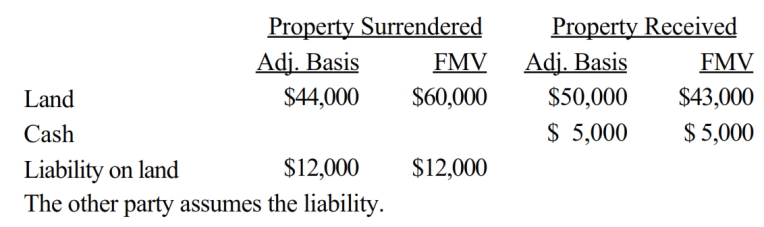 a. What is Sammy's recognized gain or loss?
b. What is Sammy's basis for the assets he received?
a. What is Sammy's recognized gain or loss?
b. What is Sammy's basis for the assets he received? (Essay)
4.9/5 (84)
(84) Edward, age 52, leased a house for one year in Memphis with an option to buy as his personal residence. At the end of the lease, he purchased the house. He lived there for an additional 26 months before his employer transferred him to Tucson. Expecting to be in Tucson for 18 to 24 months, he rented the Memphis house for 18 months with an option to extend on a month to month basis for an additional 6 months. At the end of the 18-month period, Edward's employer offered him a permanent position in Tucson as branch manager. The tenant who had been occupying Edward's house in Memphis purchased it at the end of the 24-month extended lease period. Is Edward eligible to elect exclusion treatment under § 121?
(Essay)
4.8/5 (77)
(77) How is the donee's basis calculated for the gift of appreciated property for a gift made before 1977? Assume the donor pays gift tax.
(Essay)
4.8/5 (74)
(74) If a taxpayer purchases taxable bonds at a premium, the amortization of the premium is elective. However, if a taxpayer purchases tax-exempt bonds at a premium, the amortization of the premium is mandatory. Explain this difference in the treatment.
(Essay)
4.7/5 (92)
(92) 
Filters
- Essay(0)
- Multiple Choice(0)
- Short Answer(0)
- True False(0)
- Matching(0)