



 Chat with AI
Exam 5: Gross Income: Exclusions

Exam 1: An Introduction to Taxation and Understanding the Federal Tax Law211 Questions
Exam 2: Working with the Tax Law102 Questions
Exam 3: Computing the Tax180 Questions
Exam 4: Gross Income: Concepts and Inclusions125 Questions
Exam 5: Gross Income: Exclusions113 Questions
Exam 6: Deductions and Losses: In General156 Questions
Exam 7: Deductions and Losses: Certain Business Expenses and Losses94 Questions
Exam 8: Depreciation, Cost Recovery, Amortization, and Depletion120 Questions
Exam 9: Deductions: Employee and Self-Employed-Related Expenses153 Questions
Exam 10: Deductions and Losses: Certain Itemized Deductions104 Questions
Exam 11: Investor Losses130 Questions
Exam 12: Tax Credits and Payments111 Questions
Exam 13: Property Transactions: Determination of Gain or Loss, Basis Considerations, and Nontaxable Exchanges285 Questions
Exam 14: Property Transactions: Capital Gains and Losses, Section 1231, and Recapture Provisions167 Questions
Exam 15: Taxing Business Income60 Questions
Exam 16: Accounting Periods and Methods88 Questions
Exam 17: Corporations: Introduction and Operating Rules108 Questions
Exam 18: Corporations: Organization and Capital Structure109 Questions
Exam 19: Corporations: Distributions Not in Complete Liquidation185 Questions
Exam 20: Corporations: Distributions in Complete Liquidation and an Overview of Reorganizations71 Questions
Exam 21: Partnerships248 Questions
Exam 22: S Corporations129 Questions
Exam 23: Exempt Entities153 Questions
Exam 24: Multistate Corporate Taxation204 Questions
Exam 25: Taxation of International Transactions146 Questions
Exam 26: Tax Practice and Ethics184 Questions
Exam 27: The Federal Gift and Estate Taxes141 Questions
Exam 28: Income Taxation of Trusts and Estates161 Questions
Select questions type


Ron, age 19, is a full-time graduate student at City University. During 2018, he received the following payments: 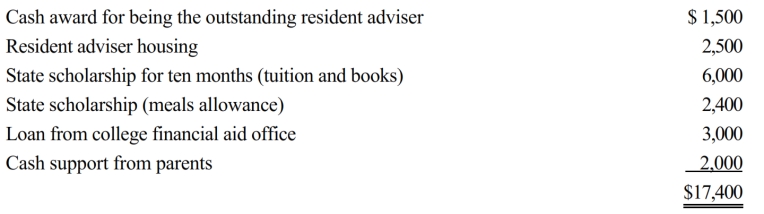 Ron served as a resident adviser in a dormitory and, therefore, the university waived the $2,500 charge for the room he occupied. What is Ron's adjusted gross income for 2018?
 (Multiple Choice)
4.8/5  (66)
(66) Bob had a terminal illness and realized that he "can't take it with him." Therefore, he cashed in his insurance policy and received $120,000. He had paid $50,000 in premiums on the policy. He used the money to fulfill his lifelong ambitions of going to the Super Bowl, driving an expensive sports car, and vacationing in Bermuda. Was Bob's behavior consistent with the Congressional intent in providing the tax exemption he was permitted to use?
(Essay)
4.9/5 (86)
(86) Sandy is married, files a joint return, and expects to be in the 24% marginal tax bracket for the foreseeable future. All of his income is from salary and all of it is used to maintain the household. He has a paid-up life insurance policy with a cash surrender value of $100,000. He paid $60,000 of premiums on the policy. His gain from cashing in the life insurance policy would be ordinary income. If he retains the policy, the insurance company will pay him at least $3,000 (3%) interest each year. Sandy thinks he can earn a higher return if he cashes in the policy and invests the proceeds.
a. What before-tax rate of return would Sandy be required to earn on the proceeds from cashing in the policy to equal the return earned with the insurance company?
b. Assume Sandy estimates he can earn a 6% before-tax rate of return on the proceeds from cashing in the policy. Assume he can earn a 6% return for the remainder of his life and that he will reinvest all earnings at the same 6% before-tax rate of return. If Sandy expects to live 10 more years, which alternative will yield the greater amount to his beneficiaries upon Sandy's death? (Given: The future value of an annuity in 10 years assuming a 4.32% after- tax return is 12.19. The future value of an annuity in 10 years assuming a 2.16% return is 11.03).
(Essay)
4.8/5 (71)
(71) Gold Company was experiencing financial difficulties, but was not bankrupt or insolvent. The National Bank, which held a mortgage on other real estate owned by Gold, reduced the principal from $110,000 to $85,000. The bank had made the loan to Gold when it purchased the real estate from Silver, Inc. Pink, Inc., the holder of a mortgage on Gold's building, agreed to accept $40,000 in full payment of the $55,000 due. Pink had sold the building to Gold for $150,000 that was to be paid in installments over 8 years. As a result of the above, Gold must:
(Multiple Choice)
4.9/5 (71)
(71) Ben was hospitalized for back problems. While he was away from the job, he collected his regular salary from an employer-sponsored income protection insurance policy. Ben's employer-sponsored hospitalization insurance policy also paid for 90% of his medical expenses. Ben also collected on an income protection policy that he purchased. Which of the above sources of income are taxable? Explain the basis for excluding any item or items.
(Essay)
5.0/5 (81)
(81) Employees of the Valley Country Club are allowed to use the golf course without charge before and after working hours on Mondays, when the number of players on the course is at its lowest. Tom, an employee of the country club played 40 rounds of golf during the year at no charge when the non-employee charge was $20 per round.
(Multiple Choice)
4.8/5 (73)
(73) The taxpayer incorrectly took a $5,000 deduction (e.g., incorrectly calculated depreciation) in 2018 and as a result his taxable income was reduced by $5,000. The taxpayer discovered his error in 2019. The taxpayer must add $5,000 to his 2019 gross income in accordance with the tax benefit rule to correct for the 2018 error.
(True/False)
4.9/5 (61)
(61) Margaret is trying to decide whether to place funds in a qualified tuition program. Her son will be attending college in 4 years. She is in the 35% marginal tax bracket and she believes she can earn an 7% before tax return on alternative investments. Thus, $10,000 will accumulate to $11,948 (after-tax) in 4 years. Margaret expects tuition to increase at the rate of 5% each year to $12,155 in 4 years. Her son will be in the 12% marginal tax bracket in all relevant years. Given these assumptions, should Margaret participate in the qualified tuition program?
(Essay)
4.8/5 (84)
(84) George, an unmarried cash basis taxpayer, received the following amounts during 2018: 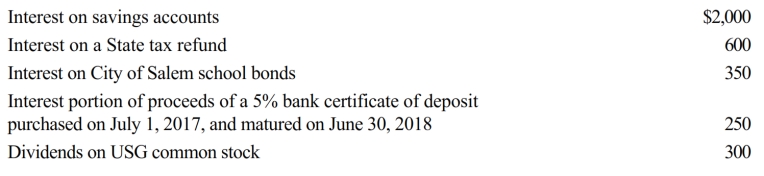 What amount should George report as gross income from dividends and interest for 2018?
 (Multiple Choice)
4.8/5 (77)
(77) Swan Finance Company, an accrual method taxpayer, requires all of its customers to carry credit life insurance. If a customer dies, the company receives from the insurance company the balance due on the customer's loan. Ali, a customer, died owing Swan $1,500. The balance due included $200 accrued interest that Swan has included in income. When Swan collects $1,500 from the insurance company, Swan:
(Multiple Choice)
4.9/5 (86)
(86) Jack received a court award in a civil libel and slander suit against National Gossip. He received $120,000 for damages to his professional reputation, $100,000 for damages to his personal reputation, and $50,000 in punitive damages. Jack must include in his gross income as a damage award:
(Multiple Choice)
4.7/5 (80)
(80) Matilda works for a company with 1,000 employees. The company has a hospitalization insurance plan that covers all employees. However, the employee must pay the first $3,000 of his or her medical expenses each year. Each year, the employer contributes $1,500 to each employee's health savings account (HSA). Matilda's employer made the contributions in 2017 and 2018, and the account earned $100 interest in 2018. At the end of 2018, Matilda withdrew $3,100 from the account to pay the deductible portion of her medical expenses for the year and other medical expenses not covered by the hospitalization insurance policy. As a result, Matilda must include in her 2018 gross income:
(Multiple Choice)
4.8/5 (67)
(67) Ben was diagnosed with a terminal illness. His physician estimated that Ben would live no more than 18 months. After he received the doctor's diagnosis, Ben cashed in his life insurance policy and used the proceeds to take a trip to see relatives and friends before he died. Ben had paid $12,000 in premiums on the policy, and he collected $50,000, the cash surrender value of the policy. Henry enjoys excellent health, but he cashed in his life insurance policy to purchase a new home. He had paid premiums of $12,000 and collected $50,000 from the insurance company.
(Multiple Choice)
4.9/5 (64)
(64) If a tax-exempt bond will yield approximately .65 (1 - .35) times the yield on a taxable bond of equal risk, who benefits from the tax exemption: the Federal government, the state and local governments who issue the bonds, or the investors?
(Essay)
4.8/5 (81)
(81) The taxpayer was in the 35% marginal tax bracket in 2017 and deducted $15,000 in state income taxes as an itemized deduction that year. In 2018, he filed his 2017 state income tax return and received a $5,000 refund of state income taxes paid in 2017. His marginal tax rate in 2018 was 12%. What was the taxpayer's Federal tax benefit from the overpayment of his 2017 state income tax?
(Essay)
4.8/5 (81)
(81) As an executive of Cherry, Inc., Ollie receives a fringe benefit in the form of annual tuition scholarships of $10,000 to each of his three children. The scholarships are paid by the company on behalf of the children of key employees directly to each child's educational institution and are payable only if the student maintains a B average.
(Multiple Choice)
4.9/5 (83)
(83) Christie sued her former employer for a back injury she suffered on the job in 2018. As a result of the injury, she was partially disabled. In 2019, she received $240,000 for her loss of future income, $160,000 in punitive damages because of the employer's flagrant disregard for the employee's safety, and $15,000 for medical expenses. The medical expenses were deducted on her 2018 return, reducing her taxable income by $12,000. Christie's 2019 gross income from the above is:
(Multiple Choice)
4.9/5 (95)
(95) In the case of interest income from state and Federal bonds:
(Multiple Choice)
4.9/5 (80)
(80) Gull Corporation was undergoing reorganization under the bankruptcy laws. The shareholders, who had made loans of $300,000 to the corporation, agreed to accept additional stock with a value of $200,000 instead of repayment on the debt. The Old Line Insurance Company, which had a $400,000 mortgage on the building, agreed to reduce the principal to $250,000. A trade creditor with a receivable of $150,000 from the company agreed to accept $70,000 in full payment for the debt incurred to purchase goods that were still on hand. Finally, the company transferred some equipment with an adjusted basis of $90,000 in satisfaction of a liability for $120,000. Compute the corporation's gross income and other adjustments necessary as a result of the above transactions.
(Essay)
4.9/5 (64)
(64) 
Filters
- Essay(0)
- Multiple Choice(0)
- Short Answer(0)
- True False(0)
- Matching(0)