



 Chat with AI
Exam 15: Oligopoly and Game Theory

Exam 1: The Big Ideas253 Questions
Exam 2: The Power of Trade and Comparative239 Questions
Exam 3: Supply and Demand249 Questions
Exam 4: Equilibrium256 Questions
Exam 5: Elasticity and Its Applications271 Questions
Exam 6: Taxes and Subsidies225 Questions
Exam 7: The Price System275 Questions
Exam 8: Price Ceilings and Floors327 Questions
Exam 9: International Trade195 Questions
Exam 10: Externalities- When the Price Is Not Right273 Questions
Exam 11: Costs and Profit Maximization Under Competition217 Questions
Exam 12: Competition and the Invisible Hand144 Questions
Exam 13: Monopoly233 Questions
Exam 14: Price Discrimination262 Questions
Exam 15: Oligopoly and Game Theory218 Questions
Exam 16: Competing for Monopoly160 Questions
Exam 17: Monopolistic Competition and Advertising113 Questions
Exam 18: Labor Markets262 Questions
Exam 19: Public Goods and the Tragedy of the Commons244 Questions
Exam 20: Political Economy and Public Choice306 Questions
Exam 21: Economics, Ethics, and Public Policy241 Questions
Exam 22: Managing Incentives263 Questions
Exam 23: Stock Markets and Personal Finance271 Questions
Exam 24: Price Discrimination151 Questions
Exam 25: Consumer Choice145 Questions
Select questions type


A(n) ________ is a group of suppliers who try to act together to reduce supply.
(Multiple Choice)
4.7/5  (85)
(85) Which of the following is the best example of a firm operating in an oligopoly market?
(Multiple Choice)
4.9/5 (81)
(81) The United States uses ______ to prevent businesses from engaging in anticompetitive practices.
(Multiple Choice)
4.8/5 (83)
(83) Which of the following explains why it is typically easier to maintain a cartel in a natural resource than in a manufactured good?
(Multiple Choice)
4.8/5 (81)
(81) The prisoner's dilemma describes situations where the pursuit of:
(Multiple Choice)
4.9/5 (84)
(84) When a cartel member produces more output and lowers prices,:
(Multiple Choice)
4.9/5 (71)
(71) _____ cartels can move an industry from competition to pure monopoly.
(Multiple Choice)
4.8/5 (94)
(94) Figure: Demand 2 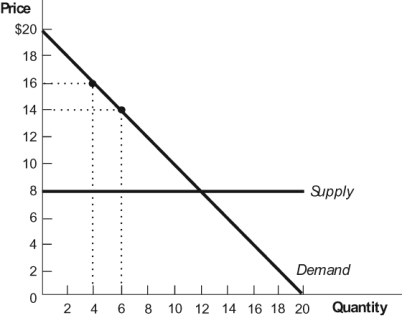 Two firms in an industry act as a cartel, with each firm agreeing to charge a price of $16 and sell two units of output. If one of them cheats and produces two more units of output, the cheating firm's total revenue increases by ______ and the other firm's total revenue decreases by ______.
 (Multiple Choice)
4.7/5 (77)
(77) A price match guarantee and a promise to pay 10% of the difference reduces the incentive for firms to compete with lower prices.
(True/False)
4.8/5 (80)
(80) Scientists are working on techniques to create bacteria that excrete oil as waste. How might OPEC have contributed to this research?
(Multiple Choice)
4.7/5 (70)
(70) The prisoner's dilemma is the negative counterpart to the invisible hand.
(True/False)
5.0/5 (83)
(83) Iran and Iraq disbanded from OPEC when engaging in war from 1980-1988.
(True/False)
4.9/5 (83)
(83) Customers are _____ refusing to join the loyalty plan only if _____ of them refuse.
(Multiple Choice)
4.8/5 (76)
(76) In cases where a cartel controls access to a key production input, firms in the cartel:
(Multiple Choice)
4.9/5 (80)
(80) Which of the following statements is TRUE with respect to economies of scale?
I. It is cheaper for 500 manufacturers to make 30,000 cars each.
II. It is cheaper for five manufacturers to make 3,000,000 cars each.
III. Bigger firms mean fewer firms.
(Multiple Choice)
4.9/5 (59)
(59) Compared to a competitive market, firms operating in a cartel will charge a price that is:
(Multiple Choice)
4.8/5 (87)
(87) 
Filters
- Essay(0)
- Multiple Choice(0)
- Short Answer(0)
- True False(0)
- Matching(0)