



 Chat with AI
Exam 16: Competing for Monopoly

Exam 1: The Big Ideas253 Questions
Exam 2: The Power of Trade and Comparative239 Questions
Exam 3: Supply and Demand249 Questions
Exam 4: Equilibrium256 Questions
Exam 5: Elasticity and Its Applications271 Questions
Exam 6: Taxes and Subsidies225 Questions
Exam 7: The Price System275 Questions
Exam 8: Price Ceilings and Floors327 Questions
Exam 9: International Trade195 Questions
Exam 10: Externalities- When the Price Is Not Right273 Questions
Exam 11: Costs and Profit Maximization Under Competition217 Questions
Exam 12: Competition and the Invisible Hand144 Questions
Exam 13: Monopoly233 Questions
Exam 14: Price Discrimination262 Questions
Exam 15: Oligopoly and Game Theory218 Questions
Exam 16: Competing for Monopoly160 Questions
Exam 17: Monopolistic Competition and Advertising113 Questions
Exam 18: Labor Markets262 Questions
Exam 19: Public Goods and the Tragedy of the Commons244 Questions
Exam 20: Political Economy and Public Choice306 Questions
Exam 21: Economics, Ethics, and Public Policy241 Questions
Exam 22: Managing Incentives263 Questions
Exam 23: Stock Markets and Personal Finance271 Questions
Exam 24: Price Discrimination151 Questions
Exam 25: Consumer Choice145 Questions
Select questions type


The market for Internet dating is dominated by eHarmony, Match.com, and Yahoo. This market is an example of monopolistic competition.
(True/False)
4.9/5  (76)
(76) Operating systems have network-good characteristics because of ______ issues.
(Multiple Choice)
4.8/5 (76)
(76) When many people are involved and when they do not all agree about whether one good really is better than another, the best final equilibrium is usually determined by:
(Multiple Choice)
4.7/5 (93)
(93) Network industries that are contestable usually perform better than uncontestable markets even if they are monopolized.
(True/False)
4.9/5 (86)
(86) The port of Rhodes (of the famed Colossus of Rhodes) was a major trading hub during the Roman Republic, charging a small harbor tax on goods that passed through. When Rome fought Macedonia, Rhodes took a neutral stance much to Rome's chagrin. In response, Rome established a rival port on the nearby Isle of Delos and eliminated the harbor tax. Trade in Rhodes immediately fell by 85% and eventually the city-state disappeared forever. Why did Rome completely eliminate the tax instead of charging one just below what Rhodes charged?
(Multiple Choice)
4.9/5 (77)
(77) Network goods are always sold by the firm with the "best" product.
(True/False)
4.8/5 (76)
(76) In the previous chapter you learned about why cartels are hard to maintain since cheating is a dominant strategy for all firms involved. If this table represents the payoffs for two firms operating as a cartel, are there any Nash equilibria in this coordination game? If so, how many? For these payoffs, what is the "best" equilibrium outcome for both firms? Which outcome is likely to occur in the market? Does your answer change if these firms can communicate and/or monitor each other easily? Explain.
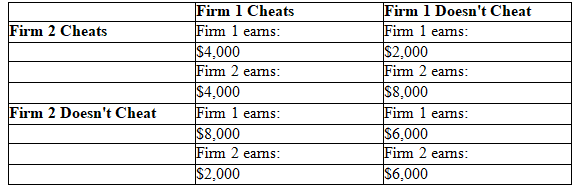
(Essay)
4.8/5 (79)
(79) Since its founding in 331 B.C.E., the city of Alexandria has been a center of trade for the Mediterranean countries, as well as the Middle Eastern countries. Part of this is due to geography, but it is also due to the network effect. What is the source of the network effect?
(Multiple Choice)
4.7/5 (87)
(87) A network good is a good whose value to one consumer increases the more other consumers use the good.
(True/False)
4.8/5 (85)
(85) 
Filters
- Essay(0)
- Multiple Choice(0)
- Short Answer(0)
- True False(0)
- Matching(0)