



 Chat with AI
Exam 5: Elasticity and Its Applications

Exam 1: The Big Ideas253 Questions
Exam 2: The Power of Trade and Comparative239 Questions
Exam 3: Supply and Demand249 Questions
Exam 4: Equilibrium256 Questions
Exam 5: Elasticity and Its Applications271 Questions
Exam 6: Taxes and Subsidies225 Questions
Exam 7: The Price System275 Questions
Exam 8: Price Ceilings and Floors327 Questions
Exam 9: International Trade195 Questions
Exam 10: Externalities- When the Price Is Not Right273 Questions
Exam 11: Costs and Profit Maximization Under Competition217 Questions
Exam 12: Competition and the Invisible Hand144 Questions
Exam 13: Monopoly233 Questions
Exam 14: Price Discrimination262 Questions
Exam 15: Oligopoly and Game Theory218 Questions
Exam 16: Competing for Monopoly160 Questions
Exam 17: Monopolistic Competition and Advertising113 Questions
Exam 18: Labor Markets262 Questions
Exam 19: Public Goods and the Tragedy of the Commons244 Questions
Exam 20: Political Economy and Public Choice306 Questions
Exam 21: Economics, Ethics, and Public Policy241 Questions
Exam 22: Managing Incentives263 Questions
Exam 23: Stock Markets and Personal Finance271 Questions
Exam 24: Price Discrimination151 Questions
Exam 25: Consumer Choice145 Questions
Select questions type


Assume that demand increases by 1 percent, the absolute value of price elasticity of demand is 1.0, and price elasticity of supply is 1.0. What is the percentage price change in this case?
(Multiple Choice)
4.8/5  (92)
(92) A good with an absolute value of the price elasticity of demand of 0.5 has:
(Multiple Choice)
4.7/5 (89)
(89) If the price of a good increases from $100 to $110 and quantity demanded decreases from 100 units to 90 units, the demand would be classified as unit elastic.
(True/False)
4.7/5 (74)
(74) The elasticity of demand for oil is -0.5 and the elasticity of supply is 0.20. If the demand for oil increases 10 percent, what happens to the price of oil?
(Multiple Choice)
4.9/5 (68)
(68) Use the following to answer questions:
Figure: Gun Market 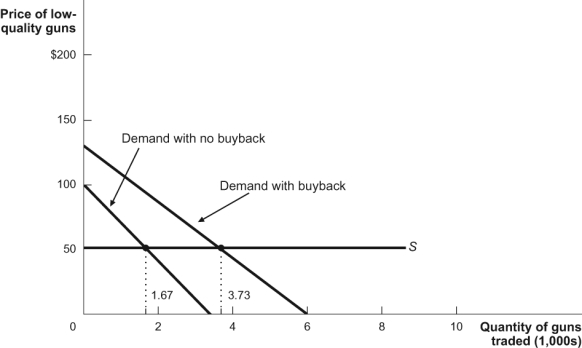 -(Figure: Gun Market) In the gun market shown, the number of guns in the city that is having the gun buyback program is:
 (Multiple Choice)
4.8/5 (79)
(79) Since the demand curve for computer chips is elastic, a decrease in the price of computer chips caused by an increase in productivity will _____ revenue for the computer chip industry and make computer chips a _____ share of the American economy.
(Multiple Choice)
4.8/5 (83)
(83) If the supply of a product is inelastic, a large price increase will:
(Multiple Choice)
4.8/5 (94)
(94) Suppose the price of a good rises from $10 to $20 and quantity demanded falls from 500 to 400. If you calculate the elasticity of demand WITHOUT using the midpoint method, the answer would be _____. If you calculate the elasticity of demand WITH the midpoint method, the answer would be _____. Economists say _____ when calculating elasticity.
(Multiple Choice)
4.9/5 (62)
(62) The fundamental determinant of the elasticity of supply is:
(Multiple Choice)
4.9/5 (71)
(71) Figure: Elasticity and Quantity Demanded 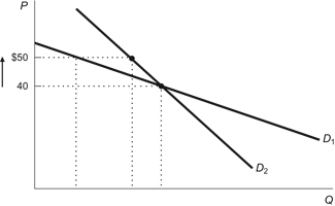 Refer to the figure. An increase in price from $40 to $50 would cause the change in quantity demanded for D1 to be:
 (Multiple Choice)
4.9/5 (73)
(73) If two linear supply curves run through a common point, then at any given quantity the curve that is flatter is more elastic.
(True/False)
4.9/5 (77)
(77) If the supply of rental housing increases causing its price to fall and apartment dwellers move into bigger apartments that cost the same as their old ones, we can infer that the:
(Multiple Choice)
4.9/5 (82)
(82) Use the following to answer questions:
Figure: Slave Redemption 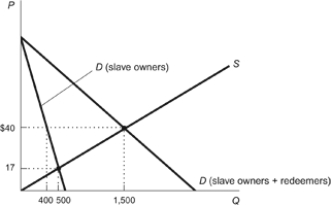 -(Figure: Slave Redemption) Refer to the figure. Assume the graph illustrates the Sudanese slave trade. When slave redeemers enter the market, the total number of freed slaves is ________ and the net number of freed slaves is ________.
 (Multiple Choice)
4.8/5 (90)
(90) If the income elasticity of demand of a good is positive, we can conclude that the good is:
(Multiple Choice)
4.8/5 (80)
(80) Both the elasticities of demand and supply tend to be more elastic in the long-run.
(True/False)
4.7/5 (82)
(82) A higher income tends to make demand for a given good ______ elastic.
(Multiple Choice)
4.9/5 (79)
(79) 
Filters
- Essay(0)
- Multiple Choice(0)
- Short Answer(0)
- True False(0)
- Matching(0)