



 Chat with AI
Exam 9: Long-Run Economic Growth

Exam 1: First Principles233 Questions
Exam 2: Economic Models319 Questions
Exam 3: Supply and Demand292 Questions
Exam 5: International Trade 5274 Questions
Exam 6: Macroeconomics: the Big Picture168 Questions
Exam 7: Gdp and Cpi: Tracking the Macroeconomy434 Questions
Exam 8: Unemployment and Inflation354 Questions
Exam 9: Long-Run Economic Growth316 Questions
Exam 10: Savings, Investment Spending, and the Financial System402 Questions
Exam 13: Fiscal Policy Appendix Taxes and the Multiplier382 Questions
Exam 14: Money, Banking, and the Federal Reserve System468 Questions
Exam 15: Monetary Policy359 Questions
Exam 16: Inflation, Disinflation, and Deflation240 Questions
Exam 17: Crises and Consequences214 Questions
Exam 18: Events and Ideas322 Questions
Exam 19: Open-Economy Macroeconomics467 Questions
Exam 20: Graphs in Economics75 Questions
Exam 21: toward a Fuller Understanding of Present Value36 Questions
Select questions type


According to the convergence hypothesis, differences in GDP per capita among countries tend to narrow over time because countries that start with a lower real GDP per capita tend to have negative growth rates.
(True/False)
4.9/5  (67)
(67) Which of the following CAN properly be called a part of infrastructure?
(Multiple Choice)
4.8/5 (78)
(78) Who established the first research and development laboratory?
(Multiple Choice)
4.8/5 (83)
(83) A nation's real GDP increased from $250 billion to $265 billion in one year. In that same year, the nation's population increased from 125 million to 130 million. Calculate the nation's real GDP per capita growth rate.
(Essay)
4.9/5 (78)
(78) Use the following to answer questions :
Table: South Korea's Real GDP per Capita 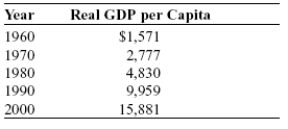 -(Table: South Korea's Real GDP per Capita) Look at the table South Korea's Real GDP per Capita. As a percentage of real GDP per capita in 2000, approximately how much did South Korea produce in 1960?
 (Multiple Choice)
4.8/5 (74)
(74) If real GDP grows at an average rate of 3% per year, it will double in approximately _____ years.
(Multiple Choice)
4.9/5 (77)
(77) Which of the following accurately describes what is happening along a typical aggregate production function?
(Multiple Choice)
4.8/5 (78)
(78) Use the following to answer questions :
Scenario: The Aggregate Production Function
Holding the human capital per worker and technology unchanged, the estimated aggregate production function in Jamaica is Y / L = 50 × K / L, where Y = real output, L = number of workers, and K = quantity of physical capital.
-(Scenario: The Aggregate Production Function) Look at the scenario The Aggregate Production Function. If K / L = $81, then real GDP per worker is:
(Multiple Choice)
4.9/5 (73)
(73) Most of the rapidly growing Asian nations, though poor, have increased their productivity by providing a very good basic education for their citizens.
(True/False)
4.9/5 (91)
(91) Use the following to answer questions :
Figure: Technological Progress and Productivity Growth  -(Figure: Technological Progress and Productivity Growth) Look at the figure Technological Progress and Productivity Growth. Which of the following changes in real GDP is most likely to have resulted from an increase in the quality (as well as quantity) of public health measures?
 (Multiple Choice)
5.0/5 (79)
(79) As a limit to economic growth, environmental problems are more difficult to solve than resource problems because:
(Multiple Choice)
4.8/5 (78)
(78) If the population and GDP increase by the same percentage, then real GDP per capita:
(Multiple Choice)
4.7/5 (68)
(68) The convergence hypothesis fits the data only when the factors that affect growth are held equal across countries. These factors include all of the following EXCEPT:
(Multiple Choice)
4.8/5 (65)
(65) 
Filters
- Essay(0)
- Multiple Choice(0)
- Short Answer(0)
- True False(0)
- Matching(0)