



 Chat with AI
Exam 9: Long-Run Economic Growth

Exam 1: First Principles233 Questions
Exam 2: Economic Models319 Questions
Exam 3: Supply and Demand292 Questions
Exam 5: International Trade 5274 Questions
Exam 6: Macroeconomics: the Big Picture168 Questions
Exam 7: Gdp and Cpi: Tracking the Macroeconomy434 Questions
Exam 8: Unemployment and Inflation354 Questions
Exam 9: Long-Run Economic Growth316 Questions
Exam 10: Savings, Investment Spending, and the Financial System402 Questions
Exam 13: Fiscal Policy Appendix Taxes and the Multiplier382 Questions
Exam 14: Money, Banking, and the Federal Reserve System468 Questions
Exam 15: Monetary Policy359 Questions
Exam 16: Inflation, Disinflation, and Deflation240 Questions
Exam 17: Crises and Consequences214 Questions
Exam 18: Events and Ideas322 Questions
Exam 19: Open-Economy Macroeconomics467 Questions
Exam 20: Graphs in Economics75 Questions
Exam 21: toward a Fuller Understanding of Present Value36 Questions
Select questions type


Sustainable long-run economic growth is long-run growth that can continue in the face of decreases in the growth rate of the world's population.
(True/False)
4.9/5  (94)
(94) Use the following to answer questions :
Figure: Technological Progress and Productivity Growth  -(Figure: Technological Progress and Productivity Growth) Look at the figure Technological Progress and Productivity Growth. Which of the following changes in real GDP is most likely to have resulted from an increase in the quality (as well as quantity) of government spending on education?
 (Multiple Choice)
5.0/5 (82)
(82) Use the following to answer questions :
Figure: Technological Progress and Productivity Growth
-(Figure: Technological Progress and Productivity Growth) Look at the figure Technological Progress and Productivity Growth. Which of the following changes in real GDP is most likely to have resulted from an increase in domestic savings?
-(Figure: Technological Progress and Productivity Growth) Look at the figure Technological Progress and Productivity Growth. Which of the following changes in real GDP is most likely to have resulted from an increase in domestic savings? (Multiple Choice)
4.7/5 (86)
(86) China has much higher rate of growth than the United States, but the average Chinese household is _____ a typical U.S. household. China's real GDP per capita is _____ that of the United States.
(Multiple Choice)
4.7/5 (91)
(91) Malthus' predictions have proved to be false because the negative effects on productivity of population growth have been outweighed by advances in technology and increases in both human and physical capital.
(True/False)
4.8/5 (75)
(75) If an economy doubles its growth rate in per capita GDP over 14 years, then the growth rate in per capita GDP averaged 5% per year.
(True/False)
4.8/5 (85)
(85) In 1820, Mexico had a higher real GDP per capita than Japan, but today Japan's real GDP per capita is higher than Mexico's because Japan's real GDP per capita has grown at _____, and Mexico's real GDP per capita has grown at _____.
(Multiple Choice)
4.9/5 (80)
(80) Sweden has real GDP per capita of $50,000, while Chile has real GDP per capita of $25,000. If real GDP per capita in Sweden grows at 2% and Chile's real GDP per capita grows at 4%, how long will it take for real GDP per capita in the two nations to converge?
(Multiple Choice)
4.8/5 (79)
(79) Use the following to answer questions :
Figure: Technological Progress and Productivity Growth 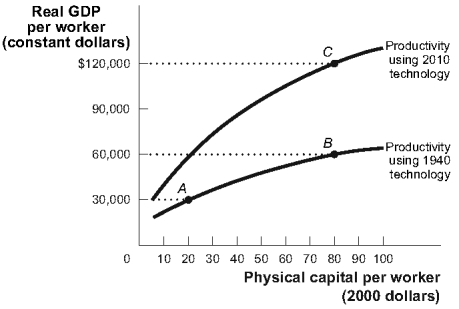 -(Figure: Technological Progress and Productivity Growth) Look at the figure Technological Progress and Productivity Growth. If there is significant technological progress (all other factors remaining unchanged), it is best indicated by a move from:
 (Multiple Choice)
4.9/5 (85)
(85) Use the following to answer questions :
Scenario: The Aggregate Production Function
Holding the human capital per worker and technology unchanged, the estimated aggregate production function in Jamaica is Y / L = 50 × K / L, where Y = real output, L = number of workers, and K = quantity of physical capital.
-(Scenario: The Aggregate Production Function) Look at the scenario The Aggregate Production Function. If real GDP per worker equals $3,200, physical capital per worker equals:
(Multiple Choice)
4.8/5 (69)
(69) Use the following to answer questions:
Scenario: Capital
An economy initially has 200 units of physical capital per worker. Each year it increases the amount of physical capital by 10%. According to the aggregate production function for this economy, each 1% increase in physical capital per worker, holding human capital and technology constant, increases output per worker by 0.25%.
-(Scenario: Capital) Look at the scenario Capital. If there is no inflation and output per worker is initially $1,000, what does the estimated output per worker equal after one year?
(Multiple Choice)
4.7/5 (84)
(84) A typical family in the United States in 1900 had a purchasing power equal to _____ of the real U.S. GDP per capita in 2010.
(Multiple Choice)
4.8/5 (80)
(80) Which of the following is a government policy to promote economic growth?
(Multiple Choice)
4.7/5 (90)
(90) Use the following to answer question:
Table: Hypothetical Relationship  -(Table: Hypothetical Relationship) Look at the table Hypothetical Relationship. This economy is undergoing:
 (Multiple Choice)
4.8/5 (95)
(95) Carbon taxes and cap and trade systems are market-based incentives that are likely to be effective in limiting greenhouse gas emissions.
(True/False)
4.8/5 (80)
(80) Use the following to answer questions:
Scenario: Capital
An economy initially has 200 units of physical capital per worker. Each year it increases the amount of physical capital by 10%. According to the aggregate production function for this economy, each 1% increase in physical capital per worker, holding human capital and technology constant, increases output per worker by 0.25%.
-(Scenario: Capital) Look at the scenario Capital. In three years' time, what is the level of physical capital per worker in this economy?
(Multiple Choice)
5.0/5 (86)
(86) There are two countries on a peninsula. The first has a per capita annual growth rate of 2%, and its neighbor to the south has an annual growth rate of 5%. How much sooner will the country in the south double its GDP per capita than its neighbor in the north?
(Multiple Choice)
4.8/5 (69)
(69) Use the following to answer questions :
Scenario: Technological Progress and Productivity Growth in Techland
In Techland, from 1980 to 2010, holding technology and human capital fixed, increasing physical capital per worker from $25,000 to $100,000 would have led to a doubling of real GDP per worker, from $40,000 to $80,000. However, not only did physical capital per worker increase from $25,000 to $100,000, but technological progress shifted the productivity curve upward so that real GDP per worker actually increased from $40,000 to $320,000.
-(Scenario: Technological Progress and Productivity Growth in Techland) Look at the scenario Technological Progress and Productivity Growth in Techland. What share of the growth rate of real GDP per capita was attributable to higher total factor productivity?
(Multiple Choice)
4.8/5 (73)
(73) Use the following to answer questions :
Scenario: Growth Rates in Two Countries
India is growing at a rate of 9% per year, and its real GDP per capita is about $3,500, while the United States is growing at a rate of 3% per year, and its real GDP per capita is about $47,000.
-(Scenario: Growth Rates in Two Countries) Look at the scenario Growth Rates in Two Countries. About how much will U.S. real GDP per capita be in 14 years?
(Multiple Choice)
4.9/5 (82)
(82) 
Filters
- Essay(0)
- Multiple Choice(0)
- Short Answer(0)
- True False(0)
- Matching(0)