



 Chat with AI
Exam 9: Long-Run Economic Growth

Exam 1: First Principles233 Questions
Exam 2: Economic Models319 Questions
Exam 3: Supply and Demand292 Questions
Exam 5: International Trade 5274 Questions
Exam 6: Macroeconomics: the Big Picture168 Questions
Exam 7: Gdp and Cpi: Tracking the Macroeconomy434 Questions
Exam 8: Unemployment and Inflation354 Questions
Exam 9: Long-Run Economic Growth316 Questions
Exam 10: Savings, Investment Spending, and the Financial System402 Questions
Exam 13: Fiscal Policy Appendix Taxes and the Multiplier382 Questions
Exam 14: Money, Banking, and the Federal Reserve System468 Questions
Exam 15: Monetary Policy359 Questions
Exam 16: Inflation, Disinflation, and Deflation240 Questions
Exam 17: Crises and Consequences214 Questions
Exam 18: Events and Ideas322 Questions
Exam 19: Open-Economy Macroeconomics467 Questions
Exam 20: Graphs in Economics75 Questions
Exam 21: toward a Fuller Understanding of Present Value36 Questions
Select questions type


Two politicians are debating the best ways to spur long-term growth in the nation's real GDP per capita. Candidate X says we should lower income taxes so that households have more money to spend on goods and services. Candidate Y says we should lower taxes on interest income so that households have more incentive to save. Which candidate has the right idea?
(Essay)
5.0/5  (71)
(71) Use the following to answer questions :
Figure: Technological Progress and Productivity Growth 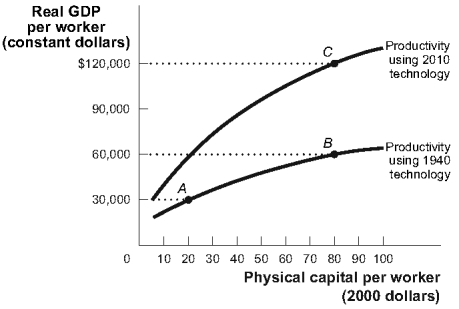 -(Figure: Technological Progress and Productivity Growth) Look at the figure Technological Progress and Productivity Growth. If there is a significant increase in human capital per worker (all other factors remaining unchanged), it is best indicated by a move from:
 (Multiple Choice)
4.9/5 (87)
(87) Suppose a panel of economists predicts that a nation's real GDP per capita will double in approximately 20 years. According to the rule of 70, what must be the predicted annual growth rate of real GDP per capita?
(Multiple Choice)
4.8/5 (76)
(76) If real GDP doubles in 35 years, its average annual growth rate is approximately:
(Multiple Choice)
5.0/5 (85)
(85) Use the following to answer questions :  -(Table: Kenya's Economy in 2010) Look at the table Kenya's Economy in 2010. Aggregate output at the end of 2010, assuming no changes in the price level, was about:
 (Multiple Choice)
5.0/5 (68)
(68) Among the factors that are important for economic growth are:
(Multiple Choice)
4.9/5 (87)
(87) Output per capita in the United States in 2010 was about _____ as high as in 1900.
(Multiple Choice)
4.8/5 (78)
(78) If output is growing at 5% annually, how many years will it take for output to quadruple?
(Multiple Choice)
4.9/5 (78)
(78) Diminishing returns to physical capital implies that when the human capital per worker and the state of technology remain fixed, each successive increase in physical capital leads to _____ productivity.
(Multiple Choice)
4.9/5 (78)
(78) Use the following to answer question 279:
Figure: The Aggregate Production Function 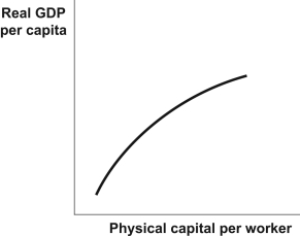 -(Figure: The Aggregate Production Function) Look at the figure The Aggregate Production Function. Does it exhibit diminishing returns to physical capital? Explain.
 (Essay)
4.8/5 (65)
(65) Use the following to answer questions :
Scenario: Growth Rates in Two Countries
India is growing at a rate of 9% per year, and its real GDP per capita is about $3,500, while the United States is growing at a rate of 3% per year, and its real GDP per capita is about $47,000.
-(Scenario: Growth Rates in Two Countries) Look at the scenario Growth Rates in Two Countries. How long will it take the United States to double its real GDP per capita?
(Multiple Choice)
4.8/5 (66)
(66) Use the following to answer questions :
Scenario: Productivity
The economy has grown by 4% per year over the past 30 years. During the same period the labor force has grown by 1% per year and the quantity of physical capital has grown by 5% per year. Each 1% increase in physical capital per worker is estimated to increase productivity by 0.4%. Assume that human capital has not changed during the past 30 years.
-(Scenario: Productivity) Look at the scenario Productivity. How much has growing physical capital per worker contributed to productivity growth?
(Multiple Choice)
5.0/5 (66)
(66) For developed countries, which of the following is considered the most important driver in productivity growth?
(Multiple Choice)
4.7/5 (80)
(80) Government spending is like investment in each of the following cases EXCEPT when:
(Multiple Choice)
4.9/5 (72)
(72) Research and development is defined as spending to develop and implement new technologies.
(True/False)
4.9/5 (88)
(88) During the latter half of the twentieth century, the Soviet Union made more physical capital available to its workers, but this increase resulted in successively smaller increases in productivity. This is an example of:
(Multiple Choice)
4.8/5 (73)
(73) 
Filters
- Essay(0)
- Multiple Choice(0)
- Short Answer(0)
- True False(0)
- Matching(0)