



 Chat with AI
Exam 9: Long-Run Economic Growth

Exam 1: First Principles233 Questions
Exam 2: Economic Models319 Questions
Exam 3: Supply and Demand292 Questions
Exam 5: International Trade 5274 Questions
Exam 6: Macroeconomics: the Big Picture168 Questions
Exam 7: Gdp and Cpi: Tracking the Macroeconomy434 Questions
Exam 8: Unemployment and Inflation354 Questions
Exam 9: Long-Run Economic Growth316 Questions
Exam 10: Savings, Investment Spending, and the Financial System402 Questions
Exam 13: Fiscal Policy Appendix Taxes and the Multiplier382 Questions
Exam 14: Money, Banking, and the Federal Reserve System468 Questions
Exam 15: Monetary Policy359 Questions
Exam 16: Inflation, Disinflation, and Deflation240 Questions
Exam 17: Crises and Consequences214 Questions
Exam 18: Events and Ideas322 Questions
Exam 19: Open-Economy Macroeconomics467 Questions
Exam 20: Graphs in Economics75 Questions
Exam 21: toward a Fuller Understanding of Present Value36 Questions
Select questions type


Growth accounting estimates the contribution to economic growth of each factor in the aggregate production function.
(True/False)
4.9/5  (86)
(86) In the past 30 years, both China and India have had substantial economic growth:
(Multiple Choice)
4.9/5 (82)
(82) High rates of savings and investment and a lack of consumption spending have contributed to the recent stagnant economic growth in Latin America.
(True/False)
4.8/5 (82)
(82) The average level of education, measured by the number of years the average adult has spent in school, is higher in Argentina than it is in China.
(True/False)
4.8/5 (82)
(82) A negative externality is a cost that individuals or firms impose on others without having to offer compensation.
(True/False)
4.8/5 (77)
(77) Suppose a panel of economists predicts that a nation's real GDP per capita will have an average annual growth rate of 2%. According to the rule of 70, how many years will it take for this nation's real GDP per capita to double?
(Multiple Choice)
4.9/5 (95)
(95) The rule of 70 states that a variable's approximate doubling time equals:
(Multiple Choice)
4.9/5 (75)
(75) Many impoverished nations struggle with diseases like malaria. How would reduction or elimination of malaria contribute to long-run economic growth?
(Essay)
4.9/5 (85)
(85) Which of the following countries is NOT characterized by abundant farmland and mineral deposits?
(Multiple Choice)
4.8/5 (81)
(81) Diminishing returns to physical capital means that when the amount of human capital per worker and the state of technology are held fixed, each increase in the amount of physical capital per worker leads to:
(Multiple Choice)
4.9/5 (75)
(75) The formula for the rule of 70, where n is number of years and r is growth rate, is expressed as:
(Multiple Choice)
4.8/5 (71)
(71) Use the following to answer questions :
Figure: Technological Progress and Productivity Growth 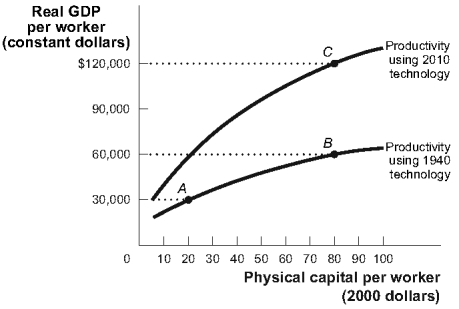 -(Figure: Technological Progress and Productivity Growth) Look at the figure Technological Progress and Productivity Growth. If there is an increase in physical capital per worker (all other factors remaining unchanged), it is best indicated by a move from:
 (Multiple Choice)
4.8/5 (72)
(72) Which of the following would shift the production function upward?
(Multiple Choice)
4.8/5 (80)
(80) In the book The Limits to Growth, The Club of Rome argued that:
(Multiple Choice)
4.8/5 (85)
(85) Roads, telephone lines, power facilities, and schools are examples of a nation's:
(Multiple Choice)
4.7/5 (92)
(92) When a country utilizes more physical capital per worker over time, there will be:
(Multiple Choice)
4.9/5 (85)
(85) Which of the following factors have contributed to the lack of economic growth in Latin America?
I. low rates of savings and investment
II. low value on education
III. political instability
(Multiple Choice)
4.8/5 (81)
(81) 
Filters
- Essay(0)
- Multiple Choice(0)
- Short Answer(0)
- True False(0)
- Matching(0)