



 Chat with AI
Exam 12: Firms in Perfectly Competitive Markets

Exam 1: Economics: Foundations and Models233 Questions
Exam 2: Trade-Offs, comparative Advantage, and the Market System259 Questions
Exam 3: Where Prices Come From: the Interaction of Demand and Supply242 Questions
Exam 4: Economic Efficiency, government Price Setting, and Taxes208 Questions
Exam 5: Externalities, environmental Policy, and Public Goods267 Questions
Exam 6: Elasticity: The Responsiveness of Demand and Supply295 Questions
Exam 7: The Economics of Health Care169 Questions
Exam 8: Firms, the Stock Market, and Corporate Governance278 Questions
Exam 9: Comparative Advantage and the Gains From International Trade189 Questions
Exam 10: Consumer Choice and Behavioral Economics302 Questions
Exam 11: Technology, production, and Costs330 Questions
Exam 12: Firms in Perfectly Competitive Markets298 Questions
Exam 13: Monopolistic Competition: the Competitive Model in a More Realistic Setting278 Questions
Exam 14: Oligopoly: Firms in Less Competitive Markets262 Questions
Exam 15: Monopoly and Antitrust Policy271 Questions
Exam 16: Pricing Strategy263 Questions
Exam 17: The Markets for Labor and Other Factors of Production286 Questions
Exam 18: Public Choice,taxes,and the Distribution of Income258 Questions
Select questions type


What assumptions are necessary for a market to be perfectly competitive? Explain why each of these assumptions is important.
(Essay)
4.8/5  (72)
(72) A perfectly competitive apple farm produces 1,000 bushels of apples at a total cost of $36,000.The price of each bushel is $50.Calculate the firm's short-run profit or loss.
(Multiple Choice)
5.0/5 (83)
(83) In the short run,a firm might choose to produce rather than shut down even if its market price is less than its average total cost of production.
(True/False)
4.8/5 (86)
(86) Which of the following describes a situation in which a good or service is produced at the lowest possible cost?
(Multiple Choice)
4.8/5 (68)
(68) Which of the following describes a difference between allocative efficiency and productive efficiency in a perfectly competitive market?
(Multiple Choice)
4.9/5 (79)
(79) Figure 12-2  -Refer to Figure 12-2.What happens if the firm produces more than Q4 units?
 (Multiple Choice)
4.9/5 (69)
(69) In long-run competitive equilibrium,the perfectly competitive firm produces where price equals minimum average total cost.
a.What is this efficiency criterion called?
b.How does it benefit consumers?
(Essay)
4.8/5 (93)
(93) Why are individual buyers and sellers in perfect competition called price takers?
(Essay)
4.8/5 (75)
(75) Perfectly competitive firms produce up to the point where the price of the good equals the marginal cost of producing the last unit.This condition is referred to as
(Multiple Choice)
4.8/5 (84)
(84) Figure 12-6  Figure 12-6 shows the demand, marginal cost (MC) and average total cost (ATC) curves for Jason's House of Apples.
-Refer to Figure 12-6.To maximize his profit,Jason should produce the rate of output indicated by point
Figure 12-6 shows the demand, marginal cost (MC) and average total cost (ATC) curves for Jason's House of Apples.
-Refer to Figure 12-6.To maximize his profit,Jason should produce the rate of output indicated by point (Multiple Choice)
4.8/5 (71)
(71) Explain two different ways to determine the profit-maximizing level of output for a firm in a perfectly competitive market.
(Essay)
5.0/5 (82)
(82) Figure 12-3 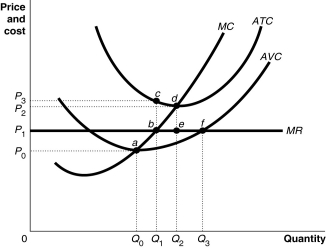 -Refer to Figure 12-3.Suppose the prevailing price is P1 and the firm is currently producing its loss-minimizing quantity.Identify the area that represents the loss.
 (Multiple Choice)
4.8/5 (90)
(90) Figure 12-2
-Refer to Figure 12-2.The firm breaks even at an output level of
-Refer to Figure 12-2.The firm breaks even at an output level of (Multiple Choice)
4.9/5 (82)
(82) Molly Sharp is producing a documentary about the plight of the six-toed ferrets of Sri Lanka.Molly has spent $125,000 of her own money on this project and the documentary is now complete.Molly just found out that no studio is willing to release her documentary and she must now shop it to cable television networks,where she knows she will not be able to recoup her investment.Which of the following statements regarding Molly Sharp's documentary is true?
(Multiple Choice)
5.0/5 (80)
(80) Figure 12-9  Figure 12-9 shows cost and demand curves facing a profit-maximizing, perfectly competitive firm.
-Refer to Figure 12-9.At price P2,the firm would
Figure 12-9 shows cost and demand curves facing a profit-maximizing, perfectly competitive firm.
-Refer to Figure 12-9.At price P2,the firm would (Multiple Choice)
4.8/5 (72)
(72) Apple introduced its iPhone 3G in July 2008 and within a month sales had topped 3 million units.By April 2009,more than 25,000 apps for the iPhone 3G were available in the iTunes store,an indication that in a competitive market
(Multiple Choice)
4.8/5 (72)
(72) A perfectly competitive firm's marginal revenue curve is downward sloping.
(True/False)
4.9/5 (70)
(70) 
Filters
- Essay(0)
- Multiple Choice(0)
- Short Answer(0)
- True False(0)
- Matching(0)