



 Chat with AI
Exam 12: Firms in Perfectly Competitive Markets

Exam 1: Economics: Foundations and Models233 Questions
Exam 2: Trade-Offs, comparative Advantage, and the Market System259 Questions
Exam 3: Where Prices Come From: the Interaction of Demand and Supply242 Questions
Exam 4: Economic Efficiency, government Price Setting, and Taxes208 Questions
Exam 5: Externalities, environmental Policy, and Public Goods267 Questions
Exam 6: Elasticity: The Responsiveness of Demand and Supply295 Questions
Exam 7: The Economics of Health Care169 Questions
Exam 8: Firms, the Stock Market, and Corporate Governance278 Questions
Exam 9: Comparative Advantage and the Gains From International Trade189 Questions
Exam 10: Consumer Choice and Behavioral Economics302 Questions
Exam 11: Technology, production, and Costs330 Questions
Exam 12: Firms in Perfectly Competitive Markets298 Questions
Exam 13: Monopolistic Competition: the Competitive Model in a More Realistic Setting278 Questions
Exam 14: Oligopoly: Firms in Less Competitive Markets262 Questions
Exam 15: Monopoly and Antitrust Policy271 Questions
Exam 16: Pricing Strategy263 Questions
Exam 17: The Markets for Labor and Other Factors of Production286 Questions
Exam 18: Public Choice,taxes,and the Distribution of Income258 Questions
Select questions type


In the short run,a profit-maximizing firm will shut down if its total revenue is greater than its variable costs.
(True/False)
4.9/5  (91)
(91) For a perfectly competitive firm,at the profit-maximizing output average revenue equals marginal cost.
(True/False)
4.8/5 (80)
(80) Assume that the LCD and plasma television sets industry is perfectly competitive.Suppose a producer develops a successful innovation that enables it to lower its cost of production.What happens in the short run and in the long run?
(Multiple Choice)
5.0/5 (87)
(87) Assume that the tuna fishing industry is perfectly competitive.Which of the following best characterizes the industry if,as demand for tuna increases,fishing boats have to go farther into the ocean to harvest tuna?
(Multiple Choice)
4.7/5 (79)
(79) The long-run supply curve for a perfectly competitive,constant-cost industry
(Multiple Choice)
4.9/5 (85)
(85) For a perfectly competitive firm,average revenue is equal to
(Multiple Choice)
4.8/5 (79)
(79) Figure 12-6  Figure 12-6 shows the demand, marginal cost (MC) and average total cost (ATC) curves for Jason's House of Apples.
-Refer to Figure 12-6.Jason is currently producing 20 thousand pounds of apples.To maximize his profit Jason should
Figure 12-6 shows the demand, marginal cost (MC) and average total cost (ATC) curves for Jason's House of Apples.
-Refer to Figure 12-6.Jason is currently producing 20 thousand pounds of apples.To maximize his profit Jason should (Multiple Choice)
4.9/5 (78)
(78) Figure 12-5  Figure 12-5 shows cost and demand curves facing a typical firm in a constant-cost, perfectly competitive industry.
-Refer to Figure 12-5.If the market price is $20,what is the average profit at the profit-maximizing quantity?
Figure 12-5 shows cost and demand curves facing a typical firm in a constant-cost, perfectly competitive industry.
-Refer to Figure 12-5.If the market price is $20,what is the average profit at the profit-maximizing quantity? (Multiple Choice)
4.9/5 (85)
(85) Figure 12-8  -Refer to Figure 12-8.Suppose the market price is $120.Which of the following is true?
 (Multiple Choice)
4.9/5 (87)
(87) The demand curve for each seller's product in perfect competition is horizontal at the market price because
(Multiple Choice)
4.8/5 (74)
(74) Which of the following is not true for a firm in perfect competition?
(Multiple Choice)
4.8/5 (70)
(70) Figure 12-1  -Refer to Figure 12-1.If the firm is producing 700 units,what is the amount of its profit or loss?
 (Multiple Choice)
4.8/5 (89)
(89) Which of the following offers the best reason why restaurants are not considered to be perfectly competitive firms?
(Multiple Choice)
4.9/5 (77)
(77) Figure 12-8
-Refer to Figure 12-8.Suppose the firm produces 4,000 units.What does the shaded area labeled B represent?
-Refer to Figure 12-8.Suppose the firm produces 4,000 units.What does the shaded area labeled B represent? (Multiple Choice)
4.9/5 (71)
(71) A firm's total profit can be calculated as all of the following except
(Multiple Choice)
4.9/5 (89)
(89) Figure 12-19 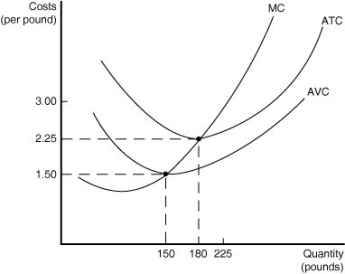 -Refer to Figure 12-19.The figure above shows the cost curves of a perfectly competitive firm in the coffee market.Use the graph in Figure 12-19 to answer the following questions.Assume the market price is $3 per pound.
a.What is the lowest price at which the coffee grower will supply output in the short run?
b.In the diagram draw the firm's demand curve (label this "MR" for marginal revenue).
c.What is the firm's profit-maximizing output?
d.Is the firm earning a profit or a loss? Identify the area in the graph that represents the firm's profit or loss.
e.Explain how entry or exit will occur in the market to ensure that firms will break even in the long run.
-Refer to Figure 12-19.The figure above shows the cost curves of a perfectly competitive firm in the coffee market.Use the graph in Figure 12-19 to answer the following questions.Assume the market price is $3 per pound.
a.What is the lowest price at which the coffee grower will supply output in the short run?
b.In the diagram draw the firm's demand curve (label this "MR" for marginal revenue).
c.What is the firm's profit-maximizing output?
d.Is the firm earning a profit or a loss? Identify the area in the graph that represents the firm's profit or loss.
e.Explain how entry or exit will occur in the market to ensure that firms will break even in the long run. (Essay)
4.8/5 (81)
(81) Suppose Veronica sells teapots in the perfectly competitive teapot market.Her output per day and her costs are as follows:
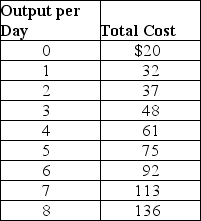 Suppose the current equilibrium price in the teapot market is $20.To maximize profit,how many teapots will Veronica produce,what price will she charge,and how much profit (or loss)will she make? Draw a graph to illustrate your answer.Your graph should include Veronica's demand,ATC,AVC,MC,and MR curves,the price she is charging,the quantity she is producing,and the area representing her profit (or loss).
 (Essay)
4.8/5 (84)
(84) The price of a seller's product in perfect competition is determined by
(Multiple Choice)
4.9/5 (69)
(69) Figure 12-7  Figure 12-7 illustrates the cost curves of a perfectly competitive firm.
-Refer to Figure 12-7.If the market price is P1
Figure 12-7 illustrates the cost curves of a perfectly competitive firm.
-Refer to Figure 12-7.If the market price is P1 (Multiple Choice)
4.7/5 (82)
(82) 
Filters
- Essay(0)
- Multiple Choice(0)
- Short Answer(0)
- True False(0)
- Matching(0)