



 Chat with AI
Exam 16: Pricing Strategy

Exam 1: Economics: Foundations and Models233 Questions
Exam 2: Trade-Offs, comparative Advantage, and the Market System259 Questions
Exam 3: Where Prices Come From: the Interaction of Demand and Supply242 Questions
Exam 4: Economic Efficiency, government Price Setting, and Taxes208 Questions
Exam 5: Externalities, environmental Policy, and Public Goods267 Questions
Exam 6: Elasticity: The Responsiveness of Demand and Supply295 Questions
Exam 7: The Economics of Health Care169 Questions
Exam 8: Firms, the Stock Market, and Corporate Governance278 Questions
Exam 9: Comparative Advantage and the Gains From International Trade189 Questions
Exam 10: Consumer Choice and Behavioral Economics302 Questions
Exam 11: Technology, production, and Costs330 Questions
Exam 12: Firms in Perfectly Competitive Markets298 Questions
Exam 13: Monopolistic Competition: the Competitive Model in a More Realistic Setting278 Questions
Exam 14: Oligopoly: Firms in Less Competitive Markets262 Questions
Exam 15: Monopoly and Antitrust Policy271 Questions
Exam 16: Pricing Strategy263 Questions
Exam 17: The Markets for Labor and Other Factors of Production286 Questions
Exam 18: Public Choice,taxes,and the Distribution of Income258 Questions
Select questions type


Figure 16-5  -Refer to Figure 16-5.Suppose the firm represented in the diagram decides to use a two-part pricing strategy such that it charges a fixed fee and a per-unit price equal to the monopoly price.What is the quantity it should produce?
Free
(Multiple Choice)
4.8/5  (74)
(74) Correct Answer: Verified
B
Table 16-2
 Neem Products sells its Ayurvedic Neem toothpaste in two completely isolated markets with demand schedules as shown in Table 16-2. The average cost of production is constant at $2 per tube.
-Refer to Table 16-2.How many tubes of toothpaste will Neem sell in Middle Fall and at what price?
Neem Products sells its Ayurvedic Neem toothpaste in two completely isolated markets with demand schedules as shown in Table 16-2. The average cost of production is constant at $2 per tube.
-Refer to Table 16-2.How many tubes of toothpaste will Neem sell in Middle Fall and at what price?Free
(Multiple Choice)
4.8/5 (82)
(82) Correct Answer:Verified
VerifiedC
Economists believe that cost-plus pricing may be the best way for a firm to determine its optimal product price when the firm's marginal cost and average cost are about the same and when it is difficult to estimate the product's demand curve.
Free
(True/False)
4.9/5 (91)
(91) Correct Answer:Verified
VerifiedTrue
Book publishers use price discrimination routinely,but the form of price discrimination they use is different from the form used by airlines and other industries.Explain.
(Essay)
4.8/5 (74)
(74) When a firm charges $4.95 instead of $5.00,what do economists call this pricing strategy?
(Multiple Choice)
4.9/5 (82)
(82) Harvey Morris bought dishes and pitchers made of blue glass during the Great Depression at a flea market.He later resold these items on eBay.The profits Harvey earned from these sales are
(Multiple Choice)
4.9/5 (82)
(82) The law of one price holds exactly only if there are transactions costs associated with buying a product in one location and selling it in another location.
(True/False)
4.7/5 (85)
(85) Figure 16-4 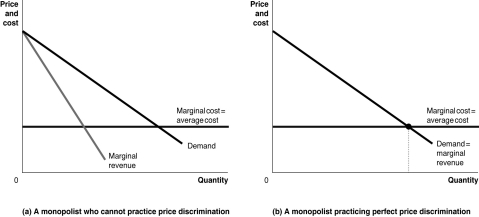 -Refer to Figure 16-4.Graph (a)represents a monopolist who cannot price discriminate and graph (b)represents a monopolist practicing perfect price discrimination.On each graph,identify the monopoly price,the monopoly output,the efficient output,and the areas representing profit,consumer surplus,and deadweight loss.
 (Essay)
5.0/5 (74)
(74) Price discrimination is possible in which of the following market structures?
a.perfect competition
b.monopoly
c.oligopoly
d.monopolistic competition
(Multiple Choice)
4.9/5 (85)
(85) For a firm that can effectively price discriminate,who will be charged a lower price?
(Multiple Choice)
4.9/5 (89)
(89) Consider the following actions undertaken by a firm:
a.charging the same price for products of different quality
b.charging different prices to different consumers for the same product when the variation cannot be explained by cost differences
c.charging different prices for products of different qualities
d.charging a lower price to match a competitor's price
Which of the above will be considered price discrimination?
(Multiple Choice)
4.9/5 (71)
(71) Table 16-3
 Julie plans to start a pet-sitting service. She surveyed her neighborhood to determine the demand for this service. Assume that each person surveyed demands only one hour of pet sitting services per period. Table 16-3 above shows a portion of her survey results.
-Refer to Table 16-3.Suppose Julie's marginal cost of providing this service is constant at $7 and she charges each customer according to his or her willingness to pay instead of a uniform price of $7.Which of the following statements is true?
Julie plans to start a pet-sitting service. She surveyed her neighborhood to determine the demand for this service. Assume that each person surveyed demands only one hour of pet sitting services per period. Table 16-3 above shows a portion of her survey results.
-Refer to Table 16-3.Suppose Julie's marginal cost of providing this service is constant at $7 and she charges each customer according to his or her willingness to pay instead of a uniform price of $7.Which of the following statements is true? (Multiple Choice)
5.0/5 (80)
(80) According to a New York Times article,shoppers from New York City have played a game of "retail arbitrage" by shopping at malls in Northern New Jersey,a state where there is no tax on clothing and shoes.Even after accounting for transaction costs,shoppers could still save money on their clothing and footwear purchases. Source: Ken Belson and Nate Schweber,"Sales Tax Cut in City May Dim Allure of Stores Across Hudson," New York Times,January 18,2007.
Is the term "arbitrage" correctly used here?
(Multiple Choice)
4.9/5 (62)
(62) Figure 16-5
-Refer to Figure 16-5.Suppose the firm represented in the diagram decides to use a two-part pricing strategy such that it charges a fixed fee and a per-unit price equal to the competitive price.(This is also called an optimal two-part tariff.)What is the value of the consumer surplus from this pricing strategy?
-Refer to Figure 16-5.Suppose the firm represented in the diagram decides to use a two-part pricing strategy such that it charges a fixed fee and a per-unit price equal to the competitive price.(This is also called an optimal two-part tariff.)What is the value of the consumer surplus from this pricing strategy? (Multiple Choice)
4.8/5 (66)
(66) Reporters from the Wall Street Journal found that the office supply store Staples charged different prices for the same product to different online customers based primarily on
(Multiple Choice)
4.8/5 (71)
(71) Consider the following pricing strategies:
a.perfect price discrimination
b.charging different prices to different groups of customers
c.optimal two-part tariff
d.single-price monopoly pricing
Which of the pricing strategies allows a producer to capture the entire consumer surplus that would have gone to consumers under perfect competitive pricing?
(Multiple Choice)
4.9/5 (101)
(101) If a monopolist engages in first-degree price discrimination,it will produce the same output level as a perfectly competitive industry.
(True/False)
4.8/5 (98)
(98) 
Filters
- Essay(0)
- Multiple Choice(0)
- Short Answer(0)
- True False(0)
- Matching(0)