



 Chat with AI
Exam 16: Pricing Strategy

Exam 1: Economics: Foundations and Models233 Questions
Exam 2: Trade-Offs, comparative Advantage, and the Market System259 Questions
Exam 3: Where Prices Come From: the Interaction of Demand and Supply242 Questions
Exam 4: Economic Efficiency, government Price Setting, and Taxes208 Questions
Exam 5: Externalities, environmental Policy, and Public Goods267 Questions
Exam 6: Elasticity: The Responsiveness of Demand and Supply295 Questions
Exam 7: The Economics of Health Care169 Questions
Exam 8: Firms, the Stock Market, and Corporate Governance278 Questions
Exam 9: Comparative Advantage and the Gains From International Trade189 Questions
Exam 10: Consumer Choice and Behavioral Economics302 Questions
Exam 11: Technology, production, and Costs330 Questions
Exam 12: Firms in Perfectly Competitive Markets298 Questions
Exam 13: Monopolistic Competition: the Competitive Model in a More Realistic Setting278 Questions
Exam 14: Oligopoly: Firms in Less Competitive Markets262 Questions
Exam 15: Monopoly and Antitrust Policy271 Questions
Exam 16: Pricing Strategy263 Questions
Exam 17: The Markets for Labor and Other Factors of Production286 Questions
Exam 18: Public Choice,taxes,and the Distribution of Income258 Questions
Select questions type


Figure 16-6  Watanabe Sensei operates the only martial arts school in Hartfield. For simplicity, assume that consumers have identical demand curves and that Sensei knows what this demand curve is. Figure 16-6 shows this demand curve.
-Refer to Figure 16-6.Suppose instead of charging the monopoly price for his classes,Sensei charges the competitive price.What is the competitive price and what is the quantity demanded at this price?
Watanabe Sensei operates the only martial arts school in Hartfield. For simplicity, assume that consumers have identical demand curves and that Sensei knows what this demand curve is. Figure 16-6 shows this demand curve.
-Refer to Figure 16-6.Suppose instead of charging the monopoly price for his classes,Sensei charges the competitive price.What is the competitive price and what is the quantity demanded at this price? (Multiple Choice)
4.9/5  (79)
(79) For many products,such as fast foods,a variety of prices can be found,but sellers with higher prices can expect to sell their products because
(Multiple Choice)
4.8/5 (79)
(79) Suppose a restaurant is trying to determine how much to charge for a bowl of chili,and decides to run an experiment to see how much its customers are willing to pay by allowing them to set their own price for this menu item.
a.Is charging a customer the price he or she is willing to pay for the bowl of chili an example of price discrimination? Briefly explain.
b.What is it called when a firm knows every consumer's willingness to pay,and can charge every consumer a different price? What happens to consumer surplus in this situation?
(Essay)
4.8/5 (73)
(73) Why is it necessary for a firm that practices price discrimination be a price maker rather than a price taker?
(Essay)
5.0/5 (72)
(72) Figure 16-6 Watanabe Sensei operates the only martial arts school in Hartfield. For simplicity, assume that consumers have identical demand curves and that Sensei knows what this demand curve is. Figure 16-6 shows this demand curve.
-Refer to Figure 16-6.If Sensei acts as a monopolist,his profit-maximizing price is ________ and the number of classes sold is ________.
Watanabe Sensei operates the only martial arts school in Hartfield. For simplicity, assume that consumers have identical demand curves and that Sensei knows what this demand curve is. Figure 16-6 shows this demand curve.
-Refer to Figure 16-6.If Sensei acts as a monopolist,his profit-maximizing price is ________ and the number of classes sold is ________. (Multiple Choice)
4.8/5 (83)
(83) Firms engage in odd pricing when they charge prices that appear to be less than they really are; for example,charging a price of $4.95 instead of $5.00 and $.99 instead of $1.00.How have researchers tried to determine whether odd pricing is successful in convincing consumers that odd prices are less than they really are?
(Essay)
4.9/5 (93)
(93) A two-part tariff refers to a pricing schedule under which a buyer must pay a fixed fee for the right to purchase the product,in addition to a per-unit price.
(True/False)
4.8/5 (79)
(79) What is yield management? How is yield management being used in the airline industry?
(Essay)
4.9/5 (80)
(80) Differentiating products to suit customers' tastes is a form of price discrimination.
(True/False)
4.8/5 (87)
(87) Assume that a monopolist practices perfect price discrimination.The firm will produce an output rate
(Multiple Choice)
4.8/5 (73)
(73) Under what circumstances will the law of one price hold,and when might it not hold?
(Essay)
5.0/5 (80)
(80) There is no evidence that odd pricing succeeds in convincing consumers that prices are lower than they really are.
(True/False)
5.0/5 (72)
(72) When Disneyland opened in 1955,what prices were charged for admission and rides?
(Multiple Choice)
4.9/5 (72)
(72) Which of the following products allows the seller to identify different groups of consumers (segment the market)and practice price discrimination?
(Multiple Choice)
4.9/5 (74)
(74) If,at the firm's projected sales level,the marginal cost is $40,the average cost is $50 and the markup is 30 percent,then its selling price is
(Multiple Choice)
4.9/5 (82)
(82) Which of the following statements about two-part tariffs is false?
(Multiple Choice)
4.8/5 (81)
(81) Table 16-2
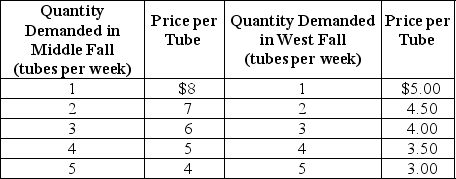 Neem Products sells its Ayurvedic Neem toothpaste in two completely isolated markets with demand schedules as shown in Table 16-2. The average cost of production is constant at $2 per tube.
-Refer to Table 16-2.Which of the following statements is true about the two markets?
Neem Products sells its Ayurvedic Neem toothpaste in two completely isolated markets with demand schedules as shown in Table 16-2. The average cost of production is constant at $2 per tube.
-Refer to Table 16-2.Which of the following statements is true about the two markets? (Multiple Choice)
4.9/5 (80)
(80) 
Filters
- Essay(0)
- Multiple Choice(0)
- Short Answer(0)
- True False(0)
- Matching(0)