



 Chat with AI
Exam 22: The Respiratory System

Exam 1: The Human Body: an Orientation118 Questions
Exam 2: Chemistry Comes Alive137 Questions
Exam 3: Cells: the Living Units131 Questions
Exam 4: Tissue: the Living Fabric109 Questions
Exam 5: The Integumentary System112 Questions
Exam 6: Bones and Skeletal Tissue106 Questions
Exam 7: The Skeleton125 Questions
Exam 8: Joints103 Questions
Exam 9: Muscles and Muscle Tissue129 Questions
Exam 10: The Muscular System100 Questions
Exam 11: Fundamentals of the Nervous System and Nervous Tissue95 Questions
Exam 12: The Central Nervous System138 Questions
Exam 13: The Peripheral Nervous System and Reflex Activity103 Questions
Exam 14: The Autonomic Nervous System103 Questions
Exam 15: The Special Senses147 Questions
Exam 16: The Endocrine System129 Questions
Exam 17: Blood126 Questions
Exam 18: The Cardiovascular System: the Heart107 Questions
Exam 19: The Cardiovascular System: Blood Vessels133 Questions
Exam 20: The Lymphatic System and Lymphoid Organs and Tissues88 Questions
Exam 21: The Immune System: Innate and Adaptive Body Defenses124 Questions
Exam 22: The Respiratory System123 Questions
Exam 23: The Digestive System148 Questions
Exam 24: Nutrition,metabolism,and Body Temperature Regulation123 Questions
Exam 25: The Urinary System129 Questions
Exam 26: Fluid,electrolyte,and Acid-Base Balance110 Questions
Exam 27: The Reproductive System131 Questions
Exam 28: Pregnancy and Human Development99 Questions
Exam 29: Heredity120 Questions
Select questions type


A patient with tuberculosis is often noncompliant with treatment.Explain why this may happen.
(Essay)
4.9/5  (86)
(86) The nose serves all of the following functions EXCEPT ________.
(Multiple Choice)
5.0/5 (69)
(69)  Figure 22.1
Using Figure 22.1, match the following:
-Trachea.
Figure 22.1
Using Figure 22.1, match the following:
-Trachea. (Multiple Choice)
4.8/5 (82)
(82) A patient was admitted to the hospital with chronic obstructive pulmonary disease.His PO2 was 55 and PCO2 was 65.A new resident orders 54% oxygen via the venturi mask.One hour later,after the oxygen was placed,the nurse finds the patient with no respiration or pulse.She calls for a Code Blue and begins cardiopulmonary resuscitation (CPR).Explain why the patient stopped breathing.
(Essay)
4.7/5 (85)
(85) Intrapleural pressure is normally about 4 mm Hg less than the pressure in the alveoli.
(True/False)
4.9/5 (67)
(67) Which of the choices below is NOT a factor that promotes oxygen binding to and dissociation from hemoglobin?
(Multiple Choice)
4.8/5 (87)
(87) The contraction of the diaphragm and the external intercostal muscles begins inspiration.Explain exactly what happens,in terms of volume and pressure changes in the lungs,when these muscles contract.
(Essay)
4.9/5 (73)
(73) 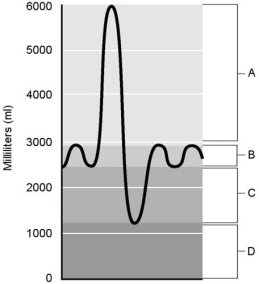 Figure 22.2
Using Figure 22.2, match the following:
-Air that does not participate in the exchange of gases.
Figure 22.2
Using Figure 22.2, match the following:
-Air that does not participate in the exchange of gases. (Multiple Choice)
4.9/5 (76)
(76) Match the following:
-Where the respiratory zone of the lungs begins.
(Multiple Choice)
4.7/5 (73)
(73) Which respiratory-associated muscles would contract or relax during forced expiration,for example blowing up a balloon?
(Multiple Choice)
5.0/5 (80)
(80) Select the correct statement about the neural mechanisms of respiratory control.
(Multiple Choice)
4.8/5 (65)
(65) Oxygen and carbon dioxide are exchanged in the lungs and through all cell membranes by ________.
(Multiple Choice)
4.9/5 (72)
(72) According to the oxygen-hemoglobin dissociation curve,PO2 in the lungs of 100 mm Hg results in Hb being 98% saturated.At high altitude,there is less O2.At a PO2 in the lungs of 80 mm Hg,Hb would be ________ saturated.
(Multiple Choice)
4.9/5 (67)
(67) Match the following:
-Composed of simple squamous epithelium.
(Multiple Choice)
4.9/5 (82)
(82) Using spirometry,a patient discovers their forced expiratory volume (FEV)after the first second is 40%.What does this suggest?
(Multiple Choice)
4.8/5 (88)
(88) 
Filters
- Essay(0)
- Multiple Choice(0)
- Short Answer(0)
- True False(0)
- Matching(0)