



 Chat with AI
Exam 22: The Respiratory System

Exam 1: The Human Body: an Orientation118 Questions
Exam 2: Chemistry Comes Alive137 Questions
Exam 3: Cells: the Living Units131 Questions
Exam 4: Tissue: the Living Fabric109 Questions
Exam 5: The Integumentary System112 Questions
Exam 6: Bones and Skeletal Tissue106 Questions
Exam 7: The Skeleton125 Questions
Exam 8: Joints103 Questions
Exam 9: Muscles and Muscle Tissue129 Questions
Exam 10: The Muscular System100 Questions
Exam 11: Fundamentals of the Nervous System and Nervous Tissue95 Questions
Exam 12: The Central Nervous System138 Questions
Exam 13: The Peripheral Nervous System and Reflex Activity103 Questions
Exam 14: The Autonomic Nervous System103 Questions
Exam 15: The Special Senses147 Questions
Exam 16: The Endocrine System129 Questions
Exam 17: Blood126 Questions
Exam 18: The Cardiovascular System: the Heart107 Questions
Exam 19: The Cardiovascular System: Blood Vessels133 Questions
Exam 20: The Lymphatic System and Lymphoid Organs and Tissues88 Questions
Exam 21: The Immune System: Innate and Adaptive Body Defenses124 Questions
Exam 22: The Respiratory System123 Questions
Exam 23: The Digestive System148 Questions
Exam 24: Nutrition,metabolism,and Body Temperature Regulation123 Questions
Exam 25: The Urinary System129 Questions
Exam 26: Fluid,electrolyte,and Acid-Base Balance110 Questions
Exam 27: The Reproductive System131 Questions
Exam 28: Pregnancy and Human Development99 Questions
Exam 29: Heredity120 Questions
Select questions type


Which of the following INCORRECTLY describes mechanisms of CO2 transport?
(Multiple Choice)
4.9/5  (83)
(83)  Figure 22.1
Using Figure 22.1, match the following:
-Main (primary)bronchus.
Figure 22.1
Using Figure 22.1, match the following:
-Main (primary)bronchus. (Multiple Choice)
5.0/5 (72)
(72) 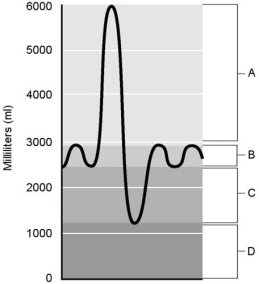 Figure 22.2
Using Figure 22.2, match the following:
-Expiratory reserve volume.
Figure 22.2
Using Figure 22.2, match the following:
-Expiratory reserve volume. (Multiple Choice)
5.0/5 (79)
(79) The law that applies to the amount of CO2 you could dissolve in a soda is called ________ law.
(Multiple Choice)
4.9/5 (78)
(78) The partial pressure gradient for oxygen (in the body)is much steeper than that for carbon dioxide.Explain how equal amounts of these two gases can be exchanged (in a given time interval)in the lungs and at the tissues.
(Essay)
4.9/5 (89)
(89) The Heimlich maneuver is a procedure in which air in the lungs is used to expel a piece of food that obstructs the opening to the trachea.
(True/False)
4.9/5 (65)
(65) Figure 22.2
Using Figure 22.2, match the following:
-Inspiratory reserve volume.
Figure 22.2
Using Figure 22.2, match the following:
-Inspiratory reserve volume. (Multiple Choice)
5.0/5 (73)
(73) Strong emotions and pain,acting through the limbic system and hypothalamus,send signals to the respiratory centers that modulate respiratory rate and depth.
(True/False)
4.9/5 (88)
(88) For gas exchange to be efficient,the respiratory membrane must be ________.
(Multiple Choice)
4.8/5 (91)
(91) Which of the following is responsible for holding the lungs to the thorax wall are ________.
(Multiple Choice)
4.9/5 (85)
(85) The statement,"in a mixture of gases,the total pressure is the sum of the individual partial pressures of gases in the mixture" paraphrases ________.
(Multiple Choice)
4.8/5 (88)
(88) Match the following:
-The respiratory membrane is composed of fused basement membrane of the capillary walls and ________.
(Multiple Choice)
4.8/5 (74)
(74) Factors that influence the rate and depth of breathing include ________.
(Multiple Choice)
4.9/5 (59)
(59) The erythrocyte (red blood cell)count increases after a while when an individual goes from a low to a high altitude because the ________.
(Multiple Choice)
4.9/5 (85)
(85) Which of the following is the leading cause of cancer death for both men and women in North America?
(Multiple Choice)
4.8/5 (66)
(66) Smoking diminishes ciliary action and eventually destroys the cilia.
(True/False)
4.8/5 (83)
(83) 
Filters
- Essay(0)
- Multiple Choice(0)
- Short Answer(0)
- True False(0)
- Matching(0)