



 Chat with AI
Exam 30: The International Financial System

Exam 1: Economics: Foundations and Models444 Questions
Exam 2: Trade-Offs, Comparative Advantage, and the Market System498 Questions
Exam 3: Where Prices Come From: the Interaction of Demand and Supply475 Questions
Exam 4: Economic Efficiency, Government Price Setting, and Taxes419 Questions
Exam 5: Externalities, Environmental Policy, and Public Goods266 Questions
Exam 6: Elasticity: the Responsiveness of Demand and Supply295 Questions
Exam 7: The Economics of Health Care334 Questions
Exam 8: Firms, the Stock Market, and Corporate Governance278 Questions
Exam 9: Comparative Advantage and the Gains From International Trade379 Questions
Exam 10: Consumer Choice and Behavioral Economics302 Questions
Exam 11: Technology, Production, and Costs330 Questions
Exam 12: Firms in Perfectly Competitive Markets298 Questions
Exam 13: Monopolistic Competition: the Competitive Model in a More Realistic Setting276 Questions
Exam 14: Oligopoly: Firms in Less Competitive Markets262 Questions
Exam 15: Monopoly and Antitrust Policy271 Questions
Exam 16: Pricing Strategy263 Questions
Exam 17: The Markets for Labor and Other Factors of Production286 Questions
Exam 18: Public Choice, Taxes, and the Distribution of Income258 Questions
Exam 19: GDP: Measuring Total Production and Income266 Questions
Exam 20: Unemployment and Inflation292 Questions
Exam 21: Economic Growth, the Financial System, and Business Cycles257 Questions
Exam 22: Long-Run Economic Growth: Sources and Policies268 Questions
Exam 23: Aggregate Expenditure and Output in the Short Run306 Questions
Exam 24: Aggregate Demand and Aggregate Supply Analysis284 Questions
Exam 25: Money, Banks, and the Federal Reserve System280 Questions
Exam 26: Monetary Policy277 Questions
Exam 27: Fiscal Policy303 Questions
Exam 28: Inflation, Unemployment, and Federal Reserve Policy257 Questions
Exam 29: Macroeconomics in an Open Economy278 Questions
Exam 30: The International Financial System262 Questions
Select questions type


If the equilibrium exchange rate exceeds the par exchange rate in the market for pounds, the pound is overvalued.
(True/False)
4.7/5  (78)
(78) Suppose an economy's exchange rate system is the gold standard and vast tracks of gold are discovered, as is what happened in the United States in 1849. If the economy is at full employment, what should this discovery do?
(Multiple Choice)
4.8/5 (68)
(68) If currencies around the world are based on the gold standard, and the EU lowers the amount of gold for which the euro will trade, then holding all else constant,
(Multiple Choice)
4.8/5 (87)
(87) How will the exchange rate (foreign currency per dollar) respond to a decrease in the relative rate of productivity growth in the United States in the long run?
(Multiple Choice)
5.0/5 (82)
(82) The ________ in the United States is best described as a managed float exchange rate system.
(Multiple Choice)
4.9/5 (79)
(79) Because the value of the euro is determined by factors that affect the entire euro zone, during the recession of 2007-2009, individual countries using the euro
(Multiple Choice)
4.8/5 (84)
(84) The "Big Mac Theory of Exchange Rates" tests the accuracy of purchasing power parity theory. In July 2013, The Economist reported that the average price of a Big Mac in the United States was $4.56. In India, the average price of a Big Mac at that time was 90 rupees. What is the "implied exchange rate" between the yen and the dollar?
(Multiple Choice)
4.7/5 (75)
(75) Expanding, contracting, and managing the money supply is easier for a central bank under the gold standard.
(True/False)
4.9/5 (67)
(67) Shares of stock and long-term debt, including corporate and government bonds and bank loans, are bought and sold on
(Multiple Choice)
4.9/5 (82)
(82) When the value of a currency is determined ________, the exchange rate system is defined as managed float.
(Multiple Choice)
4.8/5 (73)
(73) In 1991, Argentina decided to peg its currency (the Argentinean peso) to the U.S. dollar. To maintain the peg, Argentina had to purchase surplus pesos on the foreign exchange market, depleting its reserves of dollars to such an extent that it eventually had to abandon the peg. Show graphically what this implies about the peg relative to the equilibrium exchange rate in the market for the Argentinean peso.
(Essay)
4.9/5 (82)
(82) Although the pegged exchange rate between the yuan and the dollar has ________ the yuan, China has been reluctant to abandon the peg for fear that abandoning the peg would ________.
(Multiple Choice)
5.0/5 (75)
(75) Figure 30-1  -Refer to Figure 30-1. Which of the following would cause the change depicted in the figure above?
 (Multiple Choice)
4.8/5 (82)
(82) The currency adopted by most countries in Western Europe is referred to as the
(Multiple Choice)
4.8/5 (68)
(68) All of the following actions were taken by the Thai government to help Thailand maintain its peg against the dollar in the 1990s except
(Multiple Choice)
4.8/5 (71)
(71) If, at the current exchange rate between the dollar and the Norwegian kroner of 5.78 kroner per dollar, the dollar is "overvalued," how do you expect demand and supply in the foreign exchange markets to respond?
(Multiple Choice)
4.7/5 (84)
(84) Figure 30-4 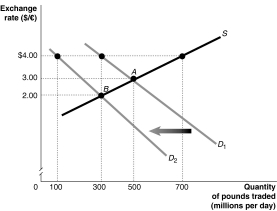 -Refer to Figure 30-4. The equilibrium exchange rate is originally at A, $3/pound. Suppose the British government pegs its currency at $4/pound. Speculators expect that the value of the pound will drop and this shifts the demand curve for pounds to D2. If the government abandons the peg, the equilibrium exchange rate would be
 (Multiple Choice)
4.9/5 (77)
(77) During the Chinese experience with pegging the yuan to the dollar, the yuan was ________. As a result, there was a ________ of dollars on the market, and the Chinese government had to purchase dollars to maintain the peg.
(Multiple Choice)
4.7/5 (80)
(80) Why might a developing country choose to peg the value of its currency to the dollar?
(Essay)
4.9/5 (89)
(89) If a country sets a pegged exchange rate that is above the equilibrium exchange rate, how can the country maintain the peg?
(Multiple Choice)
5.0/5 (70)
(70) 
Filters
- Essay(0)
- Multiple Choice(0)
- Short Answer(0)
- True False(0)
- Matching(0)