



 Chat with AI
Exam 30: The International Financial System

Exam 1: Economics: Foundations and Models444 Questions
Exam 2: Trade-Offs, Comparative Advantage, and the Market System498 Questions
Exam 3: Where Prices Come From: the Interaction of Demand and Supply475 Questions
Exam 4: Economic Efficiency, Government Price Setting, and Taxes419 Questions
Exam 5: Externalities, Environmental Policy, and Public Goods266 Questions
Exam 6: Elasticity: the Responsiveness of Demand and Supply295 Questions
Exam 7: The Economics of Health Care334 Questions
Exam 8: Firms, the Stock Market, and Corporate Governance278 Questions
Exam 9: Comparative Advantage and the Gains From International Trade379 Questions
Exam 10: Consumer Choice and Behavioral Economics302 Questions
Exam 11: Technology, Production, and Costs330 Questions
Exam 12: Firms in Perfectly Competitive Markets298 Questions
Exam 13: Monopolistic Competition: the Competitive Model in a More Realistic Setting276 Questions
Exam 14: Oligopoly: Firms in Less Competitive Markets262 Questions
Exam 15: Monopoly and Antitrust Policy271 Questions
Exam 16: Pricing Strategy263 Questions
Exam 17: The Markets for Labor and Other Factors of Production286 Questions
Exam 18: Public Choice, Taxes, and the Distribution of Income258 Questions
Exam 19: GDP: Measuring Total Production and Income266 Questions
Exam 20: Unemployment and Inflation292 Questions
Exam 21: Economic Growth, the Financial System, and Business Cycles257 Questions
Exam 22: Long-Run Economic Growth: Sources and Policies268 Questions
Exam 23: Aggregate Expenditure and Output in the Short Run306 Questions
Exam 24: Aggregate Demand and Aggregate Supply Analysis284 Questions
Exam 25: Money, Banks, and the Federal Reserve System280 Questions
Exam 26: Monetary Policy277 Questions
Exam 27: Fiscal Policy303 Questions
Exam 28: Inflation, Unemployment, and Federal Reserve Policy257 Questions
Exam 29: Macroeconomics in an Open Economy278 Questions
Exam 30: The International Financial System262 Questions
Select questions type


Figure 30-2 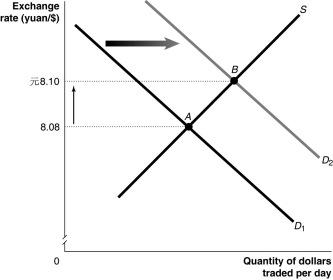 -Refer to Figure 30-2. Which of the following would cause the change depicted in the figure above?
 (Multiple Choice)
4.7/5  (74)
(74) Figure 30-4  -Refer to Figure 30-4. The equilibrium exchange rate is at A, $3/pound. Suppose the British government pegs its currency at $4/pound. At the pegged exchange rate,
 (Multiple Choice)
4.8/5 (87)
(87) Should European nations which are not currently using the euro choose to adopt the euro as their currency, these countries would risk giving up the ability to use ________ to stabilize their economies in the event of a recession.
(Multiple Choice)
4.9/5 (67)
(67) If purchasing power parity tells us that if the exchange rate is a pound for a dollar, then price of a haircut in London should cost the same as a haircut in New York.
(True/False)
4.9/5 (92)
(92) Figure 30-12  -Limits on the flow of foreign exchange and financial investment across countries are called
 (Multiple Choice)
4.9/5 (84)
(84) Which of the following is a drawback to having a common currency across countries, as in the European Union?
(Multiple Choice)
4.8/5 (81)
(81) Under the Bretton Woods exchange rate system, set up in 1944, which of the following was true?
(Multiple Choice)
4.9/5 (78)
(78) Which of the following is not an advantage to a country of choosing to fix its exchange rate against a major currency, rather than choosing a floating exchange rate?
(Multiple Choice)
4.8/5 (89)
(89) Both countries involved in a pegging of currency must agree to the terms of the pegging.
(True/False)
4.9/5 (78)
(78) Which of the following statements about capital markets is true?
(Multiple Choice)
4.9/5 (89)
(89) Under the Bretton Woods exchange rate system, the U.S. government agreed to buy or sell gold at a fixed price of ________ per ounce.
(Multiple Choice)
4.9/5 (80)
(80) Figure 30-7  -Refer to Figure 30-7. At what level should the Indian government peg its currency to the dollar to make U.S. imports cheaper in India?
 (Multiple Choice)
5.0/5 (94)
(94) Which of the following explains why purchasing power parity does not completely explain long-run fluctuations in exchange rates?
(Multiple Choice)
4.8/5 (72)
(72) Figure 30-3  -Refer to Figure 30-3. Which of the following is not true?
 (Multiple Choice)
4.9/5 (82)
(82) A depreciation of a country's currency always lowers the domestic firm's profits.
(True/False)
4.7/5 (84)
(84) The "Big Mac Theory of Exchange Rates" tests the accuracy of purchasing power parity theory. In July 2013, The Economist reported that the average price of a Big Mac in the United States was $4.56. In Switzerland, the average price of a Big Mac at that time was 6.50 Swiss francs. If the exchange rate between the dollar and the Swiss franc was 0.93 Swiss francs per dollar, explain how it would be profitable to buy Big Macs in the United States instead of in Switzerland.
(Essay)
4.9/5 (78)
(78) The Latvian currency, the lat, is pegged to the euro at a rate of 0.71 lats to the euro. At the pegged exchange rate, how many euros would be exchanged for one lat?
(Multiple Choice)
4.8/5 (80)
(80) European governments removed many restrictions on flows of capital into and out of Europe in the ________. This policy increased both U.S. investment in European stocks and bonds and European investment in U.S. stocks and bonds.
(Multiple Choice)
4.9/5 (78)
(78) A decrease in a fixed exchange rate from $1.75 per pound to $1.60 per pound is called a(n) ________ of the pound.
(Multiple Choice)
4.8/5 (72)
(72) 
Filters
- Essay(0)
- Multiple Choice(0)
- Short Answer(0)
- True False(0)
- Matching(0)