



 Chat with AI
Exam 30: The International Financial System

Exam 1: Economics: Foundations and Models444 Questions
Exam 2: Trade-Offs, Comparative Advantage, and the Market System498 Questions
Exam 3: Where Prices Come From: the Interaction of Demand and Supply475 Questions
Exam 4: Economic Efficiency, Government Price Setting, and Taxes419 Questions
Exam 5: Externalities, Environmental Policy, and Public Goods266 Questions
Exam 6: Elasticity: the Responsiveness of Demand and Supply295 Questions
Exam 7: The Economics of Health Care334 Questions
Exam 8: Firms, the Stock Market, and Corporate Governance278 Questions
Exam 9: Comparative Advantage and the Gains From International Trade379 Questions
Exam 10: Consumer Choice and Behavioral Economics302 Questions
Exam 11: Technology, Production, and Costs330 Questions
Exam 12: Firms in Perfectly Competitive Markets298 Questions
Exam 13: Monopolistic Competition: the Competitive Model in a More Realistic Setting276 Questions
Exam 14: Oligopoly: Firms in Less Competitive Markets262 Questions
Exam 15: Monopoly and Antitrust Policy271 Questions
Exam 16: Pricing Strategy263 Questions
Exam 17: The Markets for Labor and Other Factors of Production286 Questions
Exam 18: Public Choice, Taxes, and the Distribution of Income258 Questions
Exam 19: GDP: Measuring Total Production and Income266 Questions
Exam 20: Unemployment and Inflation292 Questions
Exam 21: Economic Growth, the Financial System, and Business Cycles257 Questions
Exam 22: Long-Run Economic Growth: Sources and Policies268 Questions
Exam 23: Aggregate Expenditure and Output in the Short Run306 Questions
Exam 24: Aggregate Demand and Aggregate Supply Analysis284 Questions
Exam 25: Money, Banks, and the Federal Reserve System280 Questions
Exam 26: Monetary Policy277 Questions
Exam 27: Fiscal Policy303 Questions
Exam 28: Inflation, Unemployment, and Federal Reserve Policy257 Questions
Exam 29: Macroeconomics in an Open Economy278 Questions
Exam 30: The International Financial System262 Questions
Select questions type


What is destabilizing speculation? What role did it play in the collapse of the Bretton Woods system?
(Essay)
4.8/5  (84)
(84) The Bretton Woods system was established in 1944 and remained in place until the early 1970s.
(True/False)
4.9/5 (83)
(83) Figure 30-12 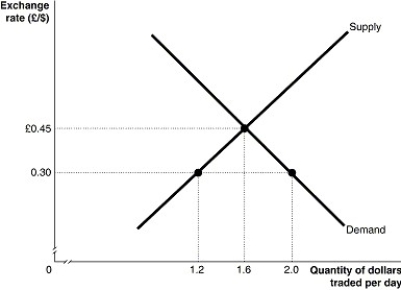 -If speculators believe a currency is undervalued, their trades in international exchange markets will
 (Multiple Choice)
4.8/5 (73)
(73) Figure 30-7  -Refer to Figure 30-7. If the Indian government pegs its currency to the dollar at a value above $.02/rupee, we would say the currency is
 (Multiple Choice)
4.8/5 (78)
(78) The currency adopted by most countries in ________ is referred to as the euro.
(Multiple Choice)
4.9/5 (90)
(90) By 2013, ________ members of the European Union were using the euro as their currency.
(Multiple Choice)
5.0/5 (74)
(74) Countries that use the euro as their currency face similar concerns as countries did during the years of the gold standard in that each are (were)
(Multiple Choice)
4.8/5 (83)
(83) The three most important financial centers in the world today are New York, London, and Tokyo.
(True/False)
4.9/5 (70)
(70) During what period of time did the United States most consistently adhere to the gold standard?
(Multiple Choice)
4.9/5 (79)
(79) Figure 30-1  -Refer to Figure 30-1. Which of the following would cause the change depicted in the figure above?
 (Multiple Choice)
4.9/5 (71)
(71) What are capital controls? Why might a financial crisis lead to a reconsideration of using capital controls, and what problems might result from the reinstatement of capital controls?
(Essay)
4.7/5 (73)
(73) If the U.S. government places tariffs on imports from countries that have been accused of deliberately undervaluing their currencies, the price of these imports will ________ and the demand for the undervalued currency will ________.
(Multiple Choice)
4.7/5 (81)
(81) You decide to work in London for the next 5 years, accumulate some savings, then move back to the United States and convert your savings from British pounds to dollars. At the time of your move, economists predict that consumers in the United States have lost their affinity for British products, and expect that this declining preference for British products will continue for the next decade. How should this influence your decision to work and save in London?
(Multiple Choice)
4.8/5 (94)
(94) Before 1980, U.S. investors rarely invested in foreign capital markets.
(True/False)
4.8/5 (82)
(82) If currencies around the world are based on the gold standard, and Japan raises the amount of gold for which the yen will trade, then holding all else constant,
(Multiple Choice)
5.0/5 (90)
(90) The three most important international financial centers today are
(Multiple Choice)
4.8/5 (64)
(64) When the value of a currency is determined mostly by demand and supply, but with occasional government intervention, the exchange rate system is defined as
(Multiple Choice)
4.8/5 (66)
(66) Figure 30-1
-Refer to Figure 30-1. Which of the following would cause the change depicted in the figure above?
-Refer to Figure 30-1. Which of the following would cause the change depicted in the figure above? (Multiple Choice)
4.8/5 (68)
(68) 
Filters
- Essay(0)
- Multiple Choice(0)
- Short Answer(0)
- True False(0)
- Matching(0)