



 Chat with AI
Exam 30: The International Financial System

Exam 1: Economics: Foundations and Models444 Questions
Exam 2: Trade-Offs, Comparative Advantage, and the Market System498 Questions
Exam 3: Where Prices Come From: the Interaction of Demand and Supply475 Questions
Exam 4: Economic Efficiency, Government Price Setting, and Taxes419 Questions
Exam 5: Externalities, Environmental Policy, and Public Goods266 Questions
Exam 6: Elasticity: the Responsiveness of Demand and Supply295 Questions
Exam 7: The Economics of Health Care334 Questions
Exam 8: Firms, the Stock Market, and Corporate Governance278 Questions
Exam 9: Comparative Advantage and the Gains From International Trade379 Questions
Exam 10: Consumer Choice and Behavioral Economics302 Questions
Exam 11: Technology, Production, and Costs330 Questions
Exam 12: Firms in Perfectly Competitive Markets298 Questions
Exam 13: Monopolistic Competition: the Competitive Model in a More Realistic Setting276 Questions
Exam 14: Oligopoly: Firms in Less Competitive Markets262 Questions
Exam 15: Monopoly and Antitrust Policy271 Questions
Exam 16: Pricing Strategy263 Questions
Exam 17: The Markets for Labor and Other Factors of Production286 Questions
Exam 18: Public Choice, Taxes, and the Distribution of Income258 Questions
Exam 19: GDP: Measuring Total Production and Income266 Questions
Exam 20: Unemployment and Inflation292 Questions
Exam 21: Economic Growth, the Financial System, and Business Cycles257 Questions
Exam 22: Long-Run Economic Growth: Sources and Policies268 Questions
Exam 23: Aggregate Expenditure and Output in the Short Run306 Questions
Exam 24: Aggregate Demand and Aggregate Supply Analysis284 Questions
Exam 25: Money, Banks, and the Federal Reserve System280 Questions
Exam 26: Monetary Policy277 Questions
Exam 27: Fiscal Policy303 Questions
Exam 28: Inflation, Unemployment, and Federal Reserve Policy257 Questions
Exam 29: Macroeconomics in an Open Economy278 Questions
Exam 30: The International Financial System262 Questions
Select questions type


In 2011, a number of Canadians purchased homes in Arizona. Which of the following would not be a logical explanation for this?
(Multiple Choice)
4.8/5  (92)
(92) Fluctuating exchange rates can alter a multinational firm's profits and losses. German auto maker Volkswagen produces automobiles in Germany and sells them in the United States. If the dollar depreciates against the euro, then Volkswagen's revenues from these operations should ________ because it will take ________ U.S. dollars to purchase the German-made Volkswagens.
(Multiple Choice)
5.0/5 (88)
(88) The current exchange rate system in the United States is best described as a
(Multiple Choice)
4.9/5 (72)
(72) How were exchange rates determined under the gold standard? How did the Bretton Woods system differ from the gold standard?
(Essay)
4.9/5 (81)
(81) Figure 30-12 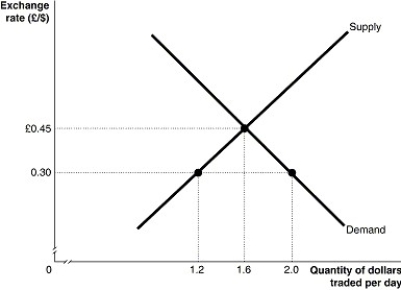 -Under the Bretton Woods system, central bankers could obtain foreign currency loans from the
 (Multiple Choice)
4.8/5 (78)
(78) The year in which euro coins and paper currency were introduced and participating "euro zone" countries withdrew old domestic currencies from circulation was
(Multiple Choice)
4.9/5 (81)
(81) Figure 30-12
-Refer to Figure 30-12. The graph above depicts supply and demand for U.S. dollars during a trading day, where the quantity is millions of dollars. In order to support a fixed exchange rate of 0.30 pounds per dollar, the British central bank must
-Refer to Figure 30-12. The graph above depicts supply and demand for U.S. dollars during a trading day, where the quantity is millions of dollars. In order to support a fixed exchange rate of 0.30 pounds per dollar, the British central bank must (Multiple Choice)
4.9/5 (99)
(99) What do reports that the dollar is "overvalued" mean? How will foreign exchange markets respond to this information? Support your answer graphically.
(Essay)
4.9/5 (78)
(78) According to the theory of purchasing power parity, if the inflation rate in the United States is greater than the inflation rate in Canada, explain what should happen to the exchange rate between the U.S. dollar and the Canadian dollar.
(Essay)
4.8/5 (82)
(82) Suppose the U.S. dollar is backed by one-sixth of an ounce of gold and the British pound is backed by one-third of an ounce of gold. The exchange rate between the U.S. dollar and the British pound equals ________ per pound.
(Multiple Choice)
4.8/5 (68)
(68) Managed float exchange systems were abandoned with the implementation of the gold standard.
(True/False)
4.9/5 (71)
(71) Figure 30-10  -Refer to Figure 30-10. Under the Bretton Woods System of exchange rates, if the par exchange rate was $2 per pound in the figure above, and equilibrium persisted at $3, then a revaluation of the currency would have
 (Multiple Choice)
4.9/5 (80)
(80) Exchange rates under the Bretton Woods system were determined by relative supplies of gold held by countries within the system.
(True/False)
4.7/5 (84)
(84) U.S. dollars can currently be exchanged for gold by foreign central banks, but not by U.S. citizens.
(True/False)
4.7/5 (84)
(84) Although the pegged exchange rate between the yuan and the dollar has undervalued the yuan, China has been reluctant to abandon the peg for fear that abandoning the peg would
(Multiple Choice)
4.9/5 (90)
(90) By 2012, Iceland's real GDP ________, and the real GDPs of Italy, Spain, Greece, and Ireland ________.
(Multiple Choice)
4.8/5 (82)
(82) If, at the current exchange rate between the dollar and the South African rand of 6.92 rand per dollar, the dollar is "undervalued," how do you expect demand and supply in the foreign exchange markets to respond?
(Multiple Choice)
4.8/5 (76)
(76) If speculators believe a currency is soon going to be revalued, they will increase their demand for that currency.
(True/False)
4.8/5 (76)
(76) 
Filters
- Essay(0)
- Multiple Choice(0)
- Short Answer(0)
- True False(0)
- Matching(0)