



 Chat with AI
Exam 30: The International Financial System

Exam 1: Economics: Foundations and Models444 Questions
Exam 2: Trade-Offs, Comparative Advantage, and the Market System498 Questions
Exam 3: Where Prices Come From: the Interaction of Demand and Supply475 Questions
Exam 4: Economic Efficiency, Government Price Setting, and Taxes419 Questions
Exam 5: Externalities, Environmental Policy, and Public Goods266 Questions
Exam 6: Elasticity: the Responsiveness of Demand and Supply295 Questions
Exam 7: The Economics of Health Care334 Questions
Exam 8: Firms, the Stock Market, and Corporate Governance278 Questions
Exam 9: Comparative Advantage and the Gains From International Trade379 Questions
Exam 10: Consumer Choice and Behavioral Economics302 Questions
Exam 11: Technology, Production, and Costs330 Questions
Exam 12: Firms in Perfectly Competitive Markets298 Questions
Exam 13: Monopolistic Competition: the Competitive Model in a More Realistic Setting276 Questions
Exam 14: Oligopoly: Firms in Less Competitive Markets262 Questions
Exam 15: Monopoly and Antitrust Policy271 Questions
Exam 16: Pricing Strategy263 Questions
Exam 17: The Markets for Labor and Other Factors of Production286 Questions
Exam 18: Public Choice, Taxes, and the Distribution of Income258 Questions
Exam 19: GDP: Measuring Total Production and Income266 Questions
Exam 20: Unemployment and Inflation292 Questions
Exam 21: Economic Growth, the Financial System, and Business Cycles257 Questions
Exam 22: Long-Run Economic Growth: Sources and Policies268 Questions
Exam 23: Aggregate Expenditure and Output in the Short Run306 Questions
Exam 24: Aggregate Demand and Aggregate Supply Analysis284 Questions
Exam 25: Money, Banks, and the Federal Reserve System280 Questions
Exam 26: Monetary Policy277 Questions
Exam 27: Fiscal Policy303 Questions
Exam 28: Inflation, Unemployment, and Federal Reserve Policy257 Questions
Exam 29: Macroeconomics in an Open Economy278 Questions
Exam 30: The International Financial System262 Questions
Select questions type


Which aspects of globalization help to increase growth in the world economy?
(Essay)
4.8/5  (71)
(71) Firms in Thailand that had ________ while the baht was pegged to the dollar faced interest payments that were higher than they had planned once the Thai government abandoned the peg because the baht had been pegged ________ the equilibrium exchange rate for the baht.
(Multiple Choice)
4.9/5 (72)
(72) Explain why international capital markets have expanded since the 1980s.
(Essay)
4.8/5 (76)
(76) Figure 30-7  -Refer to Figure 30-7. If the Indian government pegs its currency to the dollar at a value below $.02/rupee, we would say the currency is
 (Multiple Choice)
4.9/5 (75)
(75) If the rate of inflation in the United States exceeds the rate of inflation in Great Britain we would expect the U.S. dollar to depreciate in value against the British pound.
(True/False)
4.9/5 (80)
(80) The "Big Mac Theory of Exchange Rates" tests the accuracy of the purchasing power parity theory. In July 2013, the Economist reported that the average price of a Big Mac in the U.S. was $4.56. In Sweden, the average price of a Big Mac at that time was 41.6 kronor. What is the "implied exchange rate" between Swedish kronor and U.S. dollars?
(Multiple Choice)
4.7/5 (72)
(72) An increase in a fixed exchange rate from $2.00 per pound to $2.10 per pound is called a(n) ________ of the pound.
(Multiple Choice)
5.0/5 (86)
(86) Figure 30-10  -Refer to Figure 30-10. Under the Bretton Woods System of exchange rates, if the par exchange rate was $2 per pound in the figure above, and equilibrium persisted at $3, then this was evidence of ________ and the IMF would allow a ________ in the exchange rate.
 (Multiple Choice)
4.9/5 (84)
(84) In 2012, foreign purchases of U.S. corporate stocks and bonds
(Multiple Choice)
4.8/5 (78)
(78) Figure 30-9 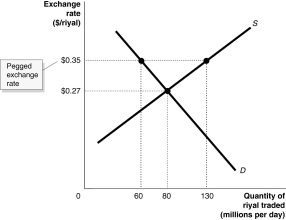 -Refer to Figure 30-9. According to the graph, is there a surplus or shortage of Saudi Arabian riyal in exchange for U.S. dollars? To maintain the pegged exchange rate, will the Saudi central bank need to buy riyal in exchange for dollars or sell riyal in exchange for dollars? How many riyal will the Saudi central bank need to buy or sell?
 (Essay)
4.9/5 (79)
(79) In the United States today, how much gold will the Federal Reserve give you in exchange for $1?
(Multiple Choice)
4.9/5 (76)
(76) Figure 30-6  -Refer to Figure 30-6. Which of the following would cause the change depicted in the figure above?
 (Multiple Choice)
4.8/5 (72)
(72) Which of the following did not help Thailand maintain its peg against the dollar in the 1990s?
(Multiple Choice)
4.8/5 (91)
(91) Fluctuating exchange rates can alter a multinational firm's profits and losses. The U.S. corporation, Motorola, produces cell phones and sells cell phones in Mexico. If the dollar appreciates against the peso, then Motorola's revenues from these operations should ________ and its costs from these operations should ________.
(Multiple Choice)
4.7/5 (79)
(79) Figure 30-10
-Refer to Figure 30-10. Under the Bretton Woods System of exchange rates, if the par exchange rate was $4 per pound in the figure above, then which of the following is true?
-Refer to Figure 30-10. Under the Bretton Woods System of exchange rates, if the par exchange rate was $4 per pound in the figure above, then which of the following is true? (Multiple Choice)
4.9/5 (86)
(86) In order to reduce or eliminate a chronic shortage in the market for a currency under a fixed exchange rate system, we must devalue the currency.
(True/False)
4.9/5 (84)
(84) China began pegging its currency, the yuan, to the dollar in 1994. Because the yuan has been ________ at the pegged exchange rate, the Chinese government ________ its reserves of dollars as the government purchased more ________ to maintain the pegged exchange rate.
(Multiple Choice)
4.8/5 (85)
(85) The exchange rate system agreed to in 1944, in which the U.S. government agreed to buy or sell gold at a fixed price of $35 per ounce, is referred to as
(Multiple Choice)
4.9/5 (80)
(80) If the GDP deflator in the United States is 114, and the GDP deflator in Ukraine is 142, which of the following changes would the theory of purchasing power parity predict? (The Ukrainian currency is the hryvnia.)
(Multiple Choice)
4.9/5 (81)
(81) 
Filters
- Essay(0)
- Multiple Choice(0)
- Short Answer(0)
- True False(0)
- Matching(0)